Letting the audience speak is already a statement of intent. In every art-world landscape there are artists who remain on the margins and persist on their own path, guided by intuition, by a sense of commitment, by folly or obsession (be it temporary or chronic), or by all of these drivers at once. They are propelled forward by these forces and nothing else. This is why they are often ignored by the establishment; rediscovered, such artists reveal the failures and the weak points of the system in which we, the art world professionals, are immersed. Colombian artist Gustavo Sorzano is one such figure. His work was on view in Partituras mentales (Mental Scores), an exhibition curated by William Contreras, who gamely assumed the difficult task of giving visual form to María Mercedes Herrera’s research. Sorzano having remained for so long in the critical shadows, it is important to finally be able to come together around such a refreshing and challenging personality in conceptual art in Colombia. The exhibition—and, with it, the best research available at this point—brings into relief and up for debate subjects and ways of doing art that are relevant to both the Colombian art scene in the 1960s, 70s, and 80s and to the current state of contemporary art. Everything else is a footnote. As I said, letting the public speak is always, ultimately, a political act; most significantly, the effort to counter hierarchies and to demystify the practice of art, the work of art, the circuits in which art circulates, and the norms that govern such circuits, runs like a foundational thread through the history of the arts since the dawn of the Twentieth Century.
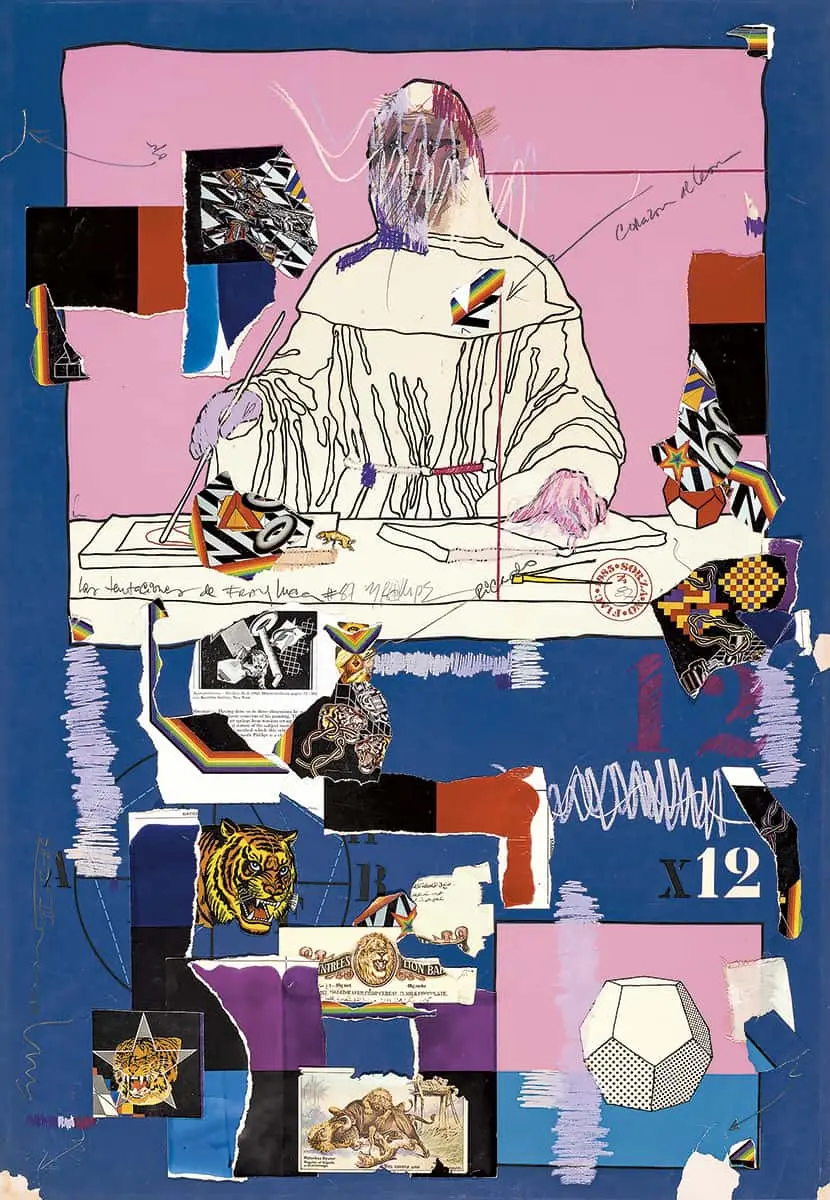
This exhibition provides a taste of what a thorough museum show of Sorzano’s work could be. Until then, we have the vision of a gallery that remains committed to its historical responsibilities. Forceful yet fleeting (this is to say, leaving us with a desire for more), the show was organized in three large groups: Sonido organizado (Organized Sound), Eventos de participación (Participatory Events), and Gabinetes de pintura (Cabinets of Painting). These blocks shed light on three essential areas of Sorzano’s investigation and practice: experimental sound works and how their visual translation was attempted. Here we encounter Zeguscua, a sound piece created to accompany the Museo del Oro’s multimedia experience in the Sala de la Ofrenda exhibit, inspired by the legend of El Dorado; the participation and influence of the general public or of artist colleagues; and Sorzano’s obsessive, Warholian return to key art-historical figures and images like Leonardo and Titian, to mention two, and to other iconic works, especially the Renaissance painter’s Mona Lisa and Fray Luca, and the Venetian painter’s Portrait of Federico II Gonzaga. Based on these works, which appropriate the language of Pop and take it to a conceptual territory, the idea of participation stands out. Besides referring to mass consumption or to the language of advertising (Sorzano’s professional field for many years), the use, reuse, intervention, and appropriation of artistic icons, among other Pop strategies, demystifies the idea of visual creation and makes it more approachable, rendering it something we can all participate in without needing to be genius artist. This occurs mainly with a reactivation of Momentum 43, originally published in the newspaper El Tiempo in 1975. Retitled Tome uno (Take One) for Partituras mentales, it asks visitors to take with them a poster that contains a blank space so they can create their own work of art. The public’s creations can be exhibited this year at the 25th National Artists Salon. Taking his cue from Álvaro Barrios or Beatriz González, who used similar actions to set in motion strategies for the mass distribution of artworks, Sorzano pushes the idea one step forward and provides an exhibition platform for people who may perhaps be strangers to artistic practices.
At a moment in history when the limits between what was and what wasn’t art were disappearing, after the irruption of Marcel Duchamp’s in the early Twentieth Century, Sorzano calls forth the essence of creation: it can be understood as a search for solutions to issues of an auditory and visual nature that respond to the problem of artistic creation as a method of experimentation; as a need to break the known in order to be able to cease spinning around the same topics; as an urgency to break with tradition, now seen as a very necessary attitude for the renewal of artistic languages that had for centuries spun around the same questions. After Duchamp’s famous urinal, the sky was the only limit to creation. In retrospect, we can perhaps say that the true limit is the freshness of a combination of a language of one’s own, a meditation on history, and the subversion of the canon established by tradition.
CARIDAD BOTELLA