Many conceptual artists of the 1960s and 70s used photography and video, prompting the question of whether a given item was a work of art or a document; this is to say, the question of whether it was an aesthetic representation or an archive. In Chile, Gonzalo Mezza (Santiago, 1946) began to explore precisely that paradigm in his early works, during the same period.
The exhibition Mezza: archivo liberado (Mezza: Liberated Archive), organized by Sebastián Vidal Valenzuela, was held from March through May 2019, at Galería D21, an independent space in the locality of Providencia, Santiago. Devoted since its establishment in 2009 to the recovery of local artistic productions from the 1970s and 80s, this gallery has assembled a vast collection of works and archives, attracting the attention of researchers like Vidal Valenzuela. On this occasion, one of the curator’s main motivations was to produce the first historiographical review of Mezza’s work. The fact that none had previously been presented is surprising, given the local and international critical attention Mezza garnered since early in his career. Critics defined Mezza’s work as media-based and focused on the use of “new technologies.” This definition was clearly exemplified in 1983 by Santiago punto cero, a solo exhibition at Galería Sur. There, Mezza used a computer and programming to depict an F-16 airplane dropping a bomb on Chilean territory. While alluding to WWII bombings and massacres, his work also pointed, even more significantly, to the dispute between Chile and Argentina over the Beagle Channel, flaring up and unresolved at the time.
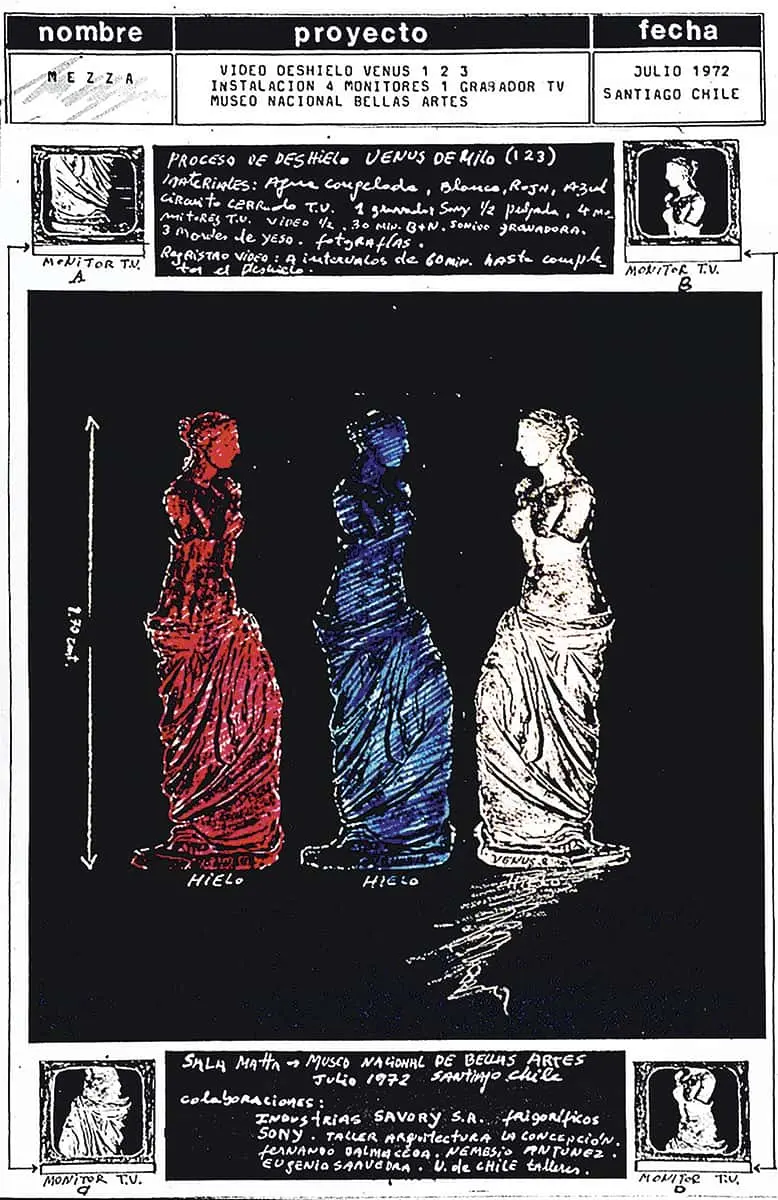
On view in Mezza: archivo liberado were information cards, sketches, mockups, cassette tapes, photographic records, postcards, catalogs, Polaroid prints, videos, and analog interventions. Entering the gallery, visitors found themselves immersed in many such liberated archives, arranged on light tables, display cases, and walls. A variety of strategies deployed by Mezza came into view, three of which bear detailed mention. The first one has to do with the monumentalizing of documents of works in process. Indeed, this strategy repeated in every room in the gallery, in works titled Fichas de proyectos (Project Cards). Mezza has produced such cards since his first approach to conceptualism, in 1969, and continues to make them today. Made in a standard letter-sized format, the cards contain the title of the project, a succinct description, the date, and a diagram, as well as a sketch or other visual materials to complement the idea.
An example of this is Deshielo de la Venus 1, 2, 3 (Thawing of Venus 1, 2, 3). Initially conceived in 1972 and executed in 1979, this document presents three Venus figures painted in the three colors of Chile’s national flag: red, blue, and white. The card is blown up and encased between two acrylic sheets. What was a document is now a work of art, providing access not only to an archive but also to a collection. This strategy, the roots of which can be traced back to the Fluxus movement in Western Europe, is brought clearly to the fore in Deshielo de Mezza (Thawing of Mezza). Across the Atlantic and south of the equator, documentation was indeed an essential part of the process, just as it was at the moment of exhibition.
Another element or strategy on display in this show was the inclusion of different technologies and media in a single project. One example is Cruz del Sur (Southern Cross). Originally shown at the 6th Colocadora Nacional competition in 1980, in the “Graphic Art” category, it encompasses several items and technologies seldom seen in early-1980s Chile. The elements of Mezza’s installation documenting an art action in Isla Negra, Valparaíso, included: six black-and-white photographs with red and blue accents, printed on silver emulsion paper; sand; five Polaroid sx70 color prints; acrylic boxes; steel bolts; a Sony audio recorder; a TV monitor; and a VHS player. Added to Cruz del Sur for the exhibition at D21 were sketches and analog mockups that served as a storyboard for Mezza’s performance.
The third and final strategy on display here is a referential condition of the exhibited projects, which hark back to a history populated by icons and freighted with great symbolic and historical weight. For example, a reference to Chilean landscapes is inescapable in the photomontage Cordillera de los Andes (Andes Mountain Range, 1987); the installation El deshielo de la Venus 1, 2, 3 (The Thaw of Venus 1, 2, 3, 1972) refers to the classical figure of an armless Venus; in the photomontage 669 Variaciones sobre la Venus del espejo (669 Variations on the Venus of the Mirror, 1987), Mezza engages not only a classical reference to Velázquez’s painting but also an updating of the figure of the mirror, which he transforms into a TV.
Mezza: archivo liberado offered a fresh view of the implications of the archive in the history of Chilean art, revealing the diffuse line that separates a document from a work of art, and how it contributes to the multidisciplinarity and the avant-garde nature proposed by Gonzalo Mezza since the seventies.
SEBASTIÁN VALENZUELA-VALDIVIA