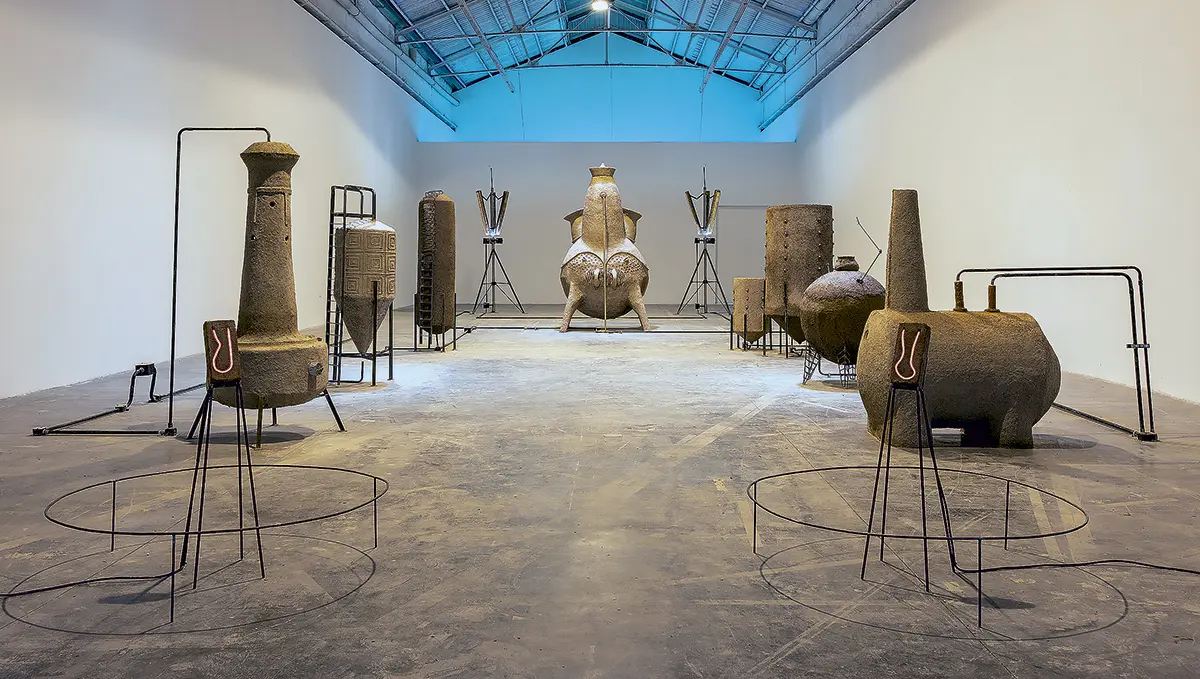
Gabriel Chaile presented Genealogía de la forma (Genealogy of Form), an installation made of a group of adobe and iron sculptures, curated and with text by Andrea Fernández, in the ample space of Barro gallery.
Chaile was born 34 years ago in the province of Tucumán. He lives in the Buenos Aires neighborhood of La Boca and is currently staying in Berlin, working towards an exhibition at the ChertLüddegallery next September.
Tucumán is part of Argentina’s northwest region, which also includes the provinces of Jujuy, Salta, Catamarca, and Santiago del Estero. Centrally located and heart-shaped, it is the region’s smallest province. In 1816, after the wars of independence, Argentina’s independence from Spain was proclaimed in Tucumán’s capital city. For many, Tucumán’s is the heart of the nation.
“I think of this exhibition as the vitality that is still present, those cultures that survive in my own face, in the faces of many northerners, or among Argentina’s poorest populations.”
A central component of the artist’s imaginary is the subtle connection, in terms of both matter and form, between his works and the ceramic art of both pre-Columbian and living cultures of the Argentinean northwest.
The installation’s adobe and iron sculptures were organized in a circular shape, and the individual pieces were connected to one another using pipes laid on the gallery floor, like parts of a system. The central item was an oven of sorts, perhaps a representation of Mother Earth, with two anthropomorphic heads and other additions with a geometric identity: vertical or horizontal cylinders and spheres. The set suggested a subtle 19th-century manufacturing landscape atmosphere as if the action of these “machines” was to be triggered from one moment to another.
The presence of metal was subtle, yet substantial; in most cases, thin iron wires supported the sculptures, and pipe fittings of a specific diameter connected them into a single system. The surfaces of some of the pieces displayed ornamental geometric lines in soft relief or bulging spots organized in lines.
Some resembled steam engines, in parallel with breathing. A sphere crowned by a small head played the role of a body, with arms raised. In three instances, the lower portions of the geometric shapes were inverted cones, indicating minimum balance.
“I derive the concept of a genealogy of form from the investigations to which my work takes me,” the artist says. “My work is not a remembrance of the past.” It has to do with the history of the shapes of objects, with understanding the process by which, over time, the surfaces of things acquire certain shape and continue to mutate in a genealogical line,” says the artist.
The writer Andrea Fernández, Chaile’s classmate at Universidad de Tucumán, who works with Wichi communities in the interior of Salta province, wrote the exhibition text. It includes a poem where she speaks in the first person, mimicking the transmutation that some indigenous communities perform, ritually shedding the human shape and exploring forms of Nature. Tacitly, it suggests a connection with a spirit of surrealism.
The artist conceived the entire group as a small productive enterprise—for example, a bakery—working in an imaginary way. In connection with this, it is impossible not to think of Víctor Grippo’s Construcción de un horno popular para hacer pan (acción urbana) (Construction of a Traditional Rural Oven for Making Bread [Urban Action]) (1972), a paradigm-setting landmark in the history of Argentinean art.
“The genealogy of form proposed by Gabriel Chaile seeks to present itself as the construction of a poem, from materials representing different cultural histories that converge and transfix one another, and with the many paradoxes that give shape to the (modern, contemporary) human experience.” These words by Andrea Fernández, curator of the exhibition, describe the syncretic essence of Chaile’s work, the tightly arranged poetic synthesis of forms brimming with history, humanity, culture, nature.
Chaile’s work was produced in Twenty-First Century Buenos Aires, in the artist’s La Boca studio. His poetic imagination, whether or not he has read the Tucumán poet and writer Fausto Burgos (1888-1930), who lived one hundred years ago in an Argentina, is more closely in tune with the rest of the world than with its vast interior. “Chewing his coca, behind his llamas, / Silently walked the old shepherd, / When, all of a sudden, he saw Pacha-Mama / Sitting at the edge of a large red rock.”
This is how Burgos’ verses described the land that today gives rise to Gabriel Chaile’s Genealogía de la forma, poetically built, with a visionary certitude nourished by the sap of those same trees, with stone from the same mountains, some of which must have inhabited the land of our artist’s birth with great anticipation.
MERCEDES CASANEGRA