When the peace negotiations between the Government of Colombia and the FARC were finalized, some, perhaps naively, believed the country was genuinely entering a new period in history. There was hope the truth of what happened during five decades of war would come to light, and we would begin to breathe new air, living at last in a land where conflicts would not be resolved by shedding blood. Alas, this has not happened, and the prospects are deeply worrisome. Since 2016, and after the fighting stopped, a campaign of extermination began against social leaders, the women and men who, in the cities and the countryside, help organize their communities, protect natural and public resources, defend water and territory; the women and men who are, in essence, the seeds from which a new future is to bloom.
The renewed awakening of violence, which has already taken nearly 700 lives, has barely been investigated. Poorly protected, social leaders are being killed at an average rate of six per month. In strategic terms, these atrocities have many similarities to what confronted the civilian left in the 1980s, the so-called “red dance,” when more than 4,000 members of the Patriotic Union (UP, for its initials in Spanish) were killed. The UP was a breakaway faction of the FARC that focused solely on political action. Unlike what happened three decades ago, however, reactions across civil society have been many and varied.
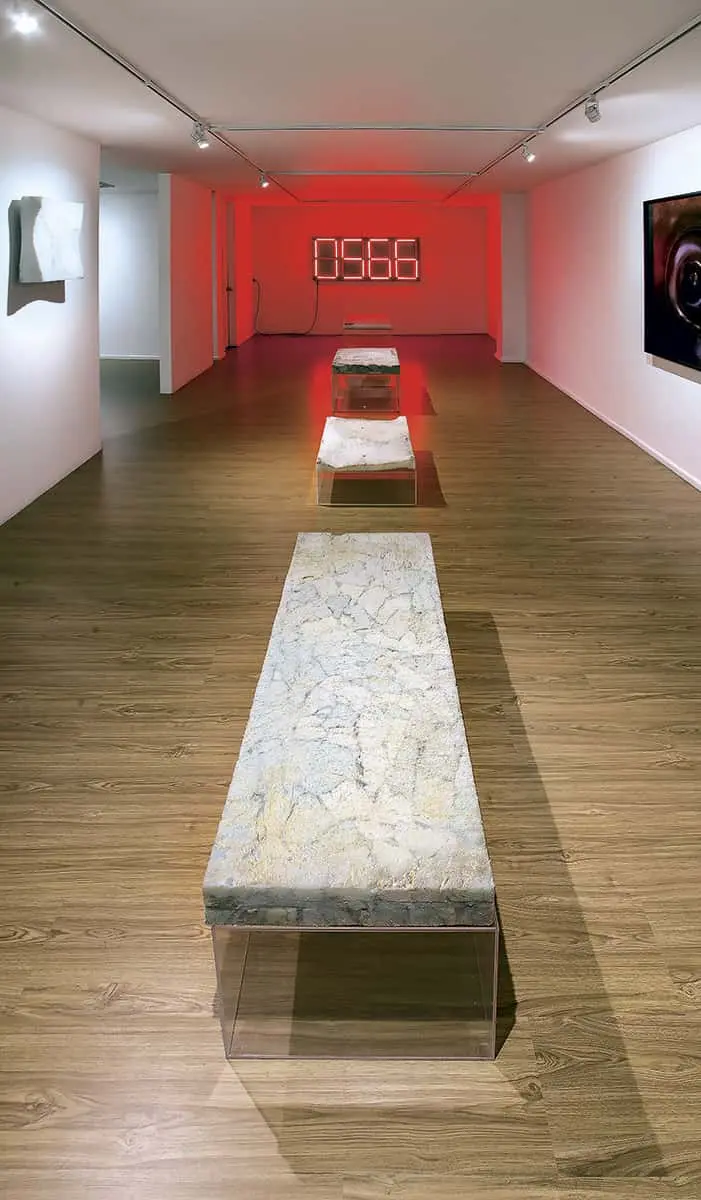
At Foro.Space, Fernando Arias presented the installation 0566 (Contador de víctimas) (0566 [Victims’ Counter]), a board of bright red LED lights set up to form the three-digit figure of the title, which was the number of victims at the time the work was created. In front of this electric mural, four butcher boards cast in polyethylene were arranged in a line towards the counter, evoking, perhaps, an altar. Nothing less could have been expected from Arias, an artist who has used bodies, flesh, blood, and fluids, as materials in a pointed and valiant probing of his own society.
In fact, 0566 (Contador de víctimas) connects us directly with Arias’ earliest installations. In 1992, Arias had a surprising exhibition at the Museo de Arte de la Universidad Nacional, titled Análisis (Analysis). Surprising, because it was the first time a Colombian artist spoke so frontally about the AIDS crisis. Surprising, his highly innovative way of doing this, using photographs of himself and blood-stain laboratory plates. Surprising, because of Arias’ youth. Surprising, because of his courage, since at the time AIDS patients were treated as pariahs.
In 1994, Arias presented Seropositivo (Seropositive), an installation consisting in a room covered in the same laboratory plates mentioned above, dotted with small blood stains as the evidence of some kind of group medical test, and under them, a 5-meter x 5-meter photograph of a nude man—Arias himself—in a crucified pose, under black or ultraviolet light. With this giant test tube, a cyber-punk chapel, Arias engaged the despair and frustration of those touched by a then-terminal, even today incurable illness. Ignorance about AIDS at the time was such that visitors to the museum refused to enter the exhibition, terrified by the space and the environment created by the artist.
Two decades later, Arias uses the same basic elements—light, objects taken from their context, bodily traces, a forceful title—to clamor in support of a new generation of victims. 0566 (Contador de víctimas) does not have the cold-room appearance of Seropositivo. The sharp-cutting red of the powerful LEDs chosen by the artist obstructed thought and reaction, disorienting viewers with that overwhelming feeling produced by any space flooded with light, a sacrificial altar where the plates have been replaced by three rectangular butcher blocks on which plenty of blood has been spilled. Studied up close, the markings left by the butcher’s knife on these blocks, traces of so many strikes severing muscle, bone, and tendons, presented a coarse, striated surface, like rough terrain, similar, if you will, to Colombia’s badly beaten social fabric. In sum, the installation was a demonstration of the perverse minimalism that Gerardo Mosquera identified in the late 1990s, the cannibalistic, anthropophagic minimalism, typical of Latin American artists of the late twentieth century.
This was not the first time that Arias dealt with the issue of political violence. In 2007, in one of the most sinister events in recent Colombian history, he had the courage of presenting the exhibition País para quién (A Country for Whom?), at the headquarters of Mapa Teatro, in Bogotá. Arias took national icons and altered them as a critique of the unilateral warlike hegemonic thought that dominated at the time. By selecting Mapa Teatro’s Republican-era building, with its coffered ceilings and its Gallicized arches and columns, he was using an image of great resonance in Latin America’s imaginary: the house of power, where the bureaucracy, the military, and the Church meet. The show consisted primarily of bronze sculptures, videos, and tapestries. In Tapiz: bala (Tapestry: Bullet) and Escudo bronce (Seal Bronze), Arias placed the national seal on a bullet, presided by the image of a fierce condor, its wings extended, holding the motto “Liberty and disorder.” In the “The presidential office” included in the installation, another tapestry, Águilas (Eagles), depicted five black eagles holding the national sea, a clear reference to the paramilitary organization of that name, relaunched in recent times and suspected of being behind the current wave of violence. On the floor, in front of it, laid like a rug, was a US flag. The white stripes had been changed to yellow, the primary color of the Colombian flag, and a new symbol was created fusing the two countries.
Arias did not abandon the drive to probe national symbols. In 2016, Más Arte Más Acción, the foundation he created alongside Jonathan Colin, organized a project titled Re Bandera (Re Flag) where they invited twenty-six artists to create a new national flag in commemoration of the 500 years of Thomas More’s Utopia, and also as a gesture in support of the peace process. Indeed, the flags were exhibited in front of Bogotá’s Center for Memory, Peace, and Reconciliation.
All these activities feed into 0566 (Contador de víctimas), Foro.Space’s inaugural exhibition. The gallery thus enters the stage with one of Colombia’s most relevant artists today. After pioneering the struggle against prejudice, ignorance, and the stigmatization of AIDS patients; after becoming an activist in Nuquí, in the Colombian Pacific (where Más Arte Más Acción has its headquarters), among other relevant efforts and projects; with his forceful, rugged, and unerring language; with his cannibalistic minimalism and his liturgical echoes, Arias clamors for the political victims of today’s Colombia, the mothers, students, teachers, peasants, whose only crime has been loving their people and their land.
SANTIAGO RUEDA