Eduardo Vargas Rico is a young multi-disciplinary artist who has developed an investigation into the subject of the archive. Visually, he engages the object as an archeological artifact; conceptually, he highlights these objects’ ample discursive approaches to generate multiple narratives.
Archivologías (lógicas de un archivo local) (Archival Studies [Logics of a Local Archive]) deals with the creation of the archive, rather than with the techniques used for the systematization of knowledge, as established by disciplines like archival science, library science, and archeology, to name a few. On the contrary, the artist deploys memory as the ground for his attempt to create dialectical and synchronic connections and temporal hybridization of history. And therein lies the problematic node of the ordering posited, since the chronological narrative is broken apart to focus attention on the discursive breaks and transformations that are present in the documents and objects. The artist calls attention to shifting processes in the materials he intervenes, alters, reformulates, and reclassifies using an intimate and local logic. Curator Lorena González, who produced an incisive essay about the show, refers to Michel Foucault’s The Archeology of Knowledge, revealing both the archive as a guarantor of knowledge and history and the drama of memory’s vulnerability as it incurs erasures and oblivion. The historical knowledge that emerges between the vestiges and the emotional load we carry as we approach them is uncertain and unstable.
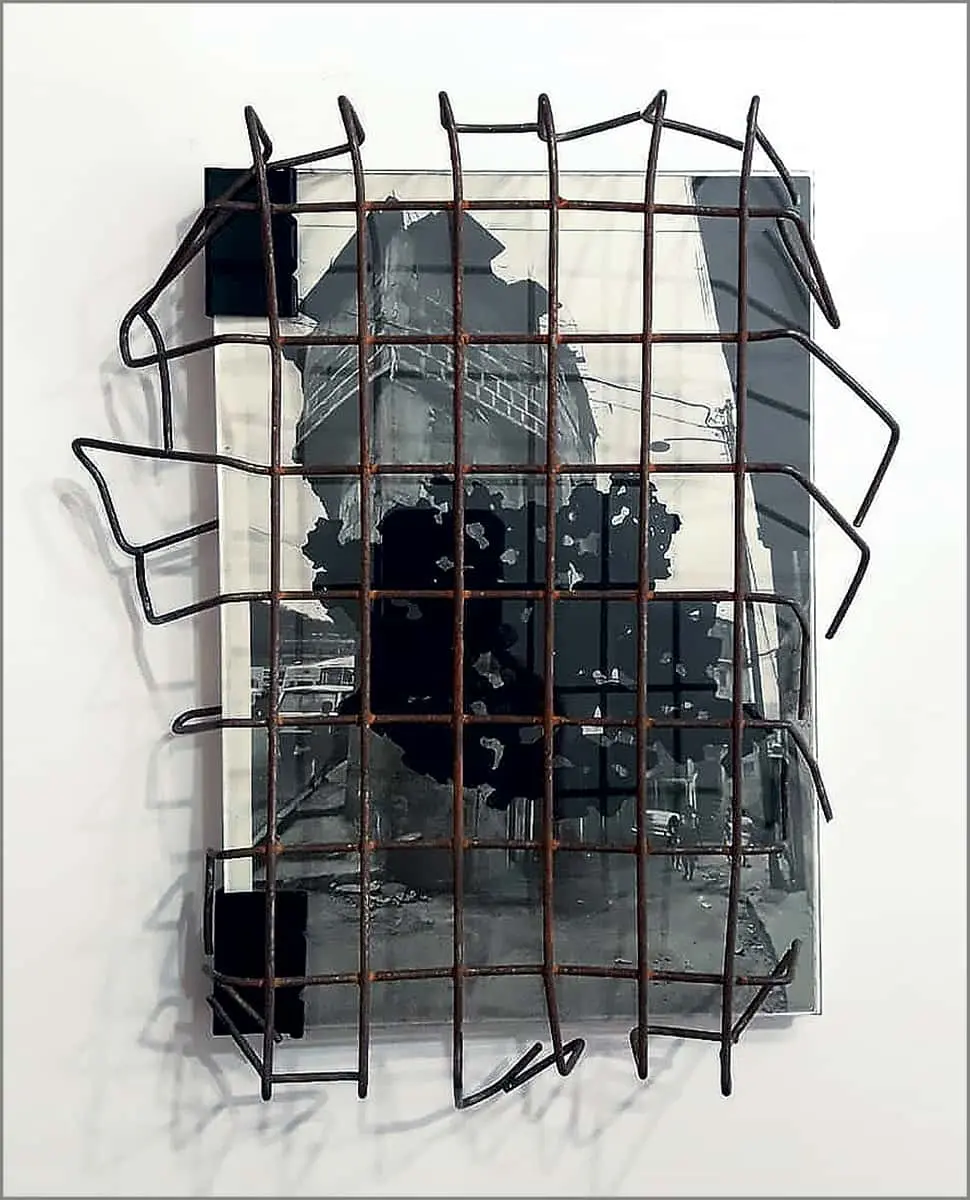
One of the exhibition’s thematic lines is the dichotomous relationship between the local and the universal, as laid out in cartography. The first group of works in the gallery is comprised of reproductions on paper of photographs, invoices, maps, and indexes preserved by wax techniques. Despite such conservation treatment, they are intervened with perforations, inks, industrial paint, wood, metal fragments, cardboard, glass. The content points in the direction of a dialog between global and Venezuelan history since the early Twentieth Century, through images of national personalities, letters, buildings, and urban vistas. Homenaje a la cartografía nacional (Homage to National Cartography) features the photograph of a group of individuals, identified by captions, whose faces have been perforated and to whom map fragments have been added; in Geografía Universal 57 (World Geography 57), Documento en pestañas (Document in Tabs), Índice de mapas (Index of Maps), Prueba “S” sobre el mar Mediterráneo (“S” Test on the Mediterranean Sea), and Prueba triangular ponchada (Punctured Triangle Test), maps are broken apart and put back together in order to design new geographies; in Archivador de acordeón de concreto (Concrete Accordion File), an accordion-type file is fossilized by a technique of casting in concrete; Torres Philips (Phillips Towers), Polar and Parque Central (Central Park), are photocopies of map fragments, intervened with blotches. Such territorial fragments have an extensive presence in museums, in various formats and supports. Made with industrial paint on metal pieces, they appear repeatedly in works like Pronósticos (Forecasts), a photographic group in which a hand raised to the sky holds one of them; in the variations within each frame, their presence is lessened gradually until it all ends on an opaque shot; or like Serie Rejillas (Grid Series), Vistas en construcción (Vistas Under Construction), Sin título (otro prototipo para balcón con vista a la avenida Bolívar) (Untitled [Another Prototype for a Balcony Overlooking Bolívar Avenue}, latticed with wooden or iron meshes. In this selection, the idea of country is reiterative, but it signifies disappearance, enchainment, and absence. It is a cartography of scenarios that, even if based on tangible documents, can only generate fractured testimonies of history and proofs of a devastating present.
The features of the works are made more complex in the course of the exhibition, moving from documents to three-dimensional items. Thus, on exhibit in the second gallery are archeological artifacts, found and rebuilt; some of them were created for other projects, and are inserted into and adjusted to the narrative here. Pewter plates and rusted metal containers, decayed cardboard and wooden crates, shoes and animal bones are all fossilized by being cast in concrete, clay, or wax. Arqueologías del consumo (Archaeologies of Consumption), Bodegón fraguado a escala doméstica (Still Life Forged at a Household Scale), Serie vaciados y contenidos (Hollowed and Contained Series), De la serie paisajes de una bitácora sin leyenda (From the Landscapes of a Captionless Logbook Series), De la serie montaje arqueológico (From the Archeological Montage Series), Léxicos y reflexiones sobre la labor (Lexicons and Reflections About Labor), Serie Construcción arqueológica (Archaeological Construction Series), Sin título (Step) (Untitled [Step]), all present a microhistory of everyday life, of use, of a congealed and discarded past. They have an appearance of devastation, of decomposition, but also of having been salvaged from the ruins. Although they are ephemeral objects of global consumption, they communicate the very meaning of existence.
With these cultural artifacts, which he elevates into the aesthetic realm, Vargas Rico creates a complex matrix. He questions established knowledge. While Vargas Rico seeks to delink from specific temporal and spatial locations, the desire to identify periods and places, to define nationalities, remains latent. His archive confronts the archive of the new technologies. Both the physical and the virtual—enduring the former, rapidly shifting the latter—will inescapably be filtered by the limits of knowledge and affective memory.
ANNY BELLO