Diego Bianchi (Buenos Aires, 1969) is a principal player in the fields of object art, performance, and installation, the latter considered by theorists like Boris Groys as the epitome of contemporary art. His works have been seen in several Latin American cities as well as Madrid, Paris, Berlin, Dresden, Miami, and Texas. He also participated in international biennials such as the X Havana Biennial (2009), the XI Lyon Biennial (2011) and the XIII Istanbul Biennial (2013).
Although Bianchi’s work unfolds in space, time is essential. Bianchi is an artist of what is happening, of the scraps, of the obsolescence, of the unnamed waste that is uncannily perceived as unknown. Let’s remember that the uncanny—das Unheimliche—signals the transformation of what is familiar (Heimlich) into its opposite, something strange and destructive that gives rise to feelings of uncertainty and mistrust.
“I am interested in the endurance of things and in what can be preserved from what exists,” says Bianchi. His aesthetic of the remnant salvage that which circumstantially becomes “present.” We know that in a world of accelerations such as ours, the present dissolves. Wake Me up When the Present Arrives is the resonant title of an installation presented at Locus Projects, in Miami, in 2007. The work gathered used garbage collected from a dump located near the exhibition space. Boat engines, carcasses and other discarded objects generated a critical landscape of the cultural idiosyncrasy of the area, accentuating the fact that identity is not only adhered to what we currently use, but also to everything useless that we discard. Thus, the prolonged interest in “rudology” (from the Latin “rudus” = debris), a discipline that analyzes the products found in the garbage, to track down in them the trace of different forms of life.
Bianchi’s works affect us and can make us uncomfortable and irritated. But they also achieve the conceptual distance that allows us to discover, for example, the conceptual scaffolding of the installation. In Wikipedia (2007), a project chosen for arteBA-Petrobras’ Prize, he staged a kind of “recipe book” of the installation made with found objects. The accepted canon was displayed on posters that read: repetition, variation, accidentalism, archeology, trash landscaping, new age influences, disgust, poetic utilitarianism, primitivism, basic existentialism. The text in another poster, “Supermarket of Resources,” it said: “Only the ugly is attractive.”
The accepted canon unfolded in boards displaying the words repetition, variation, accidentalism, “archaeologism,” trash landscape, new age influences, “gross-ism,” poetic utilitarianism, basic existentialism. In the “supermarket of resources,” another poster said: “Only the ugly is attractive.”
Art-vestige
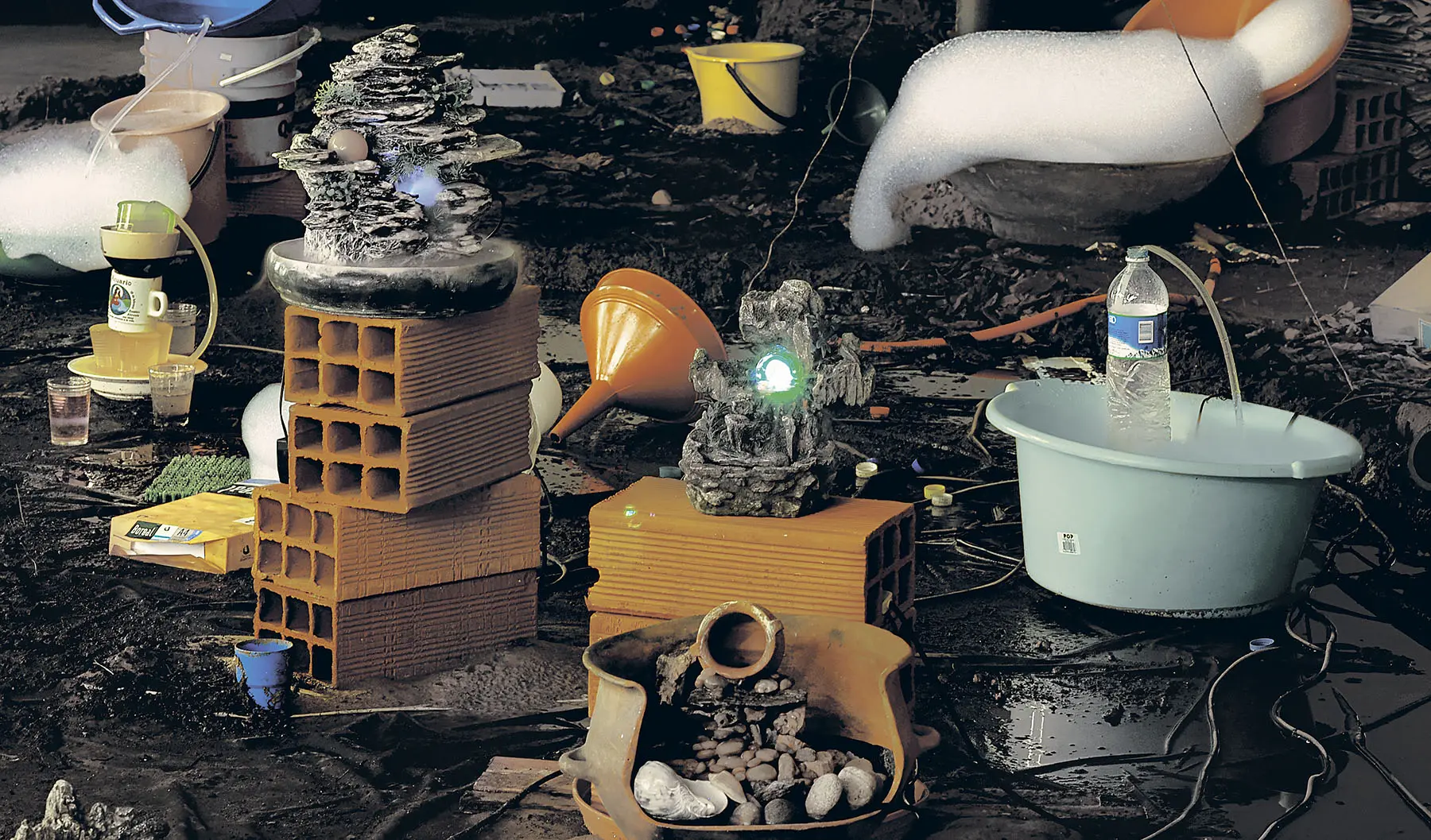
Bianchi produces aesthetic situations—rather than artworks, in the traditional sense—that speak of a fragile and dissonant world. Such is the case of P.P.P.PantanoPostProductor (P.P.P Post-Production Swamp), presented at the 25th edition of arteBA (2016), featuring an accumulation of different objects: containers, basins, buckets, feng shui fountains, angel callers, water engines, plates, glasses, bricks, newspapers, mud. Everything suggested the fragility of subsistence, the dysfunctionality of suburban settlements, and the use that is made thereof the disposable. “I am interested in what is no longer valuable, what was discarded, what is outside the mercantile exchange chain. I chose to work with objects that were not expensive or had a personal burden: everyday, democratic, banal, forgotten. I will always prefer a broken box to a healthy one. I like fragility, ephemeral harmony. Sometimes I think that I am a bit conservative, that I try to stop things in the state they are in, to preserve them from the passage of time, “ he says.
Bianchi’s vestige-art renews statements by Enio Iommi about contemporary art. The broken, the disheveled, the ruined (the mangy cat) works better than the beautiful (an Angora cat) when it comes to speaking about our world. In the essay/manifesto included in the exhibition La cocina humana (The Human Kitchen, 2005), he says: “My friend the painter Guillermo Roux says that if we have to choose between a mangy cat and an Angora cat, we keep the Angora one because, according to the painter, it represents true beauty. For a regular observer, the mangy cat lights up; it exposes the viewer to a current aesthetic, it represents man’s anguish, while the Angora cat, because of its beauty, and because it is well fed, it can never express today’s world.”
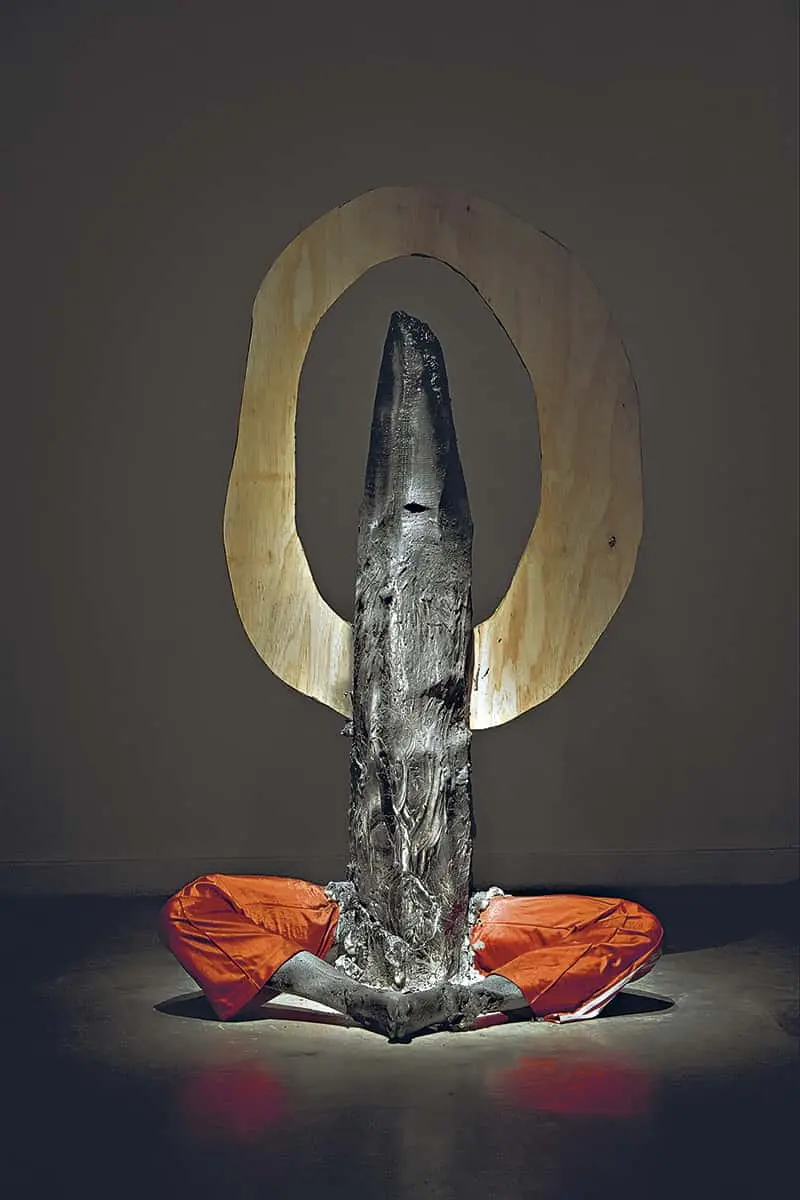
The imprint of Iommi’s art and thought is evident throughout Bianchi’s career. On the other hand, I witnessed the “master’s” interest in the work of the “young sculptor,” that, in 2010, exhibited in a space adjacent to the Cronopios room of the Recoleta Cultural Center, where the anthological exhibition Enio Iommi: el filo del espacio. Obras 1945-2010 (Enio Iommi: The Edge of Space. Works 1945-2010) was shown. In his opening speech—which I curated, together with María José Herrera—, Iommi mentioned, with undisguised enthusiasm, the exhibition Ejercicios Espirituales (Spiritual Exercises), as the product of someone who, like him, had also opted for an aesthetic of the extreme.
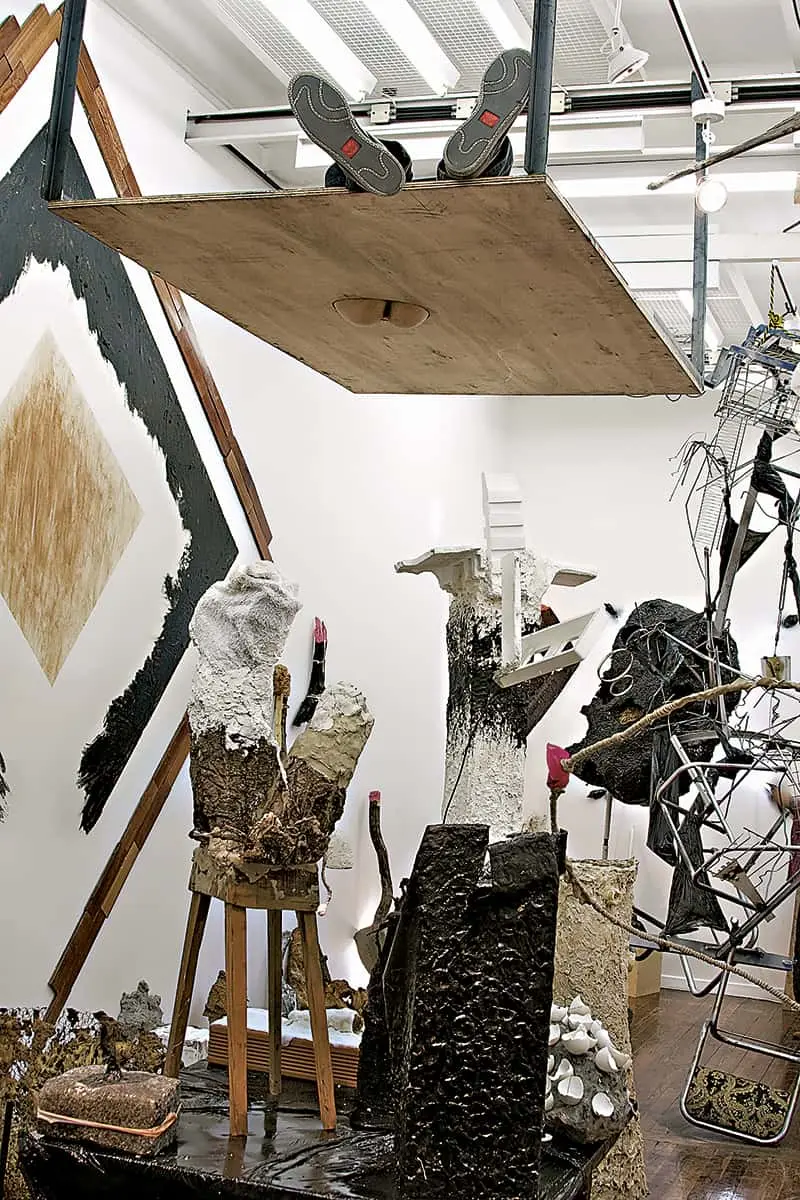
Bianchi even went to the extreme of showing his behind protruding from a hole during the opening of his show Las formas que no son (The Forms That Are Not, 2008). Likewise, the presence of private body parts caught audiences by surprise in installations such as the one that took place in the exhibition Experiencia infinita (Infinite Experience), in MALBA, in 2015, which also featured works by Allora & Calzadilla, Elmgreen & Dragset, Dora García, Pierre Huyghe, Roman Ondák, Tino Sehgal, and Judi Werthein.
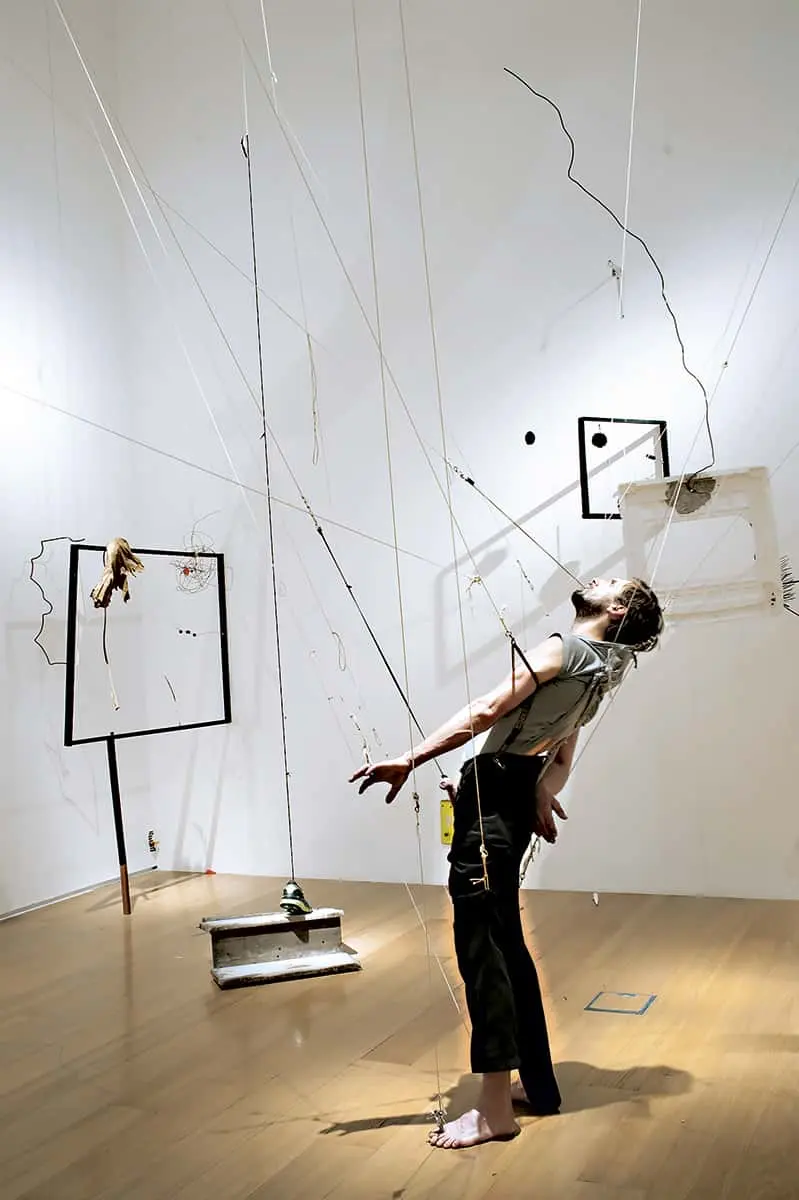
Bianchi’s installation, Suspensión de la incredulidad (Suspension of Disbelief), was without a doubt the most provocative. Visitors were startled to find a performer baring his penis, which, hanging from a thread, connected to various objects in the installation, as did other parts of his body as he moved. The body was just one more thing.
Heterochronies
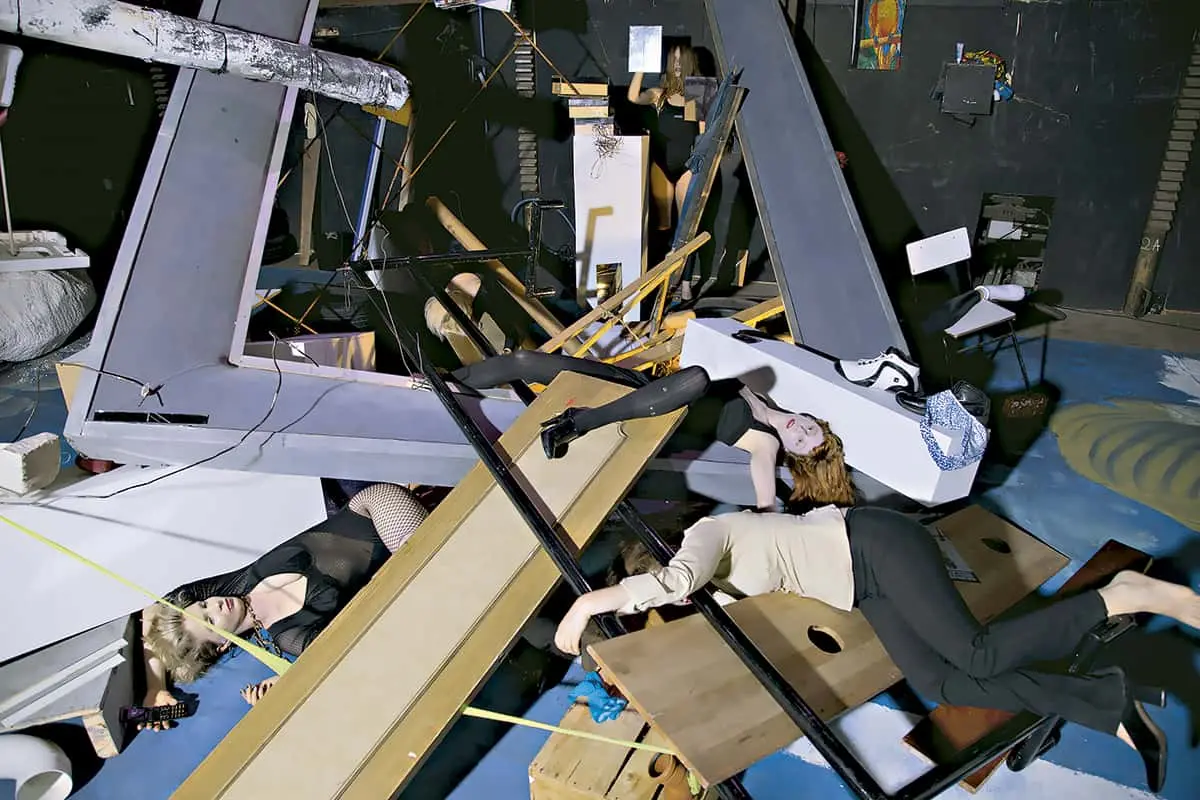
In the mega-installation El presente está encantador (The Enchanting Present, 2017), Bianchi chose canonical, “untouchable” holdings from the Museo de Arte Moderno de Buenos Aires (MAMBA) and fused them into his own work. Bringing to the present works by historical artists who motivated him, including Iommi, Heredia, Paparella, or Aisenberg, Bianchi questioned the notion of the artwork-as-monument encapsulated in the past.
Bianchi’s choice of the word “enchanting” for the title is intriguing. Perhaps it is intended to signal that the present “enchants” the past, thus highlighting the fragility of genealogies. His postproduction work gave concrete form to a space-time transposition. As Claudio Iglesias writes, “The Camembert cheese’s container that Heredia brought into a gallery in 1963 seems to rot today with a new stench.”1 At the antipodes of any attempt to transform the object into a fetish—à la Jeff Koons—Bianchi goes to the extreme of demonstrating, contravening Kantian concepts, that disgust can also be an aesthetic category, just like ugliness.
Through a deconstructive process of “deterritorialization,” Bianchi questioned the concept of “original” author and stressed the idea of the “death of the author” (Barthes). The artist would become a “system worker,” as defined by Santiago García Navarro in “Todo artista es un comunista” (Every Artist Is a Communist).2
Along with the expressed affinity with the Argentinean artists selected for the installation, there is in El presente está encantador (The Present Is Charming) an honest approach to Thomas Hirschhorn’s work. Bianchi responded ironically in an installation presented, in collaboration with Leopoldo Estol, at the Belleza y Felicidad Gallery. Escuelita Thomas Hirschhorn (Little School Thomas Hirschhorn, 2005) made aware of the expansion of the taste for accumulation and hyperstimulation.
Counter-utopias
Bianchi is a fierce critic of Western civilization and, more concretely, of the effects of capitalism. An effort is required to see them. And precisely, physical effort—both by the performer and by the viewer—is the common denominator among many of his works. At the same time, we find the idea of “tired” humanity with no possibility of resting, as presented by the inhuman armchair full of plaster and inlaid bottles shown at the exhibition WasteAfterWaste (2015), presented at the Pérez Art Museum Miami.
Spectators entering Under de sí— coauthored with choreographer Luis Garay and presented at the Performance Biennial (2015)—had to walk on a plank supported from below by five performers. Under de sí included a happening and a performance. The scenes ranged from a man holding a brick with glasses of vodka he offered to the audience, to frenzy hands jumping out of a piece of furniture, to the movements of a classical ballerina.
One year later, Shutdown (2016) divided the gallery space in two. A corrugated and translucent fence raised 45 cm from the floor hindered access to one of the parts. Visitors had to throw themselves on the floor and slide to enter, although there was also the possibility of going through a door at the end of the room. But comfort had a cost: they had to pay 50 pesos. Upon crossing the fence, the viewer saw iconic objects of consumption, such as cell phones, televisions, and household appliances, subjected to interventions.
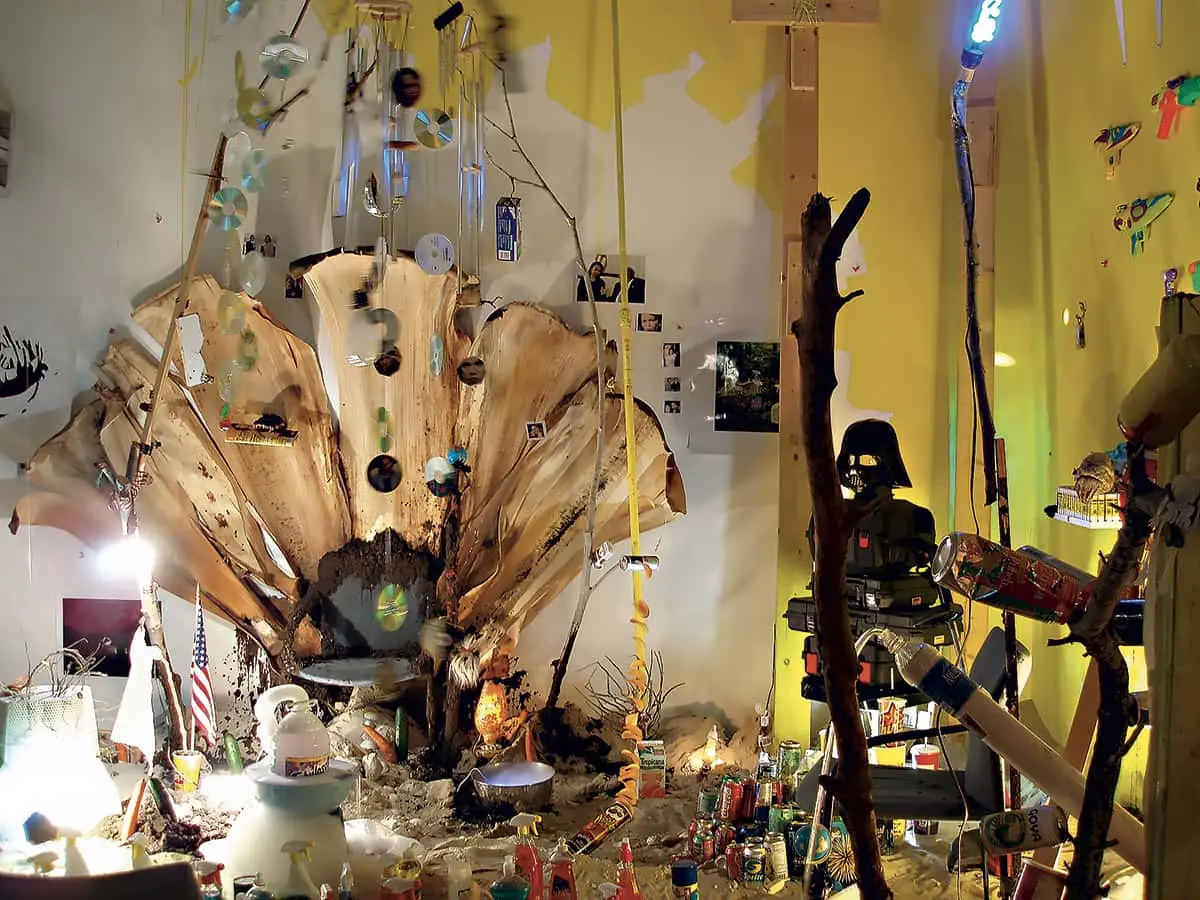
Bianchi had taken viewers outside their physical comfort zone before in Imperialismo Minimalismo (Imperialism Minimalism, 2006). To access the installation, one had to climb a wooden ramp with the help of a rope. Once the first stage of physical ability was achieved, the person entered a space were simple, minimal elements were accumulated, and which, by being excessively multiplied, reverted the concept of “minimalism.”
Bianchi’s critique of imperialism was evident in the dissonant combination of trademarks, logos, and corporate seals competing with one another. A naïf-style board game was altered by replacing tokens with soda bottle-caps (Pepsi and Coke). One had to win the game at all costs, in the context of savagery metaphorically represented by a piece of bread devoured by insects.
With a plane of exacerbated visibility, Bianchi signals the need to see, making it appear extremely urgent. He says: “With the word ‘urgency’ I refer to those aspects of the present that are being diluted and cannot wait, to that which is threatened with extinction because it lacks visibility, or, on the contrary, that which is so normalized that it becomes invisible.”3
In Estado de spam (State of Spam, 2013), a wooden prism with openwork highlighted the ever-increasing invisibility of precarious labor. Jutting out through the openings were the arms of windshield washers, flyer distributors, or African immigrants peddling watches. Artisans who display their products on blankets on the street, colloquially known as “manteros,” were also represented.
To disassemble the teleology of the market, Bianchi operates like a collector of “phainomena” (that which appears). He proves that art is a privileged site for the writing of history; in this way, between the symbol and the document, he describes our present.
Bianchi’s interest in historical documents is manifested in My Summer Bunker (2006), a tunnel made of boxes and packaging materials for artwork, leading to Condoleezza Rice’s summer bunker. It included a “track list” with the ten songs most listened to by soldiers in Iraq, according to Rolling Stone magazine.
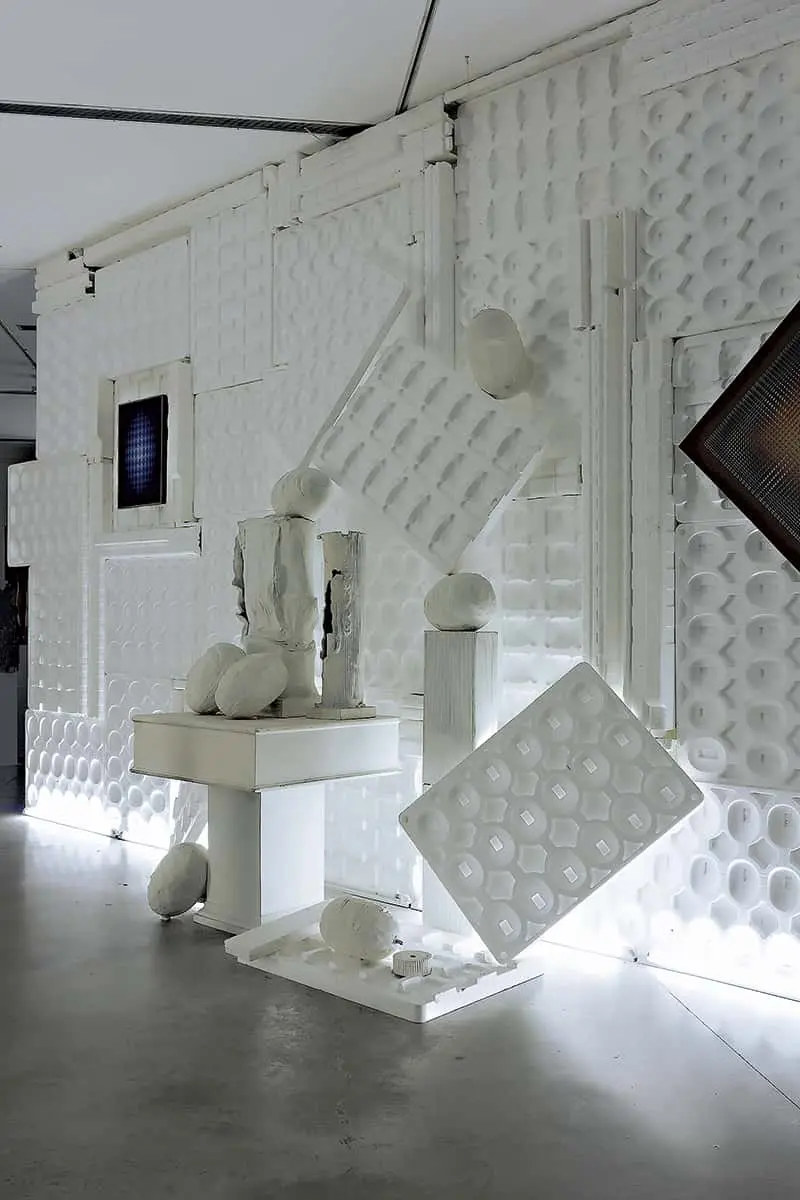
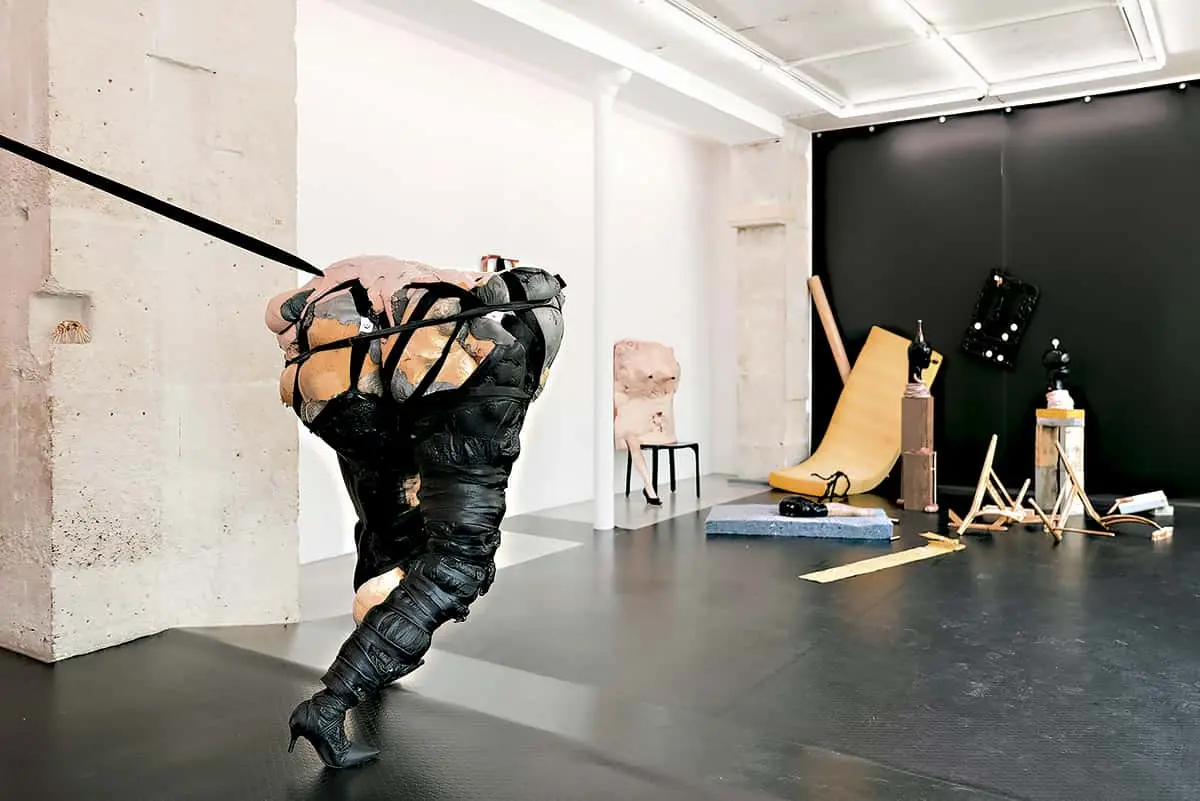
Opposites compete in Bianchi’s poetics: bio-morphism vs. systematic ordering, innocent play vs. torment, immateriality vs. materiality. Confronted by the immateriality of the digital as it expands throughout our culture, he opts for hyper-materiality, embodied in shapes that refer, ruthlessly, to the human figure. Such is the case of the bodies in the installation Soft Realism (2019), in which we perceive a “soft” resistance, similar to the soft matter that composes them.
Amid a “soft” utopia, nature emerges to prove its potential, as we see it in the photographic series Paraíso (Paradise, 2006). Although imprisoned in hallways, it continues to operate in Feel free, feel fear (2013), expressing itself unexpectedly in plants that grow inside brand-name sneakers. It also reemerges in trunks interfering in urban spaces and even adopting a monstrous shape, as if exerting revenge towards the accepted story of the beauty and happiness that characterized the modern project.
NOTES
1. Claudio Iglesias, “El karma de ciertas cosas” (The Karma of Certain Things), page 12, Radar Nº 724, 2010.
2. Santiago García Navarro, “Todo artista es un comunista” (Every Artist Is a Communist) in Inés Katzenstein (ed.), Perspectivas sobre la obra de Diego Bianchi (Perspectives on the work of Diego Bianchi), Madrid. Temblores Ediciones, 2019, p. 213.
3. An exchange between Diego Bianchi and Inés Katzenstein about the show The Work in Exhibition, Jocelyn Wolff Gallery, Paris, 2015.
ELENA OLIVERAS
Ph.D. in Aesthetics. Professor and essayist