Without the signing of a peace agreement in Guatemala in 1996, it is unlikely that private investment, the presence of transnational firms, the country’s infrastructure projects, or the privatization of telecommunications or electric power utilities would have systematically emerged as the government’s failed attempts at modernization. It is common knowledge that the peace agreement put an end to a 36-year civil war, but the fact is that it also promoted the opening of local markets, under Álvaro Enrique Arzú Irigoyen’s neoliberal policies. As with all of neoliberalism’s utopias of development, its contrasts and paradoxes reveal the gap between social life and the promise of progress: although peace was the banner of a future of economic advancement, consumerism and the presence of foreign companies still clash with the high rates of poverty and the unabated violence that continues to take many lives in Guatemala, turning them into mere statistics.
In any case, one of the most evident changes in the Central American nation is the sudden overabundance of mass-consumption products. The streets became flooded with informal commerce and gaudy objects, like a saturated landscape where identities, mediated mostly by consumerism, are forged. In this context begins the artistic production of Darío Escobar, with a clear review of the place occupied by the Guatemalan colonial past in the updated forms of economic colonialism. It is as though the promises of progress that were so enthralled Latin American nations in the second half of the Twentieth Century, had never gone away. And the truth is, they merely shifted shape. Escobar makes it his task to build a different modernity, one that, paradoxically, takes place seventy years later and lays its foundations among the debris of progress. The device he deploys is object-based, and what the work enunciates, always leaning in the direction of contemporary sculpture, is the failure of modernity.
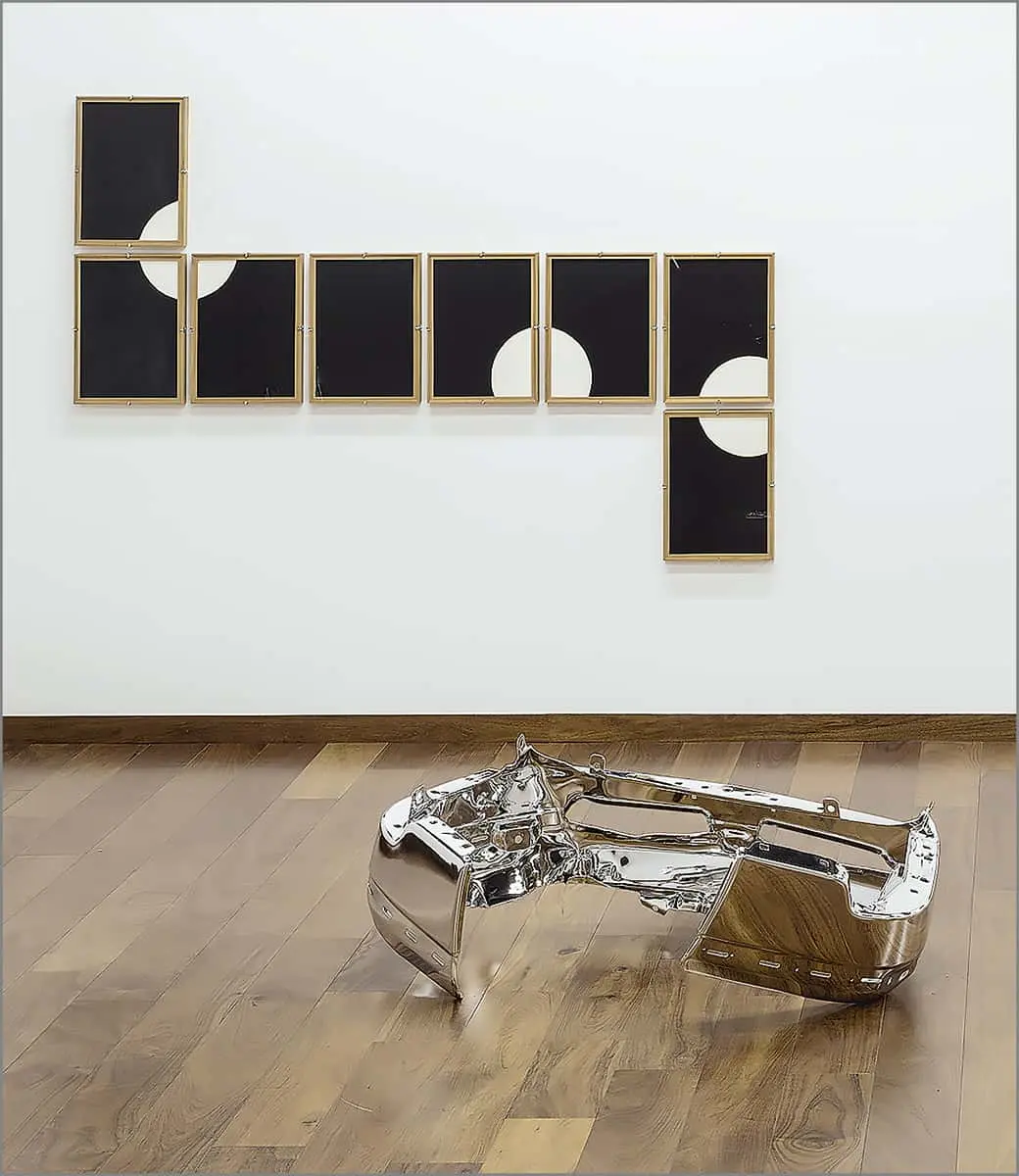
To use the accident to reveal failure. That appears to have been one of the Guatemalan artist’s guiding objectives as he developed Lo que no es bueno para uno, no es necesariamente malo para otro (What Is Not Good for One Is Not Necessarily Bad for Another), the project he presented at Mexico City’s Proyectos Monclova from June 20 through August 24. As in previous projects, the starting point is an economic reality unique to Central America: the so-called “rolling automobiles” that travel from the United States to several countries in the region. Along the highways that traverse Mexico’s Gulf coast, it is not uncommon to see used cars traveling from the United States to be distributed in Guatemala, where they are sold at low cost or to supply a black auto-part market. From local chop-shops—forbidding places where damaged vehicles pile up, sometimes literally one on top of the other—Darío Escobar collected the bumpers from unsalvageable cars to show what lies behind neoliberalism’s promises: the always-historical faults of a colonial process. Those automobile bumpers, which Escobar has been gathering at least since 2010, are then chrome-plated for their sleek exhibition in art-world locations. Several are featured in this exhibition under the title Crash.
Meanwhile, in 2005, Escobar visited parking lots throughout Guatemala City and placed sheets of paper under some of the parked vehicles. The burnt oil leaking from many of them motivated a gesture that was later repeated in other works. The series Composiciones (Compositions), also included in this show, is comprised of polyptychs where such motor-oil-on-paper technique produces an impeccable geometry. All that is left on the surface are white semicircles that will gradually become more intensely stained.
In both these two instances, the commodity goes through a status shift. What is exhibited as a set of sculptures are no longer the rolling automobiles that travel through Mexico’s Gulf coasts and arrive in Guatemala to be sold on the cheap, but the bumpers, fenders, and twisted tinplate that remain after an accident. Neatly chrome-plated, they have once again become a commodity. Darío Escobar’s operation, not devoid of a certain simplicity, closely resembles the process of seduction. Their polished plating gives these objects, no longer the rusty, road-worn iron of North American automotive castoffs, a new status: the seductiveness of consumerism, in a site also devoted to market activities, an art gallery. We were never modern, but Darío Escobar attempts to provide failure and accident with a new status. And he does it by questioning an economy that continues to widen Guatemala’s social gaps savagely.