A review of literary and film imagery indicates that dystopia, a type of narrative that uses worst-possible-case scenarios to show that the future will inevitably be bad, remains the best way to represent what is to come. Similarly, in the arts, where symbols can find themselves under the awful obligation of heralding the catastrophe, communication can adopt a predictive key, fueled by our era’s ecological concerns.
This is indeed what happens in Camila Botero’s exhibition at Lokkus gallery, in Medellin. Botero is among the most representative members of a generation characterized by its penchant for the kind of institutional critique that is already distinctive of all genuinely contemporary attitudes, here subsumed in deep consideration of the media and the alternatives for representation and presentation. Rather than becoming narrators, young artists seek to problematize the narrative device through an eclectic use of various media, supports, and languages, towards which they adopt an attitude more akin to curatorship and cultural-project approaches than to studio-based work.
Thus, in Estallido (Explosion), several different resources (text, images, object, and installation) are articulated based on research, revolving around a dominant objective: to appeal to the viewer’s intellectual empathy. The variety of media, however, is not driven by a drive to dispersion, but by the articulation that, as a genre situated midway between allegorical narrative and sensitive experience, the art exhibit facilitates.
Along those lines, two paintings depict a dormant and an active volcano, obtained using Google’s search algorithm. Volcán I (Volcano I) and Volcán II (Volcano II) show how our ability to imagine the future is dominated by technology and the growing impact of protocolization on our searches and affinities. The paintings, displayed next to each other, come across as a warning about the quietude/restlessness dialectic that defines our narratives and representations of disaster. By confounding our expectations of what a painting contains, they reveal the appearance of the image obtained through virtual procedures. As in appropriationism, the images are a kind of an oxymoron of their content. In the words of Amy Hyam, they “allude to our desire to control nature through technological means, and, in consequence,” introduce “a subtle oscillation between repeal and attraction.”
A video, Todo ocurre cuando algo se mueve (Everything Happens When Something Moves), denounces the narrative and allegorical intent that underlies all catastrophe stories, while Procesos geológicos (Geological Processes), an installation comprised of ceramic pieces based on a petrified wood fragment, highlights a dialectic between the terrestrial and the cosmic. Molded ceramic pieces are arranged on the floor to evoke the aftermath of a conflagration, while others, suspended from the ceiling, resemble meteorites on course to collide with the viewer’s head.
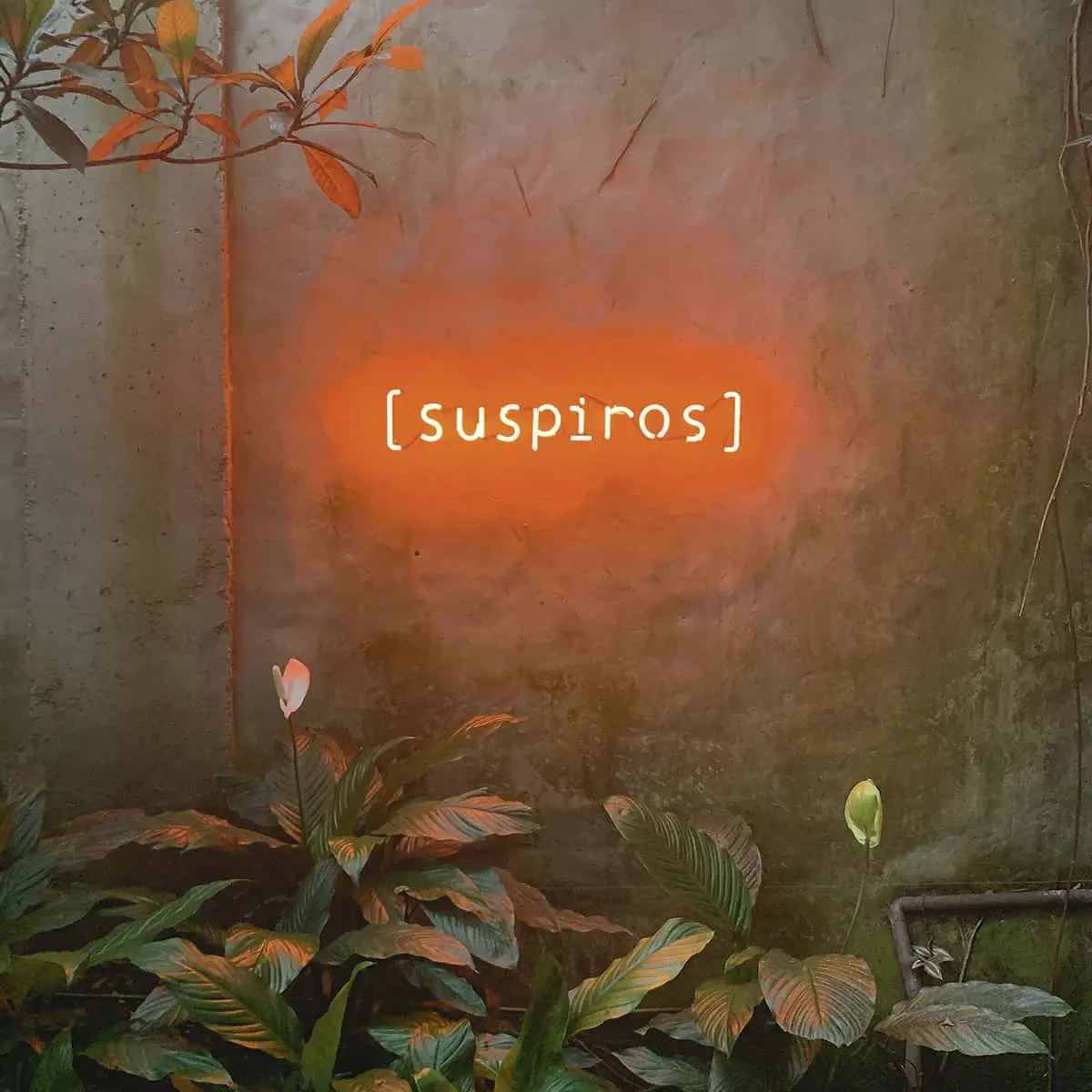
A series of acrylic paintings and neon signs with sound descriptions gleaned from the closed-caption scripts of films and TV series was one of the exhibition’s peaks. Isolated and idealized by the neon or the technical lettering, the background sounds are almost sinister. The metaphorical use of the concept of “descriptive noise” allows Botero to underscore the subtlety of the changes that could bring down humanity’s cataclysm.
The idea that the world is not indestructible and, in consequence, that humanity is; the notion of fate, with its newly regained salience; our relationship with nature in the digital era; and, above all, the idea of a world without humanity—all insinuate themselves as appropriate subjects for art’s ecological forewarnings. Botero deploys an effective strategy: to evoke the damage caused by the human presence by recreating its absence.
What all these works (or rather their articulation into a project guided by careful formal, scientific, and medium-related investigations) attempt is a metaphorical enunciation able to go beyond the somewhat literal documentary approaches that dominated the international art space for several years now.
In Estallido, we are confronted with what the anthropologist Néstor García Canclini defined as the central condition of contemporary art: bringing things (phenomena, social forces, economic and political process) to a state of imminence. What does that mean? It means that, while it is true that art has lost its ability to represent all that exists, it still allows us to shape the general forces molding the future. The fate of humanity, including an account of ecological realities, has returned as a subject, and its rearticulation in Camila Botero’s work continues to be art-based, even if it takes us beyond art’s specific domains.
EFRÉN GIRALDO