Inventiveness has been the engine behind Brazilian artist Artur Lescher’s long-standing investigation, intended to bring forth the personality of sculptural shapes in space and, in that way, activate a sensorial perception of his geometric devices.
Creator of a unique artistic language codified in works that challenge basic notions of weight and counterweight–reordering the premises that undergird the three-dimensional life of objects at the outer limits of Latin America’s constructivist tradition–, Lescher establishes a field of forces in tension.
When an exhibition project uncovers the layers of a decades-long practice, as it recently happened—in wide-angle view—in São Paulo, we are once again confronted with the main postulates of a probing explorer of geometric intelligence.
The exhibition Artur Lescher: Suspensão (Artur Lescher: Suspension), installed in the fourth floor of Estação Pinacoteca—formerly the site of the State Political and Social Order Department, an organ of State repression and for the confinement of political prisoners, now occupied by the Monument to the Resistance—offered visitors an experience of passage and reinvention of life.
Once again, a sampling of Lescher’s artistic investigation allowed visitors to stroll between pendulums, plumb-lines, metal wires, and objects in aluminum, wood, and felt, encountering the fabulous life of matter in action.
The life of matter and the personality of the materials engaged by the artist in his work have been areas of intense debate among critics as they consider Lescher’s work.
Each investigative stage processed by Lescher, in combination with the geometric plane of his sculptural objects, has the contours of fiction intended to rattle and disturb.
Each creation is a fiction materialized as an exercise in three-dimensionality—invading the architectural domains of the buildings that host his sculptural objects—that reactivates Lescher’s entire project, laying down the basis for his inventory of forms.
In those forms, we recognize the procedural foundations that connect his inventiveness to the legacy of the constructivist tradition, rediscovered in the use of cylinders and cubes and the sense of a rigorous coexistence that accepts the surrounding environment as a unifying element.
With his personal aesthetic concerns at its foundation, Lescher’s inventory of the world, matured in the geometric structures of the manufacture of sculptural objects, reacts against our habitual understanding of the relationships between various materials.
We followed the more than 120 works exhibited through an ambitious narrative that organized Lescher’s production into three lines of reasoning: Liquid Narratives; Suspension (which gave the exhibition its general title); and Engineering of Memory.
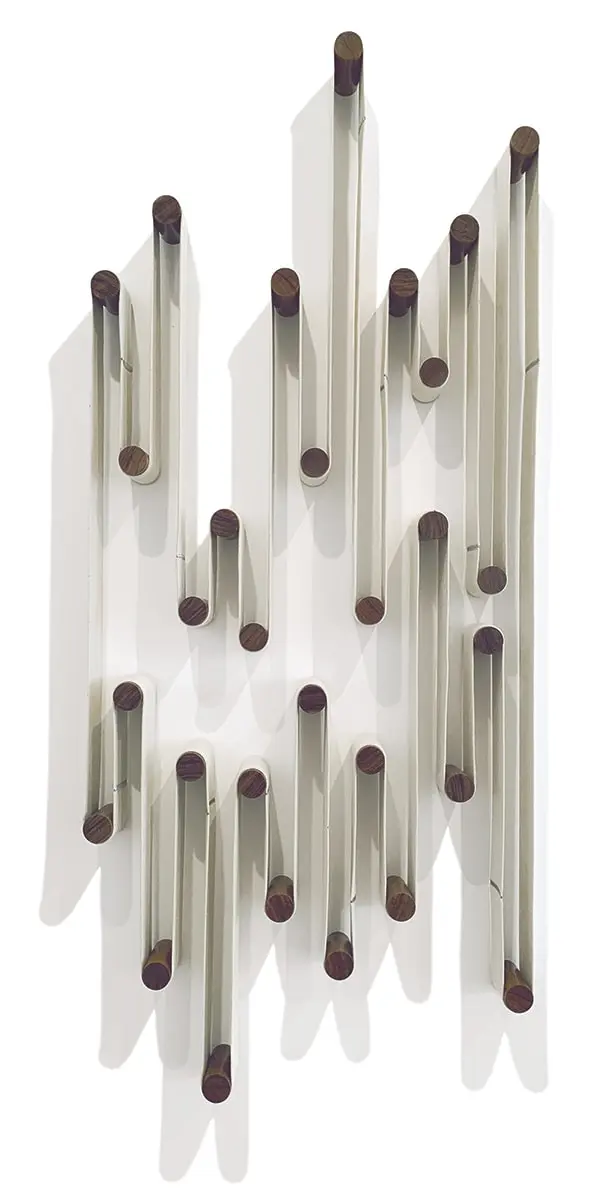
In Liquid Narratives, the instability of flows associated with the malleable gliding of stainless-steel webs and felt bands, and with the vibrations of paper strips, illuminated Lescher’s interest in process-related investigations, as evident in works like Rio Máquina (River Machine, 2009) or in his series Afluentes (Tributaries, 2013, 2015, 2017, 2018).
Lescher scrambles our habitual understanding of the materials’ physical attributes by establishing relationships that refer to their opposites. In his heavy metallic grids, we perceive the slippage of a stainless-steel net supposedly melting onto the exhibition gallery floor—a calculated transgression.
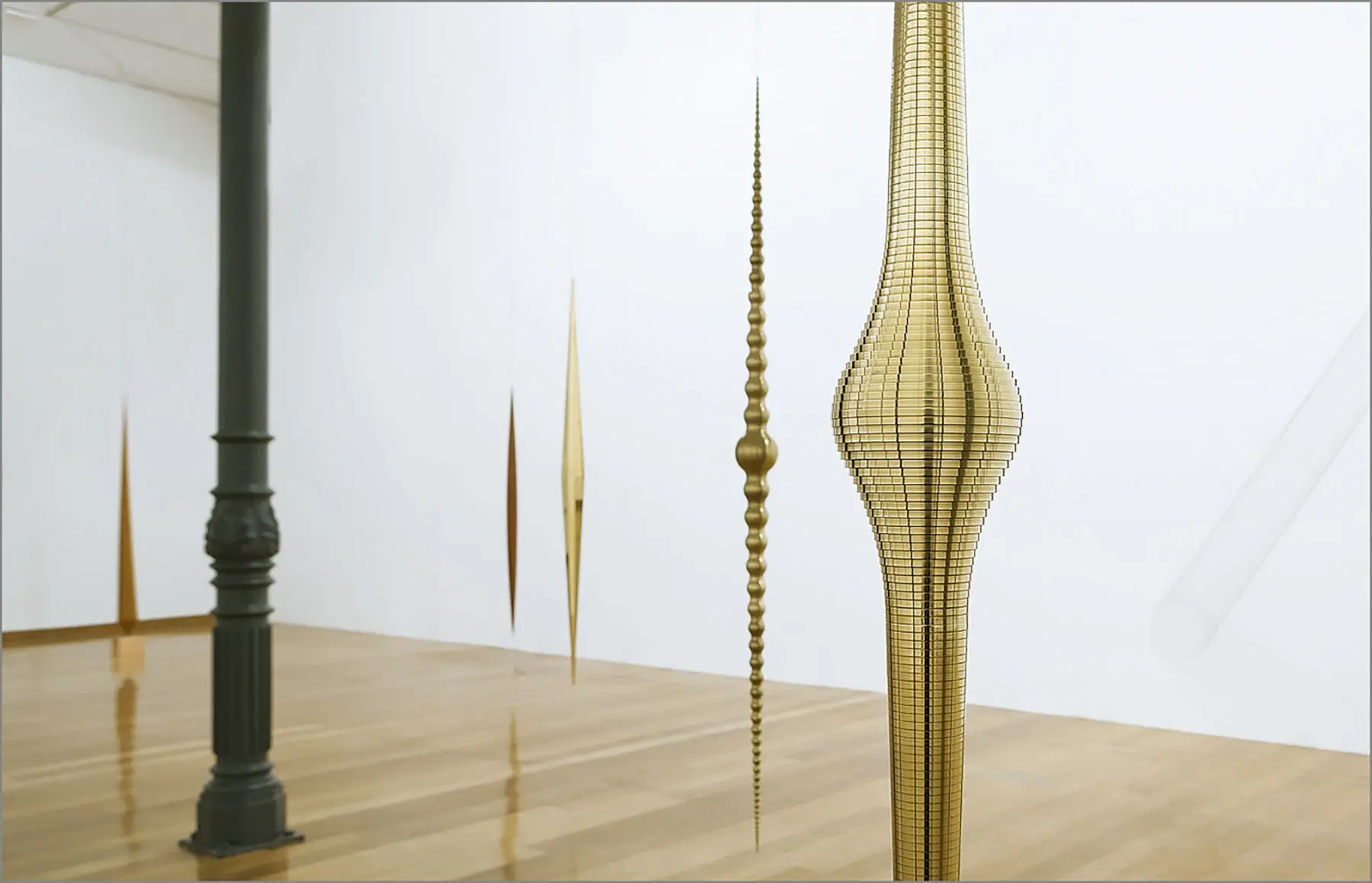
In the Suspension room, the structural rationalism of the space helped shape a markedly vertical expressive module. The works selected for this—almost fluctuating—section arranged pendulums, needles, and glistening metallic filaments, in a linear dialog supported on relationships of ascent.
Lescher’s study notebooks displayed in horizontal cases provided a record of his artistic investigation. His notes contain a constant reflection about the works and reveal the paths his creativity has followed.
Lescher’s colorful notebooks show how he ingeniously registered landscapes, sketched structures, tested colors, calculated planes, listed cuts and measurements for later works that focused, and collected loose thoughts that served almost as a guide for the exhibition’s visitors.
The third exhibition room, Engineering of Memory, revisited an important area of interest for Lescher, an artist who seeks to activate the singularity of each architectural space in which his works are situated to renew a dialog with the cultural environment.
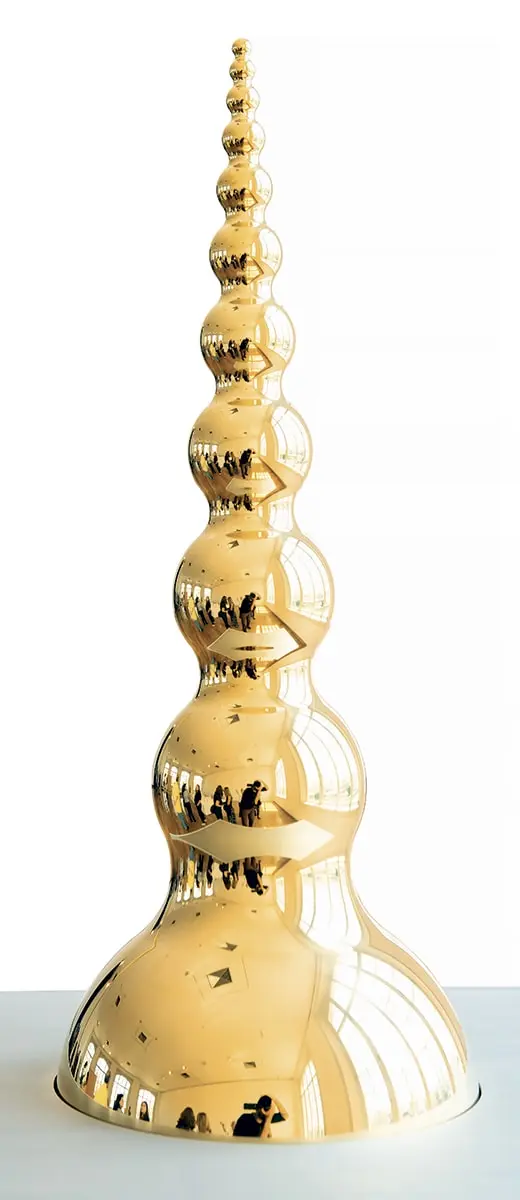
In the selection of sculptural objects in brass and aluminum on exhibit there, memory is posited as a monument celebrating an event undoubtedly deserving of preservation; under the right circumstances, always an almost-unforgettable event.
In this module, the works titled Finial #06, Finial #07, and Finial #08, from 2017, arranged together in solemn disposition and associated with the identification of project elements calculated for the completion of an architectural plan, connected with the interior and the outer spaces of the exhibition hall.
Thus, a crucial component for the closure of an architectural commitment to its destiny, a finial, reached monument contours and expanded its presence.
Arranged on regular bases, the works stood up together with the imposing windows of the building—designed by the office of Ramos de Azevedo (1851-1928) for the offices and warehouses of the Estrada de Ferro Sorocabana—and silently pointed to the ceiling of a gallery that, despite being restored, remains almost isolated amid the abandonment of an urban area surrounded a violent and degraded environment.
A further presentation of the artist’s trajectory needs to be mentioned as part of the Pinacoteca’s initiative: a bilingual English-Portuguese catalog. With an introduction by Jochen Volz, curatorial text by Camila Bechelany, essay by Juliano Garcia Pessanha and an interview with the artist by Lilian Tone, the publication undoubtedly collaborates with the writing of the history of Brazilian art.
By bringing together sculptures, notebooks, drawings, films, mockups, and large-format installations, the exhibition Artur Lescher: Suspensão presented a good portion of the artist’s production in a proposal that was, in fact, relational.
CLÁUDIA FAZZOLARI
Vice President OF THE BRAZILIAN SECTION, AICA