In current debates, the detailed analysis of artistic practices in the contemporary era has often tended to include, among its areas of interest, levels of meaning, and peripheral concerns, the terrains opened by digital technology experiences.
Those terrains, which permeate the space around us and the modes of our subjectivity at the boundary of human relations, are often the object of Brazilian artist Anaísa Franco’s investigation.
At Galería Lume, in São Paulo, Franco recently presented the directions taken by a project that moves between decentered identities, between multimedia formulations.
In a continuous process of material technological interactions, motivated by the sensorial environment, and relativizing places and images, Franco inaugurates an electrified visual universe and problematizes the boundaries of the physical realities that surround us.
Inside the space of ID Expandida (Expanded ID), a solo exhibition centered on an experiential passage, visitors encountered the movements of creative labor concerned with understanding the forces of unstable, inconclusive, fickle identities, activated by the coexistence of digital processes and three-dimensional interactive thought.
Investing in a long-term project addressing the debate around technological resources and new contemporary identities, Anaísa Franco uses media associated with the interfaces of the active digital world when, questioning fixed positions that focus exclusively on binary readings, she probes the connections between the physical and conceptual maneuvers of interaction between media that give materiality to the ratiocinations of interactive dynamics.
The work that gave the title to the exhibition, ID expandida, included an interactive sculpture built like a large-scale, 150-cm-by-150-cm wooden bench. Capturing the digital imprint left by visitors as they interacted with the work, the mechanism adjusted the information and materialized a generative response. The result of the interactions registered, then, a multiplicity of colorful light flows irradiating throughout the exhibition space.
Among other works exhibited, Paranoia (2010), Devenir: interface de flutuação de gênero (Becoming: Interface of Gender Fluctuation, 2013), and Homem Grávido (Pregnant Man, 2018) confronted visitors with situations that activated sensorial thought and inscribed an interrogation of our bodies and our actions.
The selection of works included interactive sculptures with dental prostheses, activated by a mechanism attached to the wall; with distorted images of the viewer in the exhibition space, generated by an interactive mirror that displayed accentuated or softened masculine and/or feminine features, putting pressure on gender stereotypes; and a large structure of a pregnant man that explored the edges of traditional readings of identity.
It is worth noting that many of the projects circulated in this recent solo were already in advanced development at the time of Anaísa Franco’s participation in “Homeostase@The Wrong,” the Digital Art Biennial, presented in São Paulo, in 2018.
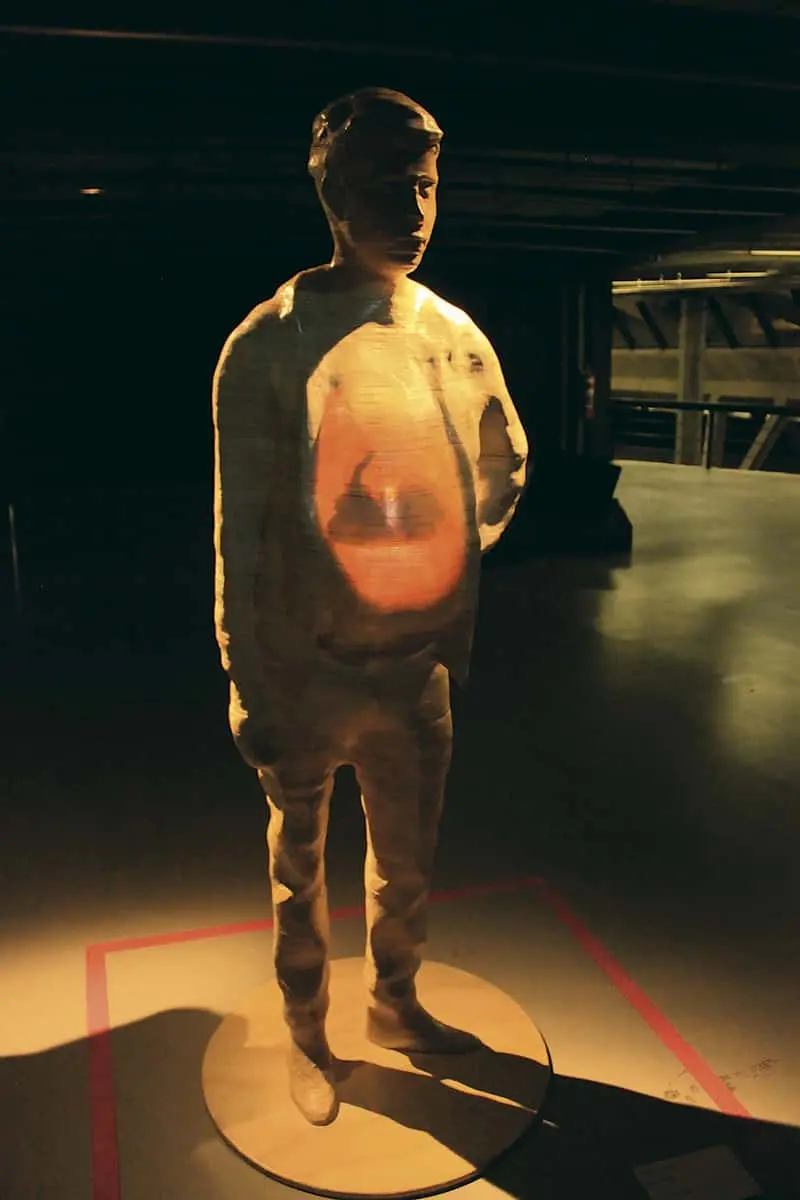
In Homem Grávido, a large-format sculpture resembling a three-dimensional scan of a male body in an advanced state of pregnancy, Franco attaches to the abdomen of the structure (made in wood laminate) a video with mages and testimonies of transsexual individuals who experienced gestation, underscoring the paths followed by their decision-making and the constitution of their families.
Identities, in the contemporary scene, are no longer present as fixed axes of individual projection, in the way in which the stability of the subject was configured in the past. Today, an interest in shifting positions, in the diversity of subject-making processes, and even in transitional states between genders, has contributed to the drive the artist, especially in the construction of perceptual-simulation devices.
Franco is interested in digital manufacture. The development of her works involves constant research, and they activate the presence of the viewer, returning to an emphasis on the body and behavior, and giving the other significant space.
As we have noted, Anaísa Franco is a multi-media artist, sculptor, and designer who investigates our bodies relationship with objects activated by the maneuvers of digital technology.
Franco’s projects seek to establish new modes of coexistence, expanding our senses through the proposal of transformative interfaces conceived for subjectivities that lay outside the commonplace. In this way, the artist points to the production of here-dimensional narratives by activating senses and sensors, in machines that bridge the divide between the digital and the physical.
ID expandida introduced to the ongoing debate, in an expanded conception of the contemporary investigation, one more chapter in the studies of an artist interested in the life of forms, in the possibilities for interaction and amplification of virtually created emotions, and the temperamental instabilities of materials activated for the advancement of experimental processes.
CLAUDIA FAZZOLARI