“When have we seen a museum burn the artworks or the photographs it receives, revealing an element of impermanence among the tenets of contemporary art?” With this fundamental question, Adriana Marmorek (Bogotá, 1969) shifted the message contained in the reliquaries presented in the 15th Central Region Salon, El museo efímero del olvido (The Ephemeral Museum of Oblivion), in 2015. By means of an open public call, Marmorek built a collection of objects imbued with special significance by their original owners, objects that materialize specific memories of love, fate, or heartbreak. At the end of the regional Salon, the artist reflected on the objects’ circumstances and their fragility as memories (in an ever-changing world, perhaps the only thing making them concrete is the narrative that surrounds them). Later, she burned the objects but preserved their remains, in the way in which broken pieces of works of art are kept after an accident, providing a material base for history in fragments.
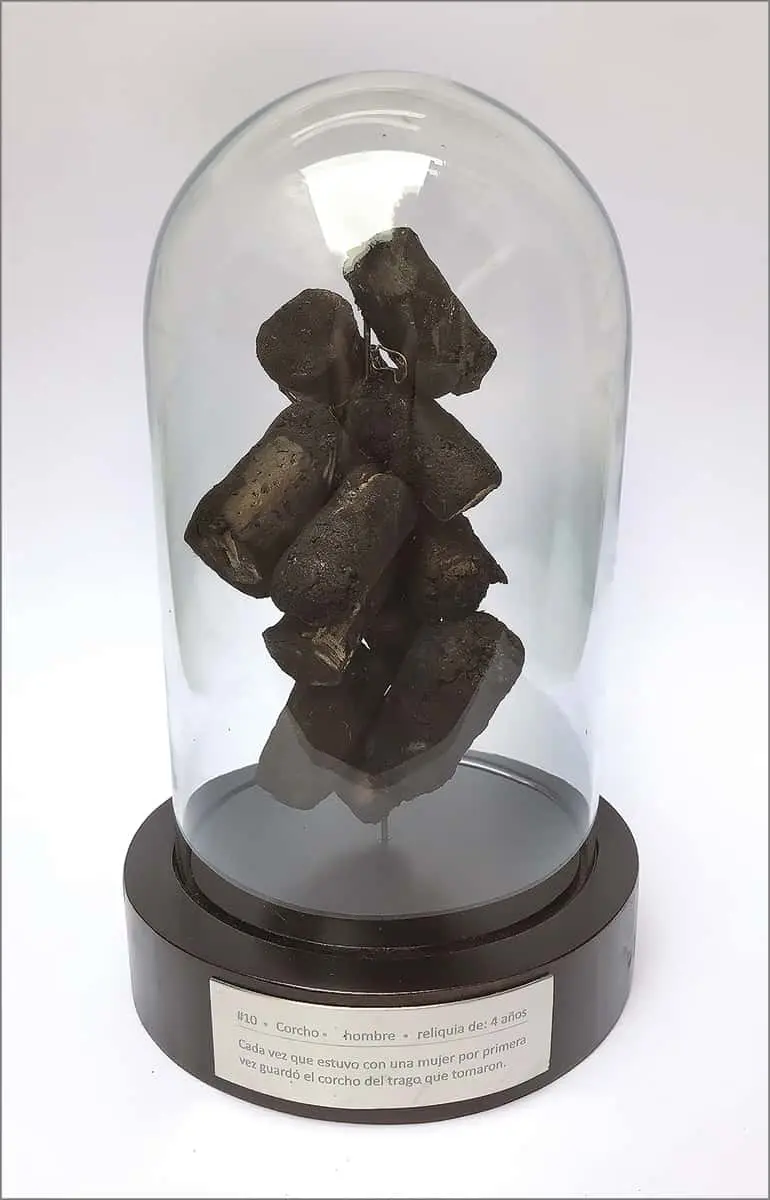
Adriana Marmorek’s exhibition at the Museo Rayo, curated by Miguel González, brings together these object-vestiges based on their aura, which in a way—echoes of Walter Benjamin—preserve every gaze, and the accompanying texts and remembrances establish them as paradigmatic. On the other hand, transformation is an important concept in Marmorek’s work; the significance of what remains as the trace of something no longer there is an element in series like Reliquias (Relics, 2016) and Osarios de amor (Ossuaries of Love, 2018): an emptiness—having to do with loss—finds in the vestige a way to be invoked. This is why the artistic processes preferred by the artist are processes of decomposition: combustion phenomena that mutate one thing into another, while it paradoxically continues to be (to allude to) the same.
Reliquia No. 17 (Relic No. 17, wedding dress, video installation, 2016), from the Transmutación (Transmutation) series, is a central piece of this exhibition. It encapsulates the concepts and symbolic allusions the artist is after. A video and photographic records of the burning of a wedding dress, donated to Marmorek’s collection, happens in front of our own eyes just like the myth of everlasting (idealized) love, the (collected) objects, and people (who sometimes forget how they change) fall apart. In this case, the burning has to do with the time of the tragic, a monstrous process when accelerated.
The conservation and museography of the objects allude to the new anthropologies that have gained a foothold in contemporary art, expressed through cabinets, artworks that are collections of things, ruins created by projecting a future, curations within curations, and, as is the case here, the devices used in the preservation of the objects. These are several glass domes that create the microenvironments of an autonomous world, bounded by labels applied by an external anecdote (a voice). In this way, the “others” are a notion, a testimony that in the cabinets and domes becomes the evidence of unnamed humanity. The exhibition breeds feelings that are collective, but under the parameters of individual life experiences.
Ultimately, a feeling of tragedy is inevitable in the face of the works on exhibit at the Museo Rayo, in connection with their color (combustion blackens most of the relics and the objects in the ossuaries), the domes, the videos, and the threat of fire, latent in what is being consumed. Grief, something each culture represents in a different way, is made to correspond with the color black in Marmorek’s works, directing us to the place of the dead, to the mausoleum as a possible container for the artist’s meditations on the finitude of the museum and the end of love after its institutionalization in marriage. After all this, the key question of many of her projects—What is love?— remains unanswered, although the collection she is able to build does provide an account of one of its dimensions.
BREYNER HUERTAS