
First, Adán Vallecillo’s origins. In speaking about Honduras, we do more than merely framing his work. The context makes the artist, and in this case, the artist unmakes the context. The historian Robustiano Vera said that the country owes its name to the depths found by the air pilots who, at the beginning of the 20th century, probed the surface of the land. Their cries of “God save us from those depths!” gave the nation its moniker.
Whether this historiographic anecdote is true or not, the truth is that the divine invocation accompanies anyone who lands or takes off from the short runway of Tegucigalpa’s airport, located at the bottom of a circular valley.
Arriving is no easy feat, and neither is leaving.
In the hallways of the international art world, the murmurings of other artists can be heard: How has Adán Vallecillo (1977) been able to position himself in the global scene while working from his plot in Santa Lucía.
That is one of the artist’s first great merits, the spur of a generation of restless creators who have continued their wake, as Vallecillo himself acknowledged in an interview: “Never in the history of our country has there been as diverse and productive a generation of artists like this one, which also has the merit of having brought to an end the monopoly of easel painting.” Indeed, there is even today in Honduras a distinction between “painting” and “art,” as though they were two separate things. We said at the beginning that the artist unmakes the context.
With an unusual tool in local art faculties, reflection about the contemporary, Adam Vallecillo upsets the monolithic conception of tradition to generate objects, drawings, or actions with an accessible message. The social and political content of his work—Vallecillo studied Sociology—reaches beyond its homespun depths and connect with a distant viewer. The humor, ingenuity, and intelligence Vallecillo has demonstrated in exhibitions throughout his career justify the accolades.
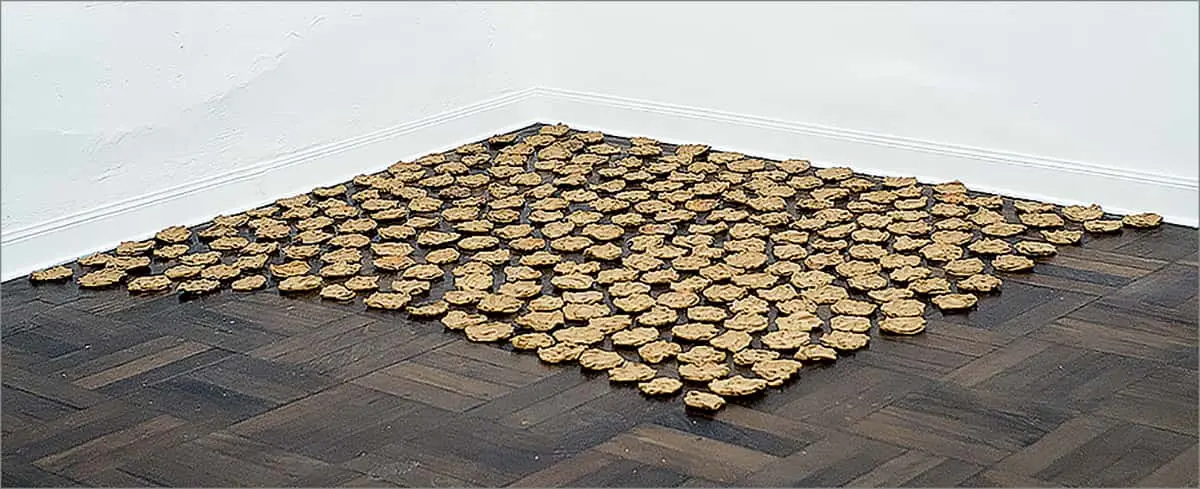
The first time I encountered one of Vallecillo’s works was at the Ortiz-Gurdián Foundation’s Centro de Arte de León, in Nicaragua. It was Cacerólica (“Panabolic,” 2005), an antenna attached to a frying pan, like a space module, a visual riddle, wordplay with objects. Along surrealist lines, but with social content, as the artist notes: “It seeks to bring to the surface some of the Eurocentric political, moral, scientific, and aesthetic discourses that we have assumed as true and absolute.” The non-assumption of imposed stories adds an interpretative layer to his initial works, perhaps grouped under that suggestive set of “Totemic pieces,” containing an anti-colonial reading and guarantors of a claim of the same. Under this epigraph, we can include Asepsiófono (“Asepsiphone,” 2005), a telephone transformed into a tool for cleaning mouths and ears using some cotton swabs and dental floss. One’s belongings as something discarded and remade. Paradoxical as it may seem, the guiding text for Vallecillo in those early years was Émile Durkheim’s The Elementary Forms of the Religious Life (1912). In connection to Cacerólica, that parabolic antenna that rises over a utensil used for frying dead meat, the supernatural properties we attribute to technology—or which are attributed to it from a First World’s vantage—are a link to the sacred, starting with the inanimate. Hostias (Communion Wafers, 2007) de-fetishizes and de-aurizes an element of the Catholic liturgy by converting (or de-converting) it into a cloth of the kind used to clean firearms. The idea of the Catholic sacrament of Communion is also present in Bonbon Terres (2015), where dirt biscuits are transmuted into ceramic pieces. This is part of an investigation in Hinche (Haiti), focusing on geophagy and connecting indigenous elements with art icons, as described by curator Carla Acevedo-Yates: “Using and juxtaposing materials and objects collected in Hinche, Vallecillo poses questions about the relationship between modern society’s healing rituals and ancestral spiritual practices, through Western art history’s aesthetic codes.” Both Hostias and Bonbon Terres introduce another subject of Vallecillo’s concern: armed conflict.
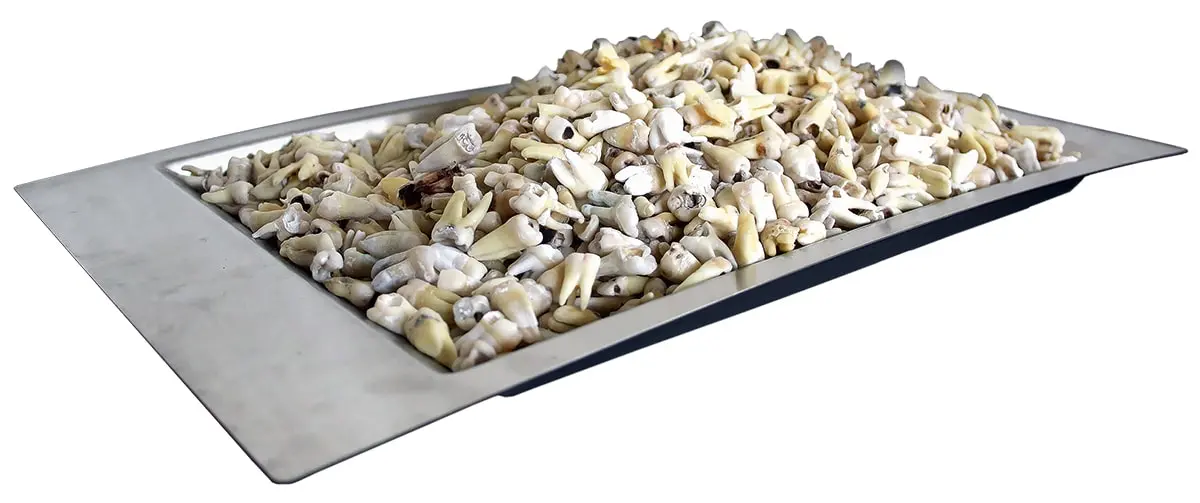
All Central American artists inevitably will, at some point in their careers, invoke the issue of violence in a region convulsed by conflict, be it in its modality of guerilla war or its domestic dimension. The artist knows it first-hand: Municiones (Munitions, 2007)—bullets boxes that he fills instead with cotton swabs—mimics the cases used to clandestinely transport ammunition through the border between Honduras and Nicaragua, the region where he grew up. Vallecillo approaches the subject through metaphor and poetry, but he does not hesitate in the creation of brutal images. The installation La fisiología del gusto (The Physiology of Taste, 2008-2010) is comprised of teeth extracted to members of the Lenca indigenous community by medical missions organized by evangelical churches, in the poorest municipalities of the western region of Honduras. An ontological study that combines the anthropological with the social, and the political with the artistic. These remains demand answers: why were they extracted; what explains their decay; what factors result in teeth loss. A recollection that counts. A sculpture made of suffering and depletion, exemplifying another one of Vallecillo’s creative pathways: presenting an accumulation as the trace of an extraction. He does this by reusing what has been left over. He remakes with refuse.
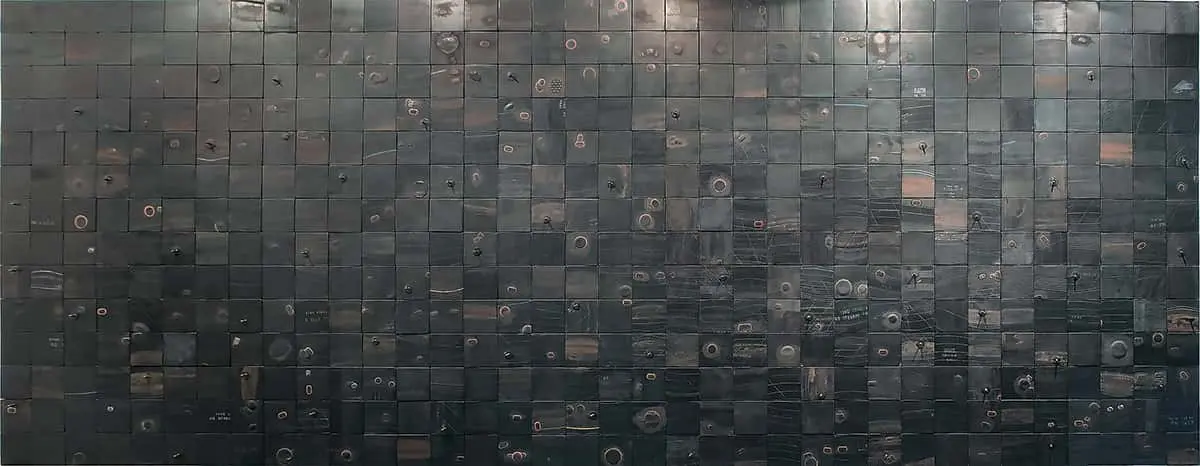
Topografías (Topographies, 2010-2016) is perhaps Vallecillo’s best-known recycling project. It is a 12-piece series using worn-out tires. An elastic map, full of accidents, in this case, both topographic and vehicular that has been repaired to satiety, just as the capital of Honduras has been fixed not once but a thousand times after the accidents of its history: coups, civil wars, invasions.
The fragility of the patch plugging a tense puncture as an allegory of the complex social contract in a country both exploited and about to explode. A bas-relief recording time and its erosion; a cartography of movement as a symbol of progress brought to a stop and hung on a wall. That which is discounted, the non-functional dross, is also the raw material for Pintura mural (Mural Painting, 2010-2014), a Vallecillo work with different implications. In his presentation of this fresco containing a portrait of society, Vallecillo paraphrases Zygmunt Bauman: “Waste is simultaneously divine and satanic. It is the midwife of all creation—and its most formidable obstacle.” Vallecillo’s mural painting is the result of his wandering around a trash dump area for five years, a period he calls his “dumpster tourism” phase. There he selected detritus that could be made into pigment, and using an artisanal process, transformed waste into dye. Multiple speculations about the consequences of the growth of big cities, of the “b” side of industrialization, and the second life of what is condemned to humus.
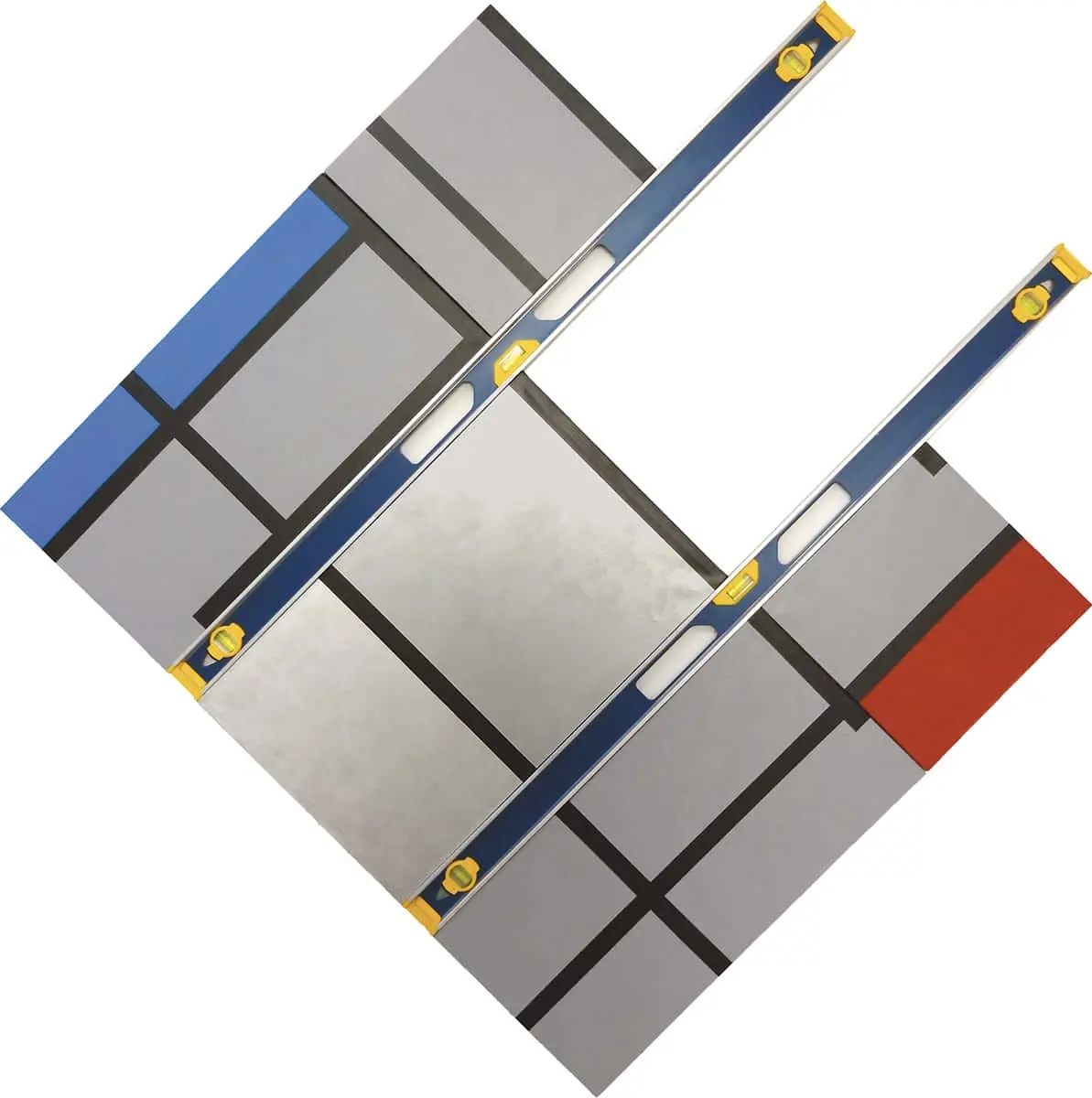
Gustavo Larach calls them “fetishes of the capitalist machinery,” but their implications go beyond that. This is a work of pictorial art that can be interpreted as decorative. A color gradient that conceals the degradation of the environment. As an ornament, it parodies the dominant role played by painting in Honduran salons, museums, and academic circles. If any detractors of contemporary art were to examine this work up close to determine whether the black sheep of the nation’s cultural scene has finally returned to the fold, they would quickly turn away in disgust. Vallecillo’s Pintura mural stinks. The beautiful colors derived from the world’s filth retain the smell of shit. Less odorous, but perhaps more painful, is Juego de semejanzas (Game of Similarities, 2010), which presents a collection of baroque mirrors, broken by having potatoes thrown at them. The reference to traditional art is joined by the act of launching a potato at the face of colonialism (these are baroque mirrors, hit by potatoes) from a subaltern art site. In this action, as in the performance Pintura política (Political painting, 2012), Vallecillo brought out his easel-painting gear and transformed it into a protest banner: against the 2009 coup, but also against artists comfortably ensconced in their studios, separate from social reality. Another line of investigation is the use and reconstruction of art-historical icons, as made evident by Homenaje a Mondrian (Tribute to Mondrian, 2012), which would undoubtedly have prompted at least a smile from the subject of its celebration.
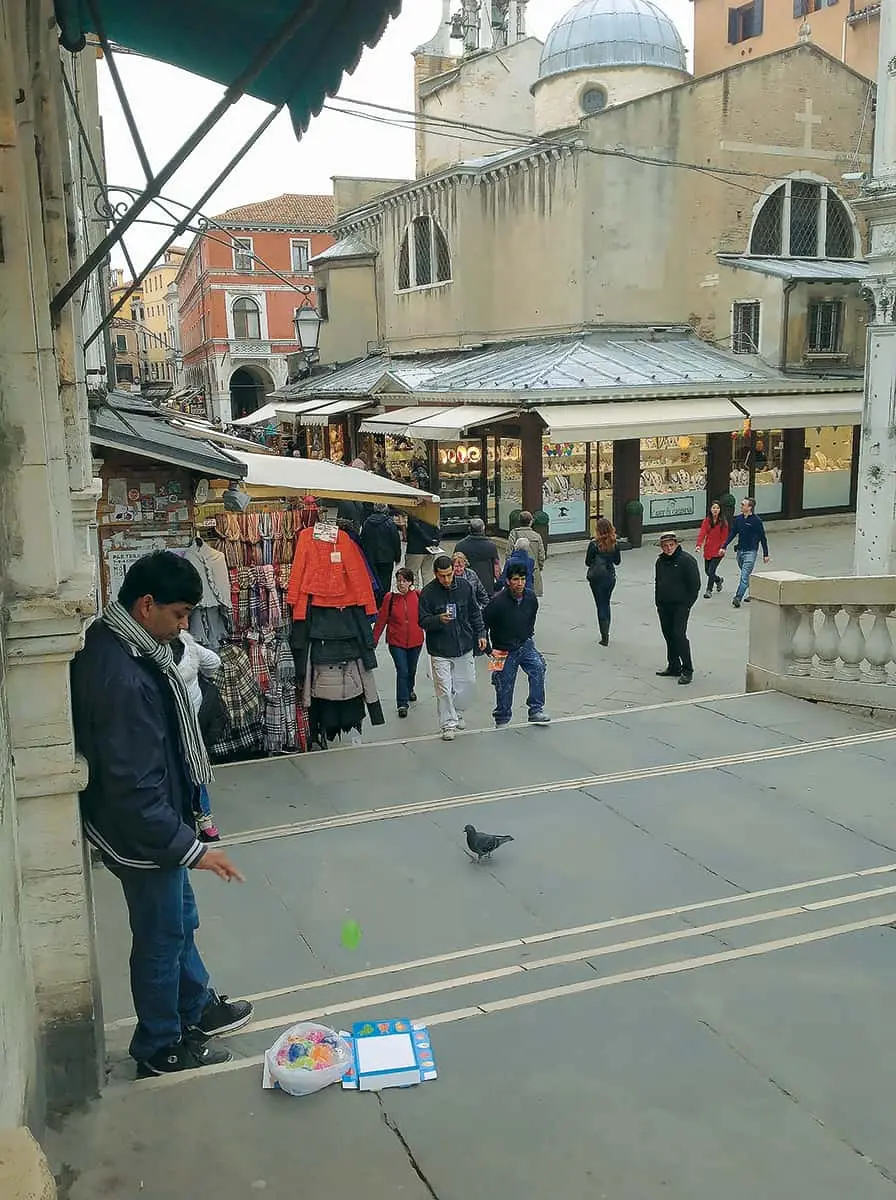
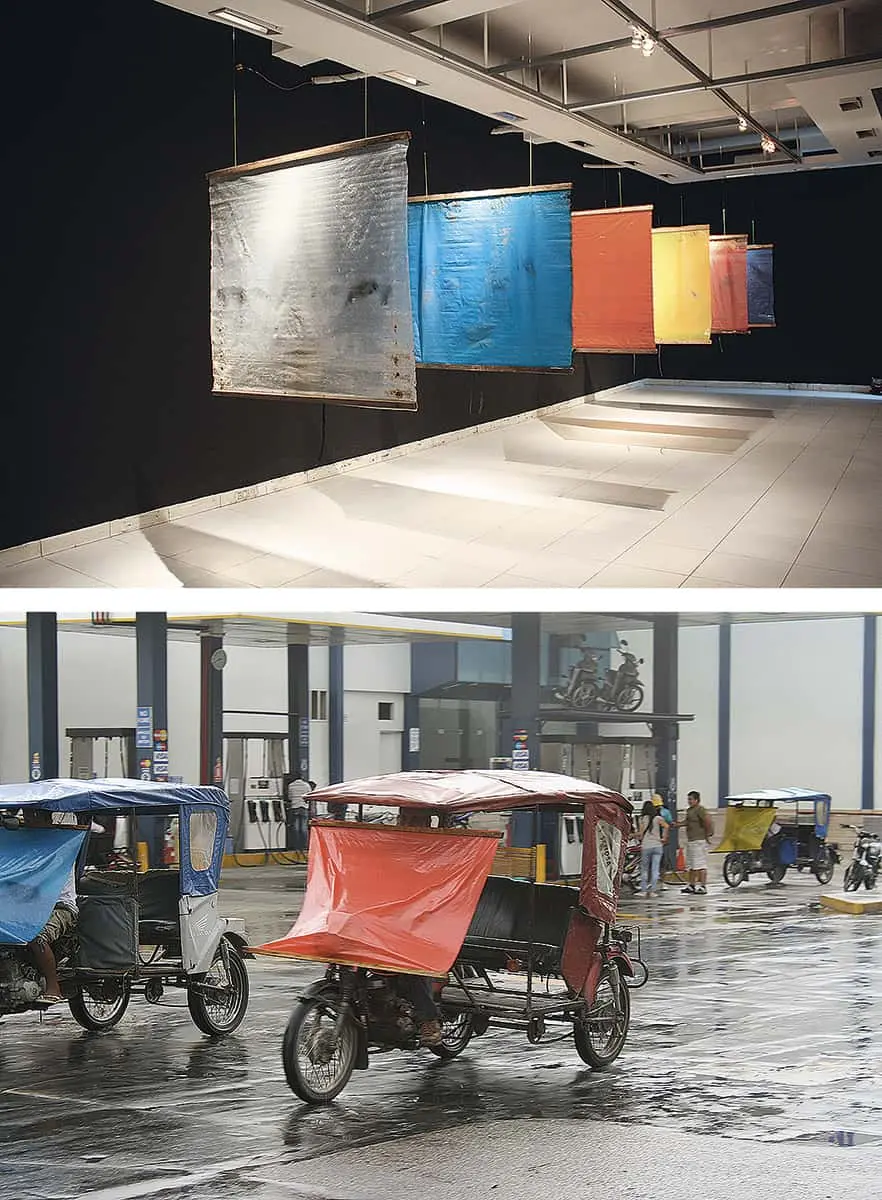
The waving flag in Pantone (2013) is the imbalance resulting from a model of capitalism based on providing comfort to tourists and anchored on the exploitation of the poor. During a stay in the rainforest city of Iquitos (Peru), Vallecillo proposed a transaction to three-wheeled motorcycle drivers. He would provide them with new plastic screens (which they use for protection against the incessant rain), in exchange for their old ones. Those screens, covered in grime and soot after thousands of kilometers under the elements, transmute into polychrome flags, which function as a parodic readymade in the exhibition space. As Vallecillo sees it, they are an example of everyday kinetic art. Another one of his concerns is tourism and its impact on the landscape. In Cartones veloces (Fast Cardboards, 2013), process and action determine a performative practice. Every afternoon during his residence in Venice, Vallecillo collected the cardboard sheets used by Bangladeshi peddlers, who place them on the sidewalk to prevent the gelatinous toys they threw on the floor from getting dirty. By day’s end, the cardboard sheets are dotted with the imprint of the toys that struck them. The interpretive layers in this work, underscoring two nouns, traces, and strikes, are manifold: from the black market for such products to the mistreatment of precarious workers in the “city of the eye.”
Vallecillo’s recent works carry his investigation forward. After an artist’s residency at Flora ars + natura (2018), he made a series of works based on waste produced by auto-repair shops in Bogotá. In this case, air filters. The paper membranes that capture the contaminants coming out of the inside of car engines are transformed into accordion-like objects, minimalistic in appearance. As they contract and expand, they display the traces left by soot and used motor oil, which is in turn used to make drawings. Hipercapnia (Hypercapnia, 2018) gets its name from an ailment caused by excessive carbon dioxide in one’s blood. We are talking about excess here: contamination by overproduction. Let’s not be fooled by the beauty of the color gradations. This recreation, made from garbage generated in one of the world’s most polluting cities, should contract and expand our thoughts.

Adán Vallecillo’s restless gaze does not limit itself to analyzing, and connecting with, the drive to create works of art that signal a different way of seeing. It also focuses on curatorial practice. As a curator, Vallecillo has made interesting proposals of collective observation and process. In Reunión (Reunion), he worked in a natural landscape with artists like Paul Maheke, Leonardo González, Natalia Domínguez, and Lucy Tomasino, and in collaboration with gardeners and farmers. Dislodged from the usual context of a contemporary art exhibition, the participants combined the artistic point of view—projections, roundtable discussions, performances—with meditation, hiking, and debate. Admittedly, some of the disquisitions that took place between hike and hike must have coincided with the areas of interest that Vallecillo has proposed and will continue to address: capitalism, inequality, eurocentrism, art history, or violence, intervened or interrogated by means of the object (as a symbol of something altered) and the subject (as the moderator of history). This, from the depths of Honduras all the way to the most prestigious museums and institutions, biennials (Montevideo, Paiz, Curitiba, Venice, Havana, or Cuenca), and collections (Daros Latinamerica, Zurich-Río de Janeiro; LARA, Singapore; CIFO, Miami, Florida; Sayago and Pardón, Los Angeles, California; TeorÉtica, San José, Costa Rica; Patricia Phelps de Cisneros Collection, New York-Caracas; Museum of Latin American Art, MoLAA, California; Museo de Arte y Diseño Contemporáneo, San José, Costa Rica; Saxo Bank, Denmark, among others). Representing not a country but a way of thinking and doing.
JUAN JOSÉ SANTOS
Art critic and curator. Profesor of the University Diego Portales and UNIACC.