Along with many of the artists who defined the political map of contemporary art in Mexico during the last twenty years, Yoshua Okón came out of the mid-1990s underground scene. It was formed by recent art school graduates unable to find a place (or their place) in a landscape that, while valuing contemporary art expressions (with practitioners like Helen Escobedo, Felipe Ehrenberg, Mónica Mayer, and Maris Bustamante, among others), relegated them as extemporaneous (in exhibitions brought to the iconic local museums) and peripheral (in alternative spaces). In 1993, thanks to a proposal brought by Eloy Tarcisio to the National Fine Arts Institute, Ex Teresa Arte Actual was established as an official space for the underground, but it was far from sufficient. Given the need for spaces unmediated by the authorities, where artists (always accompanied by a nomadic cultural scene) could have a place to come together and display their work, Yoshua Okón, and Miguel Calderón decided to launch La Panadería in an empty building belonging to Okón’s family. As a cultural center, La Panadería became one of the sites where what comes next was actually happening (something similar yet different occurred with Temístocles 22). This continued to be the case while La Panadería remained open, and it now lives on as part of a foundational story, documented in the way the Mexican Revolution tends to be, in a constellation of iconic images that allude to past as immediate as it is remote, about which we can forever speculate.

Later, an initiative—supervised in large part by Okón—emerged among these artists, many of whom have not only achieved recognition in the local scene but also made the jump to international circuits, to create a space for debate, a non-profit place where to view and propose, and thus SOMA was established in November of 2009. With contributions from Eduardo Abaroa, Pablo Vargas Lugo, and Sofía Taboas, among others, it became a bastion for the continued construction and debate of the new reach and potential of artistic activity, confronting the interests and slogans of conservative groups intent on imposing a more generic and conventional kind of art.

Okón’s art can only be separated from his work in management and organizing in the sense that it can be cataloged, and one can say, “here is the art” and “here is the management.” But the fact is that on both platforms he proposes a confrontational debate (which, according to the new terminology, does not break but takes issue with), ranging from our procedures and habits—so to speak—with regards to the edges that cut through the canonical, to a paradoxical quest for new horizons to reach (and break). And even further, to the question of what is and isn’t art, of what art says or could say, and its paradoxical linkages with a country’s political and cultural processes (one must remember that contemporary art ceased to be outside the mainstream with the arrival of neoliberalism). It also encompasses, in consequence, the power relations and the pacts that have shaped art as part of the social landscape.
I don’t mean to imply that contemporary art and neoliberalism are one and the same thing, only that they run in parallel, with the paradoxical coexistence of sedition and the logic of the market. Okón draws on both worlds to produce a forceful, often obscene condemnation of the contemporary cultural malaise. He produces explicit allegories of the discontents of consumer society, based on power relations at the political, cultural, or market levels, and on the impact and consequences of certain endogamous groups. He leaps from one side of the border to the other to satirically underscore the state of affairs, documenting or recreating—generally, on video—a variety of social behaviors. He is always pushing the bar a bit in this direction, a bit in the other, taking themes and motifs from a culture that finds refuge in subversion.
On the one hand, Okón cites local folklore by naming the dog in one of his videos “Chocorrol” (Chocorrol, 1997). The word alludes to the local use of the commercial name of a Twinkie-like pastry as a nickname among certain social groups, such as construction workers and car washers; the male dog’s actions in the video, mounting a female, is a clear allegory of those groups’ aspirations. On the other hand, he pays homage to other artists, as in the scene that emulates the social excesses depicted by Pier Paolo Pasolini in his film Saló, in a video work where images of a ravenous human mob are intercut with shots of an Orange County, California shopping mall parking lot.

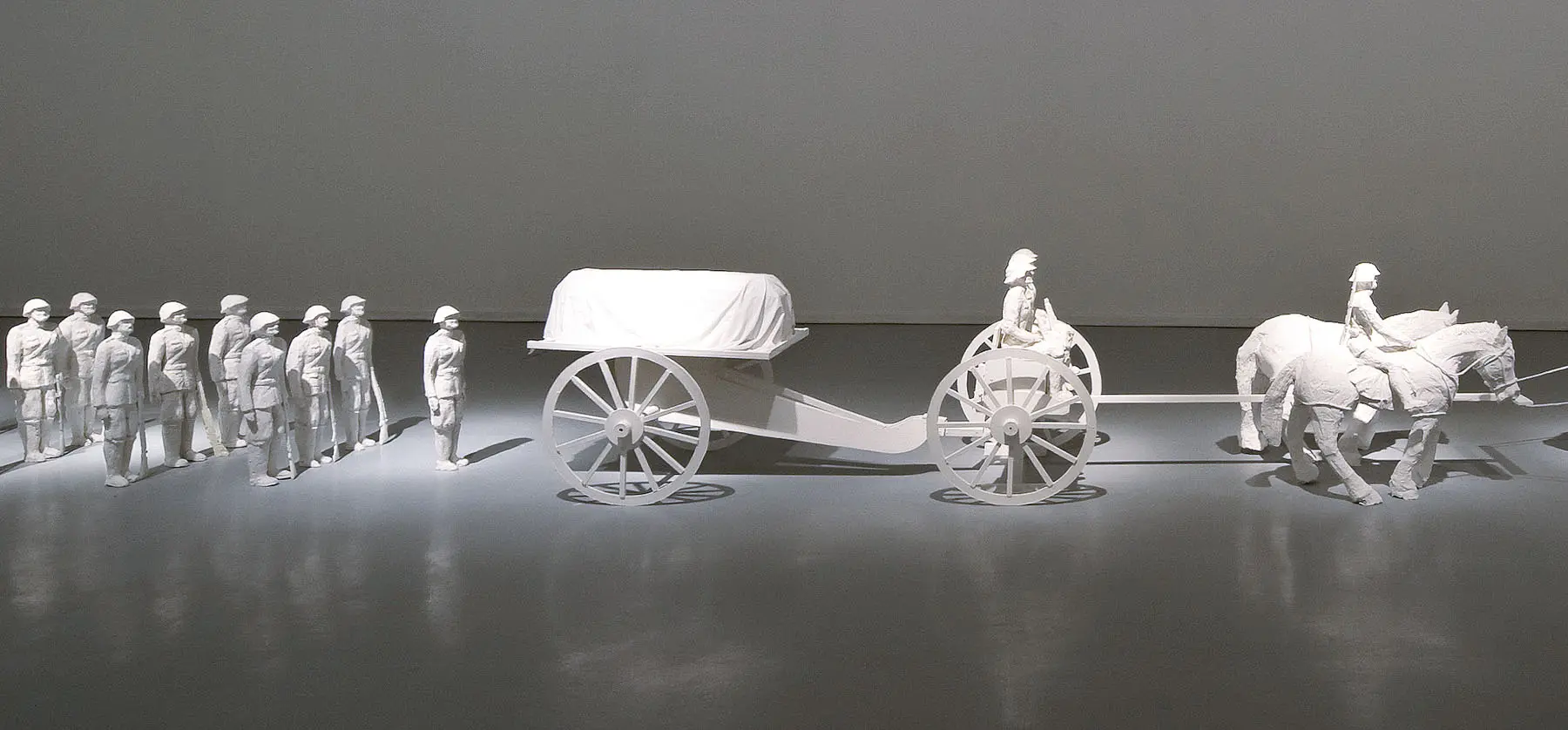
More than a year after Colateral (Collateral), his large retrospective at the MUAC in Mexico City, curated by John C. Welchman, a monographic exhibition of Yoshua Okón’s work opened in April at Centro Cultural Matucana, curated by Gonzalo Pedrero. The former reviewed the artist’s commentary on the malaise of neoliberalism, its excesses, and consequences, such as the collateral damage it inflicts on an ever-evanescent global economic hegemony. The latter, in turn, focuses on his oeuvre’s relationship with (or allusions to) the issue of power. Some of Okón’s works feature a direct reference to power, their extensions, or their stand-ins. This is illustrated by the Nazi group in Bocanegra (2007); the evocation of the Pinochet regime, in Chile Scream, a play with the word Chille (2009), and the logo in the shape of an AK-44, that denounced in Chiquita Banana (2004). In all these works, he intends to address what lies behind power, its ideology, or doctrine. He explores something as present as it is ungraspable; something that exists and speaks instead of; something that is unbearably uncomfortable. That which we glimpse through a monitor of the airplane window, at once solemn and denigrating, alluded by Okón only via humor and mockery, as a way of highlighting the horror of the social patterns that produce it.
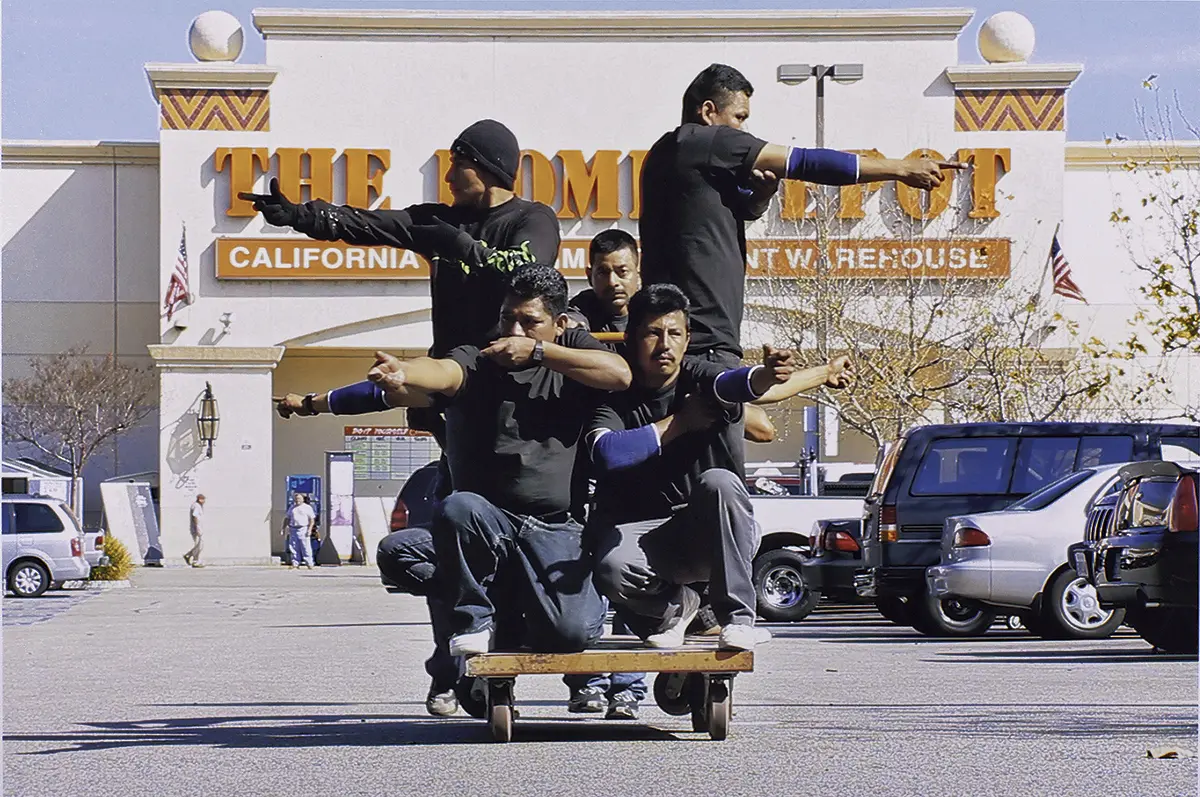
Thus, the Guatemalan civil war veterans in Octopus, a video set in the chain store parking lot in a poor neighborhood in Los Angeles, making military maneuvers as choreographies for the camera. Thus, Okón’s response to an invitation to create a site-specific work in Israel, where he built a performance-sculpture with the only respondent to his ad in a local paper in Herzliya. The man danced on a platform with an orange ribbon tied to his penis (an allusion to the symbol used by Palestinians to signify the occupation), in front of eight monitors, eight cameras, and disco lights, and the recording later became a multi-channel video work.
Okón plays with the assumptions that can emerge from the constructions he documents by using those who exert them or are their victims: Mexican neo-Nazis acting as Mexican neo-Nazis; a morbidly obese woman posing as a Neolithic Venus in the sites where she consumes the corporate-marketed products that contribute to her condition (omnipresent in chain stores). It is not a matter of people acting as someone else, but of people acting as themselves. In this acting as themselves, in the paradox of their simulation, a gap opens. The brutality of the content does not preclude Okón from invoking the immanent, something that exists—or is alluded to—as a ghost.
The title of HCl refers to the main contents of the vomit that flows through a tube along Okón’s entire MUAC retrospective, like an essence but also like a gesture. Donated anonymously by bulimia patients from a specialized clinic, it is the consequence of an unfulfilled dream, but also the dream itself. It is there in the donating patients’ stead, and its presence is similar to that of the choirs Okón uses in other works. In that perpetual trajectory, in that river that eats itself in the course of the exhibition and makes us waver between disgust and fascination, we cannot but see a manifestation of something that only appears in dreams: a sublimated scatological remnant.
Such sublimation—I want to avoid the word redemption—brings to my mind the Marquis de Sade’s moral novels, one of which was the source for Pasolini’s film, that Okón used as a model for his video work. It also makes me think of the social, political, and personal consequences that Saló had for Pasolini, and of those that Okón risks with his video. Both made an allegory of a state of affairs and denounced a political climate, yet they occupy a different place in time. Pasolini was to become an ideological martyr (his ghost ultimately embodied, in that postmodern game of substitutions, by Willem Dafoe in an Abel Ferrara film). The danger for Okón is to become precisely that which his work critiques and rails against, a product of neoliberalism. Up to know he has been able to avoid this pitfall. It is safe to assume he will continue to do so, never transforming—as has happened to other artists—into a brand.
RICARDO POHLENZ