
This is a silly show with a profound heart because we so easily disguise and accept paradoxes as an undisturbed version of reality. And there is probably no greater paradoxical conflict at the heart of the entire project we call art than the concept of use value. The fact that it is a conflict of our own making, one that spills well past art and into our daily lives, ethics, and economies, is what motivated curator Gerardo Mosquera to bring together fifteen artists–some famous, others not–with their purposely useless contraptions and a well-thought catalog essay.
Depending on whom you read from what different historical time, you can locate an oscillating discourse on the value, character, and use or uselessness of art as an all-inclusive concept. Some of the most significant chapters on its importance have dealt with its use in rituals and as an instrument of power. These can be traced from the caverns to Mesopotamia and Egypt, to the French Sun King of the seventeenth and eighteenth centuries, who considered it so powerful and useful that had to lock it within the prohibitions of the newly invented art academies.
Liberation for art, modern art, came from inverting the equation into power within art itself, eventually known as art-for-arts-sake. This made art a private domain, one appropriate for the late 19th and 20th centuries, a period also known as the “Century of Self,” a period some argue that has intensified rather than passed. By withdrawing into itself as a private and internal affair, art gained freedom by declaring that it was useless to anything but itself. And as writers like Walter Benjamin and John Berger have placed before us, the age of reproduction (one now increased by digital rather than mechanical) helped confuse and gloss over the lines between private and public, often through art’s preemption by advertising and pervasive imagism. In his own way Mosquera is taking this argument to task, again inverting the equation back to uselessness to once again liberate the concept of art but not to privatize, rather to let it back into our lives where “doing nothing” has become a radical and useful concept, perhaps even a saving grace, in the age of multitasking.
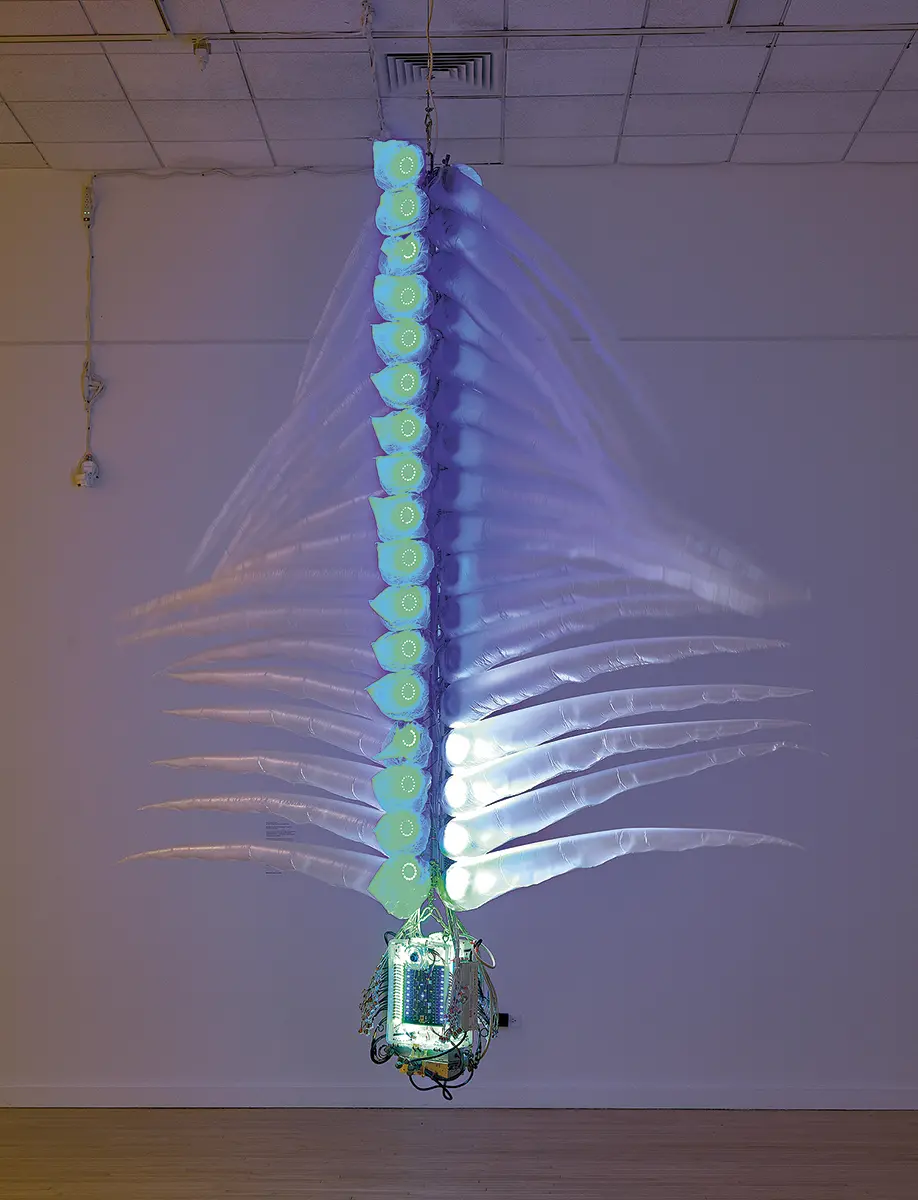
Nothing could demonstrate this better than one of the most impressive visual and kinetic pieces in the exhibition, whose 14-foot length hangs from the ceiling, lights up in bright colors and makes noise while it expands and contracts. Shih Chien Huang’s mysteriously titled VT-34-BTB (Blue Angel Eye) (2017-2018), is typical of his work in that he constructs the most “high-tech” piece in the show but in combination with definitely low-tech materials. Here the tentacles of the piece that extend into space and then collapse are made from thin-film plastic baggies that cover bright glowing LEDs of blue, red and white. If Huang followed his normal procedures, even the wiring and synchronized timer are made from rewired parts and of course are housed in a Tupperware container with apparently useless indicators.
That his works are referred to as “organic” and “magical creatures” was fully confirmed when a teacher’s aide ushered in a group of very young children and had them extend their arms and inhale and exhale in time with the work…the giggles and “oh-wows” were additional. Silly and perfectly logical! It also completes the circle since he began modifying toys at age twelve when he moved to the US.
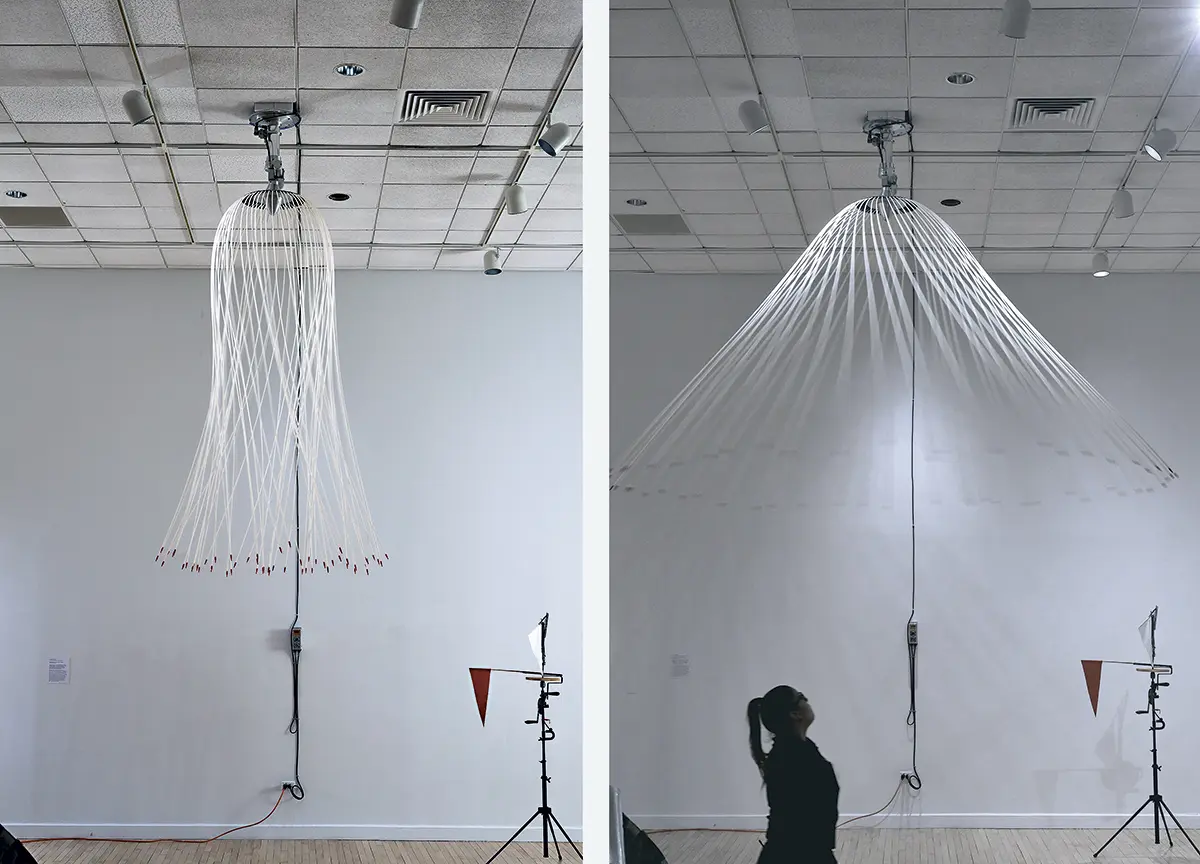
Mosquera argues that kinetics were of secondary concern to his uselessness, but yet many of the works move in both spectacular and quiet ways. The most dynamically active is Arnaldo Morales, Tentaculosa No. 12 (2012). Its red-tipped white plastic rods also cascade from the ceiling, but thankfully stop well above average head height. Fortunately, because when the spindle to which they are attached snaps them into circular motions left, then right, the heavy industrial strength plastic swirls out to 16 feet in diameter with not only noise but danger. Only the security guards can activate the piece with a key and a large red button. But you have to ask them to do so, which is an interesting way to leave interaction optional and for the aggressively quizzical.
Kinetically quiet and far smaller but equally impressive are Adriana Salazar’s three mechanical installations. Each of the two Careless Machines (2004) have an extended, moving armature that holds “shot” glasses that move towards each other as if to clink them together in a toast to something. But they are misaligned and never meet; drunken machines that stagger through time. My favorite was the smallest, her Machine that Tries to Thread a Needle (2005), which like the toast glasses, never does it, at least not while I stood there. The activation switch is on the side of the pedestal!
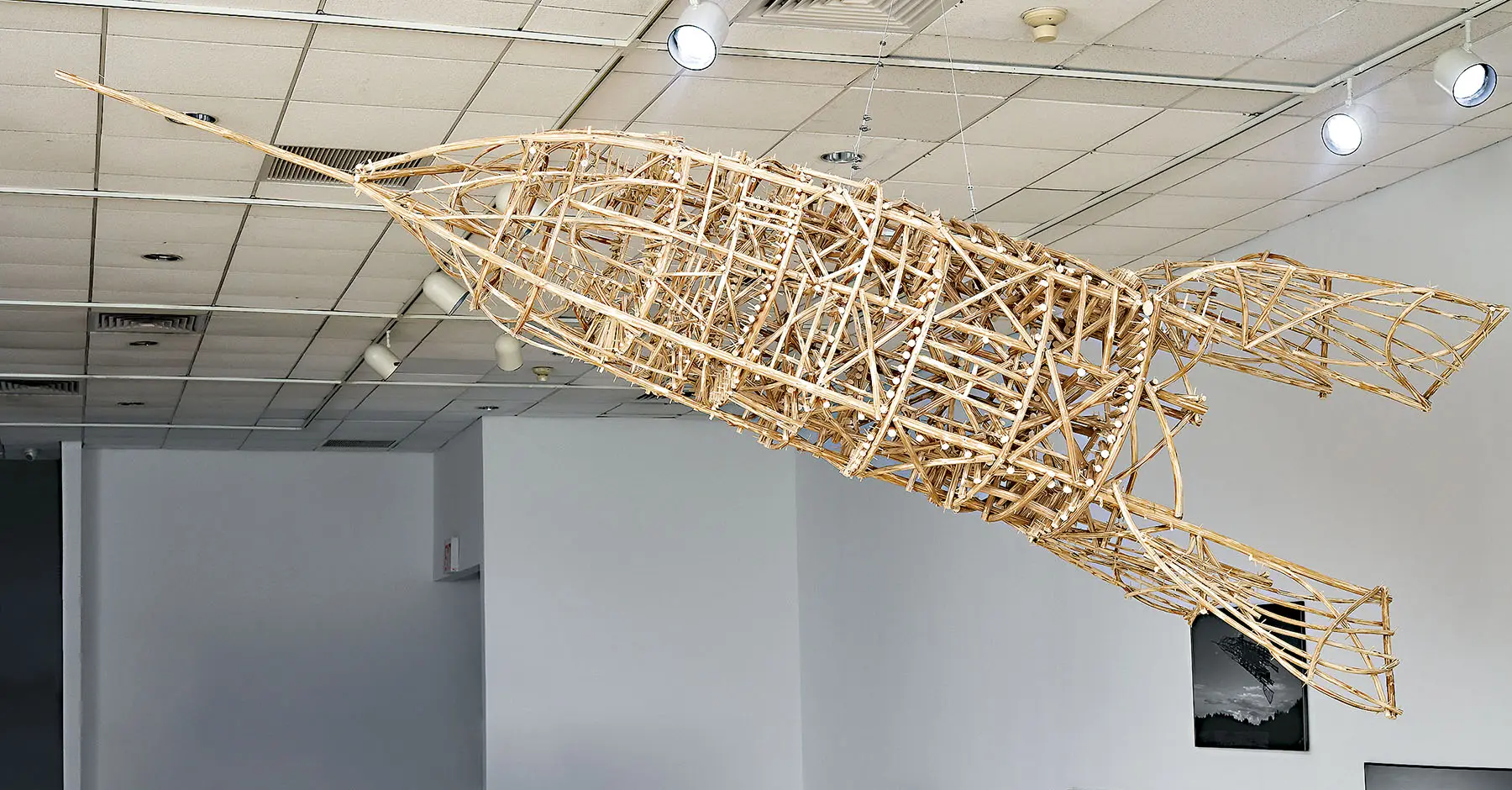
Perhaps the most audacious is an installation that does not move at all, except in our imaginations. The Lithuanian artist, Algis Griškevičius, has a long history of nonsense. Here, his hand-constructed wooden glider (Airship of Illusions, 2017) hangs suspended from the ceiling combined with five black and white wall mounted photographs. The glider is of course not usable, for many reasons, and he pokes serious fun at the whole Leonardoesque concept through the first photograph titled The First Lithuanian Astronaut (2009) that is a rear view of a naked man whose outstretched arms link to a heavy wooden construction that looks roughly like wings, whose support poles are buried in the ground. But he does look skyward in anticipation. Illusions? Perhaps. But certainly, the wings of imagination in which we have all flown. The last photograph shows him in the glider like a cocoon come to rest, floating peacefully on water.
As conceptually funny and as consciously careless as are his construction processes, they are purposeful strategies, and he objects to so much art that has degenerated into “entertainment.” The creative process, he argues, “is a serious work.” And of course, this is to the point of the exhibition: the use of uselessness, a concept much in vogue in the era of multi-tasking and helicopter parents, is to allow imagination to work. Dreams have work to do.
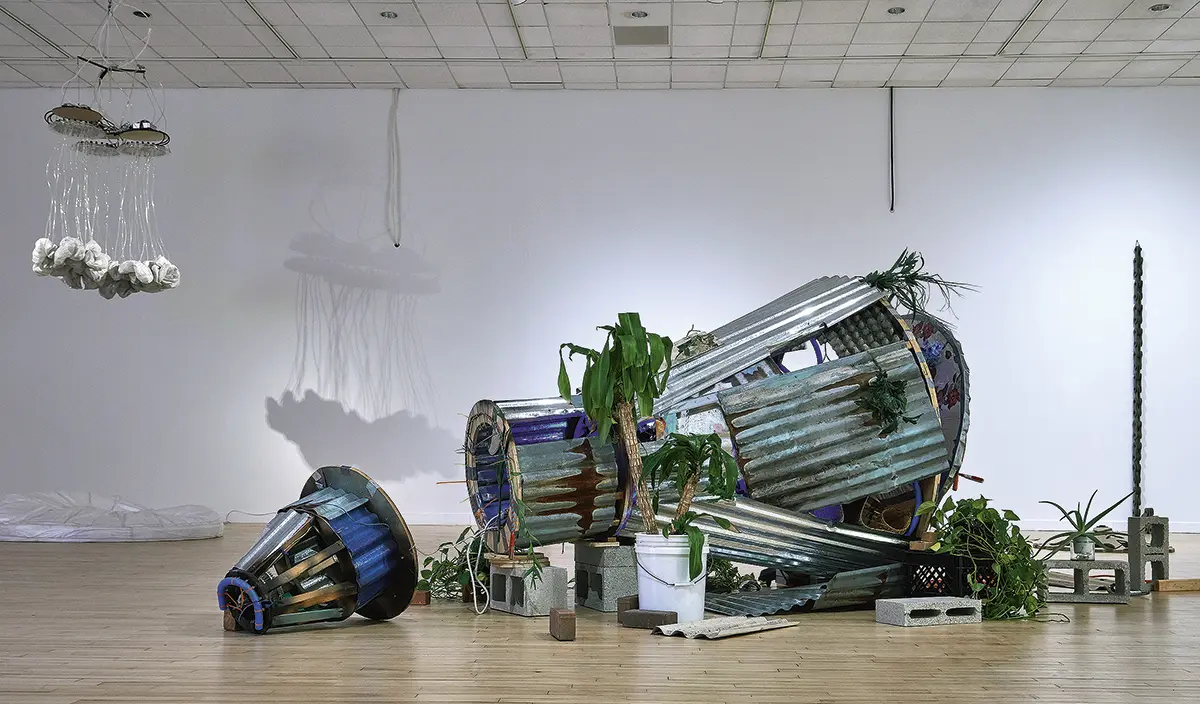
The centerpiece of the second gallery holds the sprawling installation by the Salvadorian artist Simón Vega, Tropical Mercury Capsule (2010). Apparently, the space capsule has crashed to sprawl across the gallery floor, or to judge by the concrete blocks and flora (made from plastic), more like in some junkyard, thus now useless. He assembles structures from commonly found materials that are purposefully kitschy and low-tech–a plastic pilot’s chair, cheap tin roofing sheets, etc.–to invoke historically known objects that have geopolitical overtones. But in this case, the reference, one common for him, to Russian (and NASA) space travel, conceptually works against the very premise of the exhibition despite the uselessness of its phenomenal physical presence. Such conceptual cross-currents are at work elsewhere against the exhibition’s intentions of uselessness. But this seems inevitable given that each work has a different level of communication and interpretation. Mosquera is aware of it and writes in his essay of several tensions, usually phrased as the different functionalities in contrast “between utilitarian technology and art’s ‘inutility.’” Those differences include conceptual connotations. One example of such multi-layering, among several, comes to mind.
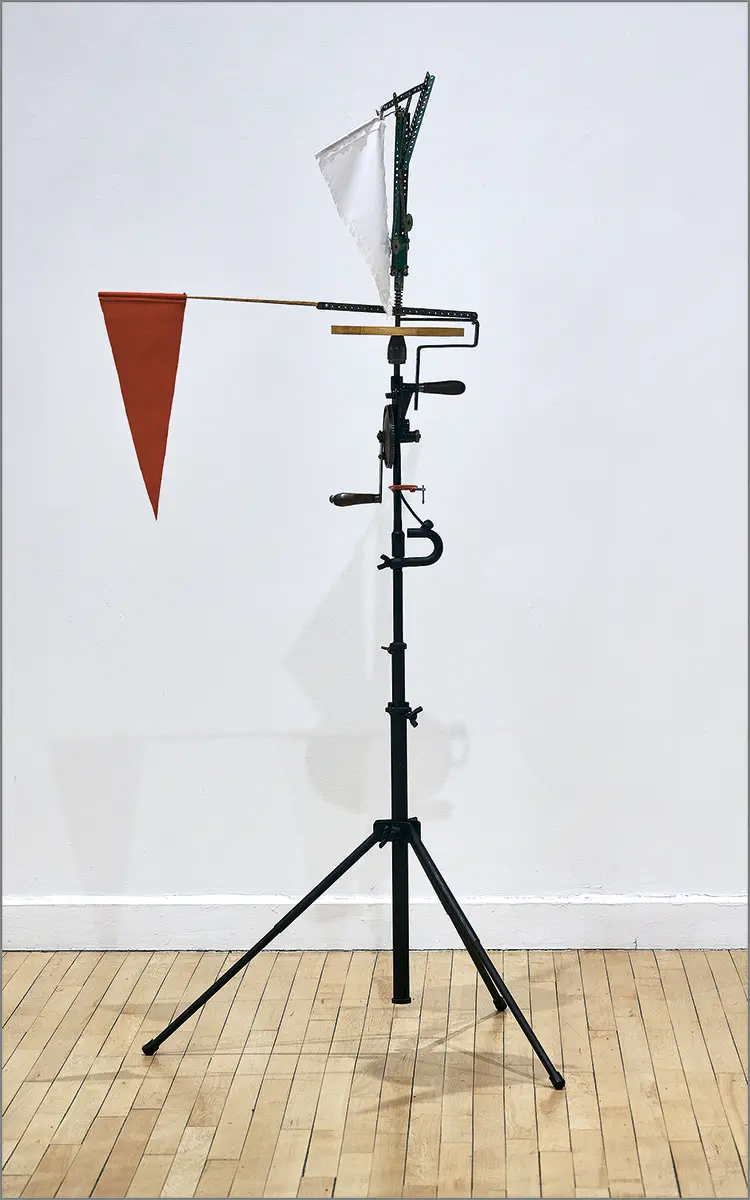
The well-known and politically oriented South African artist William Kentridge is represented by two subtitled mechanical sculptures Mecanno Sculpture (2011) and Wooden Kinetic Machine (2013), installed side-by-side. Essentially, they are small replicas or creative interpretations of Russian Constructivist sculptures of metal and wood set atop small flat planes mounted on tripods at eye level. Each sculpture has a small cloth flag attached, red colored on one, white on another. The flag colors are recognizable as the opposite colors of the Russian Mensheviks and Bolsheviks who squared off in the Russian Revolution. The flags unfurl and wave when you - the security guard, not you -crank the handles mounted on the tripod under the sculptural platform. And here’s the rub; the cranking mechanisms were those similar to the old-fashioned hand-cranked mechanical egg-beater or hand-operated drills. Why so amusing? Not only do they fit well Mosquera’s curatorial decision to go with low-tech mechanics, but it references the central problem of the Russian Revolution: advanced ideas without the industrial capacity to carry through with their plans. The point is that the uselessness, in this case, is equally embedded at the connotative level, the historical associations that many would miss but are nevertheless present.
And what focus on uselessness would be without three of the most iconic examples, all made by the well-known and established artists. Roxy Paine’s machine-made extrusions of low-density brown polymer look like just what you would expect. They are here in six examples of his “abstract” forms from the 2011 series title SP-P2-Mar, but without the machine that produced them. His life-long interest in juxtaposing the organic or natural, often indexed to “art,” against industrialization, exemplifies one of the sub-themes of the exhibit.
More directly implicated and deep into “feces” is Wim Delvoye’s infamous Cloaca machine but here in a miniature version as a Travel Kit inserted into a travel suitcase with wheels. His versions, large and small, mechanically mime the way the human digestive system works. In contrast to some of his installations, this one is not fed nor actually processes food, so it is product and odorless free. In this case, what is inoperable moves the concept of uselessness to another and, in this case, a more hygienic level.
Of course, almost required in this context is a 30-minute version of Peter Fischli & David Weiss’s hilarious and legendary film “The Way Things Go” (1987). I cannot remember how many times I have laughed and chuckled my way through its carefully contrived serendipity of cascading parts, a larger art studio version of a child arranging tiles or dominoes to tip into each other across the floor, albeit a more dangerous construction.
I do believe the greatest and most relevant of the useless machines is missing. It was created by the cognitive scientist Marvin Minsky, eventually, a founder of Artificial Intelligence, in 1952, while a graduate student at Bell Labs, was working under the father of information theory, Claude Shannon. Known at the labs as the “useless machine” it was a wooden box that used a doll’s arm that reached out to shut itself off. However, as a testimony to today’s times and Mosquera’s characterization of them as neoliberal with too great a focus on “utilitarianism and profit,” It is noteworthy that Minsky’s useless machine is now in a kit and the online orders are at an all-time high.
RICHARD LESLIE