
What is a border? What are borders for? Does anyone know the meaning of being Colombian or Ecuadorian, or what the difference is between being Venezuelan or Mexican? A person living on a border, an imaginary boundary, extends an arm across that dividing line and the hand is in another country, another government, another state, different from the one where the feet are. However, this person has lived all his/her life crossing borders, eating just like the people living on the other side, speaking with the same accent and the same “jargon,” having similar life experiences. There, in the boundary between two countries, it becomes clear that the border is as imaginary and strange as desire can be; the desire to live, to die, to love, even the desire to desire. In Hippias Major (or What is Beauty?), one of Plato’s dialogues, Socrates concludes—after approaching the theme from many directions and, not without some sarcasm, cleverly confusing Hippias Major in the process—that beauty is difficult. It is that simple and complex at the same time. Suddenly, if we are allowed to adopt that conclusion, we could say, to paraphrase Socrates, that a border is also a complicated thing. It is that simple and, at the same time, that complex.
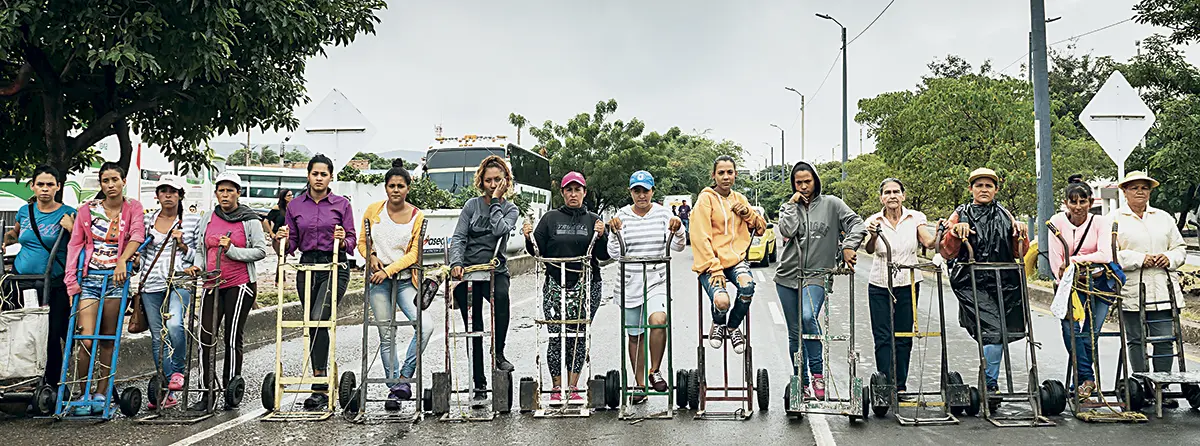
To get away from the politics between Colombia and Venezuela, we could place ourselves at the interesting border between Leticia (Colombia) and Tabatinga (Brazil). Both seem to belong to the same municipality, with the same laws, the same country, and identical landscapes and people. But one needs only to cross a four to five meters wide unpaved street to get to the other side of the border. We can enter and leave Colombia or Brazil as many times as we want in just a few seconds. That is why the border becomes something so complicated, something that manages political and bodily dynamics that do not sympathize with each other. Let us then refer to Deleuze and Guattari when they try to define the difference between the smooth and the fluted and compare them with the way territories are handled in chess and go games. Chess follows its own rules, its own limits, its hierarchies: chess is striated, and it handles war following specific rules, occupying clearly defined spaces in advance. Chess is an institution. On the other hand, in go, space is open, the possibilities of movement are endless because space is managed under different strategies than those of war. Space is smooth, it is a strategy without limits, it manages territories and “dis-territories” in continuous evolution.1 One thing is the State that governs a border issue, a country, just as it has been framed in a geopolitical map under specific rules similar to the territory and the hierarchies of the game of chess. Another very different is the person who inhabits the border and who, as he comes and goes, gives meaning to the territory he occupies or vacates. Its border is not the same as the one dictated by a central government. “Another justice, another movement, another space-time.”2
However, the fluted and chess-like government of the territory gains space, and what seemed so open to the ways we are living it ends up yielding to an indelible imaginary line drawn between two countries. If for many years the idea of the border between Venezuela and Colombia hardly existed, now it is a challenge, a before and after for thousands of people, a life-changing decision. If before a bridge was just a passage through the air, now it becomes a heavy, immobile, and absolute construction. Teresa Margolles approaches this place as a study site in which governments’ problems develop, and where there is a significant difference between having one foot in one place or the other. A place where flags of property, of xenophobia, of mistreatment, are waved. Where the sweaty shirt of a freighter or an assistant that allows the passage through indecipherable paths translates into bundles subject to substantial and rigid rules. Margolles shows us that the chess game demarcated by politics has generated different ways of defining the territory. In this exhibition, which is above all a sample of the fieldwork developed at the border, we can begin to see that the human being can always find his own ways of becoming in space, of evading the border, no matter how difficult.
NOTES
1. See “Treatise on Nomadology: The War Machine,” chapter twelve. In the book A Thousand Plateaus: Capitalism and Schizophrenia by Gilles Deleuze and Félix Guattari.
2. Ibid.
ANDRÉS GAITÁN T.