Prolific Peruvian photographer Sonia Cunliffe presented at ARCO Madrid an unsettling recovery of negatives: self-portraits from the 1940s that capture the sexual encounter of two autumn lovers. The exhibition was selected by critic Gerardo Mosquera for the proposal titled “Body. Eros and Politics of PhotoEspaña-Trasatlántica” in Miami (2012).
From the prehistoric ideal of beauty contained in the famous 300,000-year-old Paleolithic Venus figurines to the Nude Maja by Goya (1797-1800), the history of art also wages a battle between sex and its representation. It is a skirmish that compromises aesthetic standards, specific notions about gender, fertility, and even a morality disguised with fig leaves—in the paintings by Jan Van Eyck, for instance—or directly aggravated through prohibition. The censorship shown in England and Germany during the centennial of Austrian painter Egon Schiele’s death, in 2017, sadly resurfaced when, by erasing the image of the painting L’Origine du Monde (The Origin of the World, 1866) by Gustave Courbet from every timeline, the algorithm used by Facebook became the first cyber censor.
One cannot but wonder how come that this iconic realist painting by the citizen of Ornans, a work of art that revolutionized the depiction of sexuality in the history of art and that has been freely admired by people of all ages at the Musée d’Orsay, could not be shown on the social network. The Venus of Willendorf, a thirty-thousand-year-old sculpture on display for anyone who wants to see it at the Naturhistorisches Museum Wien, had also been censored by the site, along with the iconic Vietnam War photo of a naked girl fleeing napalm bombs. This type of censorship appeared to subside after the emergence of the #FreeTheNipple movement aimed at disassociating images of female nipples from the concept of pornography.
So it appears that the anatomically crude display of female genitalia divested of any literary artifice sparks an equally elemental fascination: we are only looking at what we are. Could this be then what we should not see? In 1940 an elderly Peruvian man guided solely by a telluric outburst of passion—removed from any discourse about the history of sexuality and the issues associated with it—decided to tie a cord to the shutter-release button of his photographic camera to capture a sexual encounter with his lover.
Angelical Pubis
Everything indicates that the explosive love between César and Paquita began during the wild and euphoric 1920s, a golden period that unfolded between the First and Second World Wars also known as the “roaring twenties;” a time of speculative bubbles and economic crashes that in Peru was also marked by revolts and larceny. Thanks to several notes written by César—in which he describes in detail his romantic encounters with the woman in question—it was also possible to establish that the relationship lasted until 1934. Soon after, it suffered its first fracture when Paquita married another man. For aesthetic purposes, though, which is what interests us, the affair is documented up to a late sexual encounter in 1959.
The cord tied to the shutter-release button is unavoidably present in several primary forms. We assume that the man pulls this cord time after time under the rhythmic spell of lovemaking. This is the connection between the act and his pupil, between the shutter that repeatedly fires at the seminude subject showing his penis and similarly phallic forms—a tie, for instance—in a series of shots the capture the point of view of a lover who directly gazes at the camera, a highly persuasive indication of his decisive sexuality. This point of view from the male subject objectifies the female partner by divesting her of any intimacy as she is exposed to the microscopic scrutiny of the anonymous viewer.
The result reveals a soft female lover subjected to the gaze of an impulsive photographer-voyeur who systemizes every encounter and transforms it into a memorial of desire; making lists of the furtive encounters, detailing every advance and impulse, turning every silver halide into tangible proof of his exploits. It is the burning block of an intimacy perpetuated through one-hundred 35mm negatives that had wandered aimlessly in the flea markets of Lima until someone showed them to Jorge Bustamante, a local antique dealer who facilitated their delivery to the hands of artist Sonia Cunliffe. She used this material to develop a tripartite project: a table with documents, an installation, and a book-object.
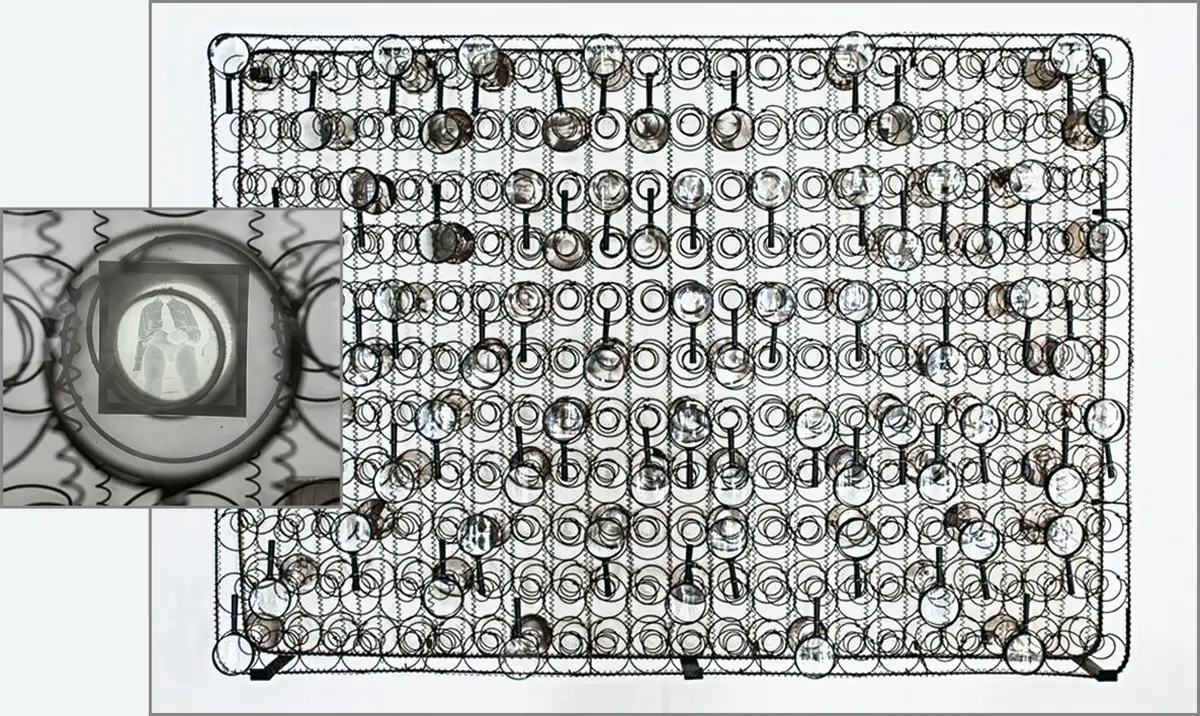
In the first section, there is a large file consisting of a series of letters, diaries, and undeveloped negatives. The table is built on the springs of a square and a half cot that supports the photographs of both and the letters they exchanged. Also deserving special attention is a table with documents built on the base of a spring-studded small mattress. There Cunliffe, a news photographer, contextualizes the romantic relationship, including a sort of charcoal Kamasutra created by César. But the real seduction is contained in the images shown through a succession of magnifying glasses placed on the mattress coils. This is the filter that enlarges and brings together the otherwise incandescent series.
Eros and Otherness
That the images remained undeveloped for more than fifty years—well after the death of Paquita, in 1960—is a mystery that generates plenty of hypotheses. Was it because of an explicit request, extreme modesty, or a pact to develop them only in the darkroom of memory? Also subject to speculation is the fortuitous path that led this material into the hands of the talented visual artist. But the fact that the romantic session can be spied through the magnifying glasses inserted in the mattress springs as if they were keyholes says a lot about the approach to the artistic occurrence proposed by Cunliffe.
Thus, the crux of the whole thing is in the support. There, the different aspects that frame sexuality and overflow it are woven: the construction of the stereotype, taboos about age, the history of copulation and its construct; all of which intensifies the metaphoric charge and confronts viewers with their bodies, their own pleasures, and prejudices. The mattress created by Sonia Cunliffe builds an alternative story and proposes a challenge for its approach. Would he be the one who decides the order, degree of closeness and details, fostering the evocation of a discourse charged with meanings: yes, the mattress carries the vestiges, but viewers are in charge of directing the actions.
The final and unavoidable reading will have to do with one of the great reasons for art, with the great spirit that briefly inhabits every human being, expressed through symbols that allude to the temporary and decisive nature of the journey that is life. And if this translates into fallen flowers, rotten fruits, and sand clocks—vanitas artworks, clearly—then Sonia Cunliffe deconstructs and subjects the erotic collages of a man bathed in pheromones to intersubjective knowledge. This is what “A Man and a Woman” essentially is, an exhibition that is completed with a highly explosive discovery: the pubic hair of the female lover classified by her irreducible lover.
That is, precisely as Courbet did. Like the lovers of Magritte. Like any act that considers the human body the best work of art.
CZAR GUTIÉRREZ