Ricardo Lanzarini (Montevideo, 1963) exhibited his work for the first time in 1992, and since then his career has included a significant number of local and international solo shows, as well as invitations to numerous contemporary art biennials in Europe and the Americas. Lanzarini’s oeuvre encompasses drawings, sculptures, urban interventions, and installations, with an emphasis in the last ten years on the conceptualization and development of site-specific projects.
Lanzarini’s strenuous activity emerged from the start in connection with the familial environment, and very soon began to dialog with the historical era and with his country’s socio-political situation, in the context of a world undergoing profound transformations. It is not merely incidental that his earliest works first appeared after the fall of the Berlin Wall and the implosion of the USSR, just as democracy was returning to Uruguay. In that sense, Lanzarini’s installation Ensalada rusa (Russian Salad) (Museo Blanes, 1995), which depicted a kind of wake for Lenin, clearly indicates the world in which his oeuvre begins to emerge. Gabriel Peluffo, the museum’s Director, suggested that Ensalada rusa “reformulates the problem of artistic language from a transgressive standpoint, bordering on the language of politics.” 1
Years later, Lanzarini stated that he sees this work “as the farewell to an ideology that made us all closer to humanity and to those who had given so much for it.”2
In a way, and following Eric Hobsbawm3, Lanzarini—born in the middle of the “short century”, the 20th century, and having lived through the long decade of the Uruguayan dictatorship (1973-1985)—could be characterized as an artist who begins the transition to the 21st century to settle, in its current stage, with an utterly contemporary work that maintains the political burden rooted in its origin. If before 2000 his production was marked by cynical humor concerning the political-ideological rigidities, today his world is the presentation of a look that-without losing humor-invites us to think. It is a game of participatory virtuosity, where the other, meaning us, completes the work by looking at the reality and the surrounding space in a way that modifies us, enriches us, transforms us.
Three periods have been proposed to understand Lanzarini’s evolution 4: an early period through the year 2000, a second period through 2010, and a third period covering the most recent years. While we can agree with this temporal sequence, the artist himself has shown that his work does not follow a linear development; instead, his works come and go in a sustained internal dialogue that revisits earlier proposals, transforming and giving them new meanings in the process. Something along those lines happened with the objects in his installation En el baile (At the Dance), first presented at the Museo del Cabildo de Montevideo, in 1994. At Lanzarini’s 2008 exhibition at Xippas Gallery, it was meant to relate to one of the pieces in the Artefactos series, a group of sculptures he began to develop in the 1990s, reengaged and reformulated for the 5th Moscow Biennial (2013), that has since become a central element in his site-specific installations.
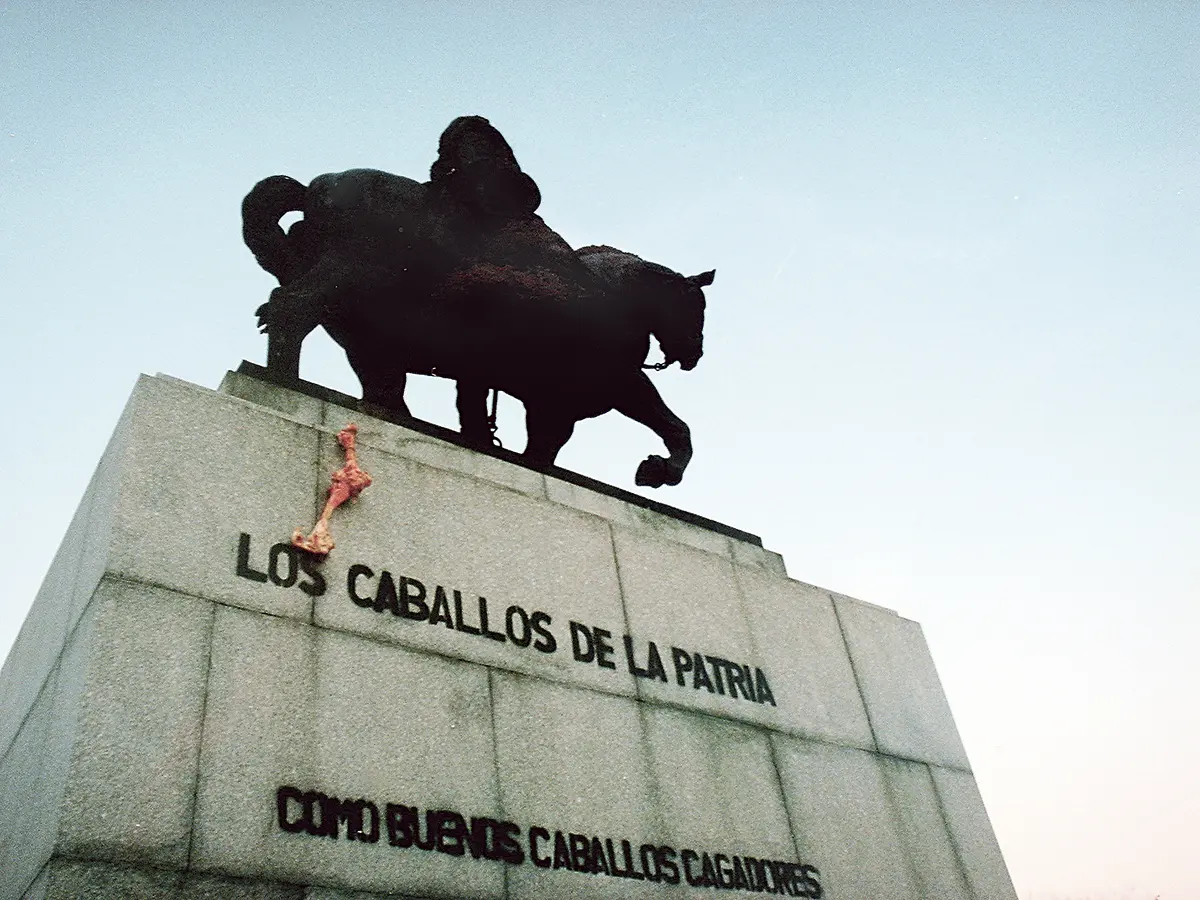
Summarizing Lanzarini’s career is not an easy task. What complicates it is the fact that his installations, drawings, and urban interventions at times come together and at times are shown independently, but also the fact that his proposals are interventions on what happens in the now of the work, while at the same time gambit beyond the instant of their production. In that sense, projects like his intervention on the Aparicio Saravia monument in Montevideo, which memorializes a Nineteenth-Century historical figure closely associated with one of Uruguay’s oldest political parties, could be understood as a circumstantial political act (which is how the justice system that processed the artist saw it), but in fact it goes farther. In a press conference about his intervention on the monument, Lanzarini described it as “an art action and civic reaction that interrogates and challenges the political body as a whole.” 5
This is central: the artist is not alien to the sociopolitical situation in which he lives, but his production is always “an artistic action.” Some of this can be summarized by going back to the heart of “aesthetics” because “est/ethics” implies, in an unavoidable way, ethics and aesthetics, values and art.
Twenty-First Century: Irony and Social Awareness
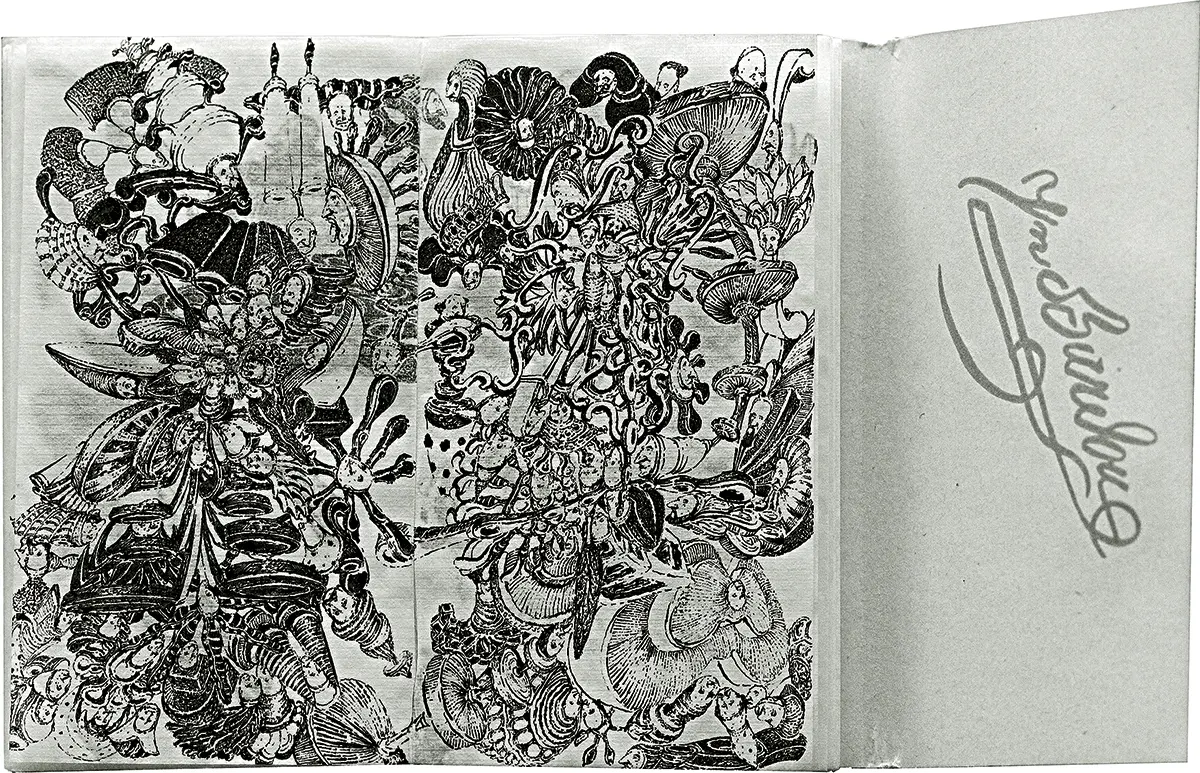
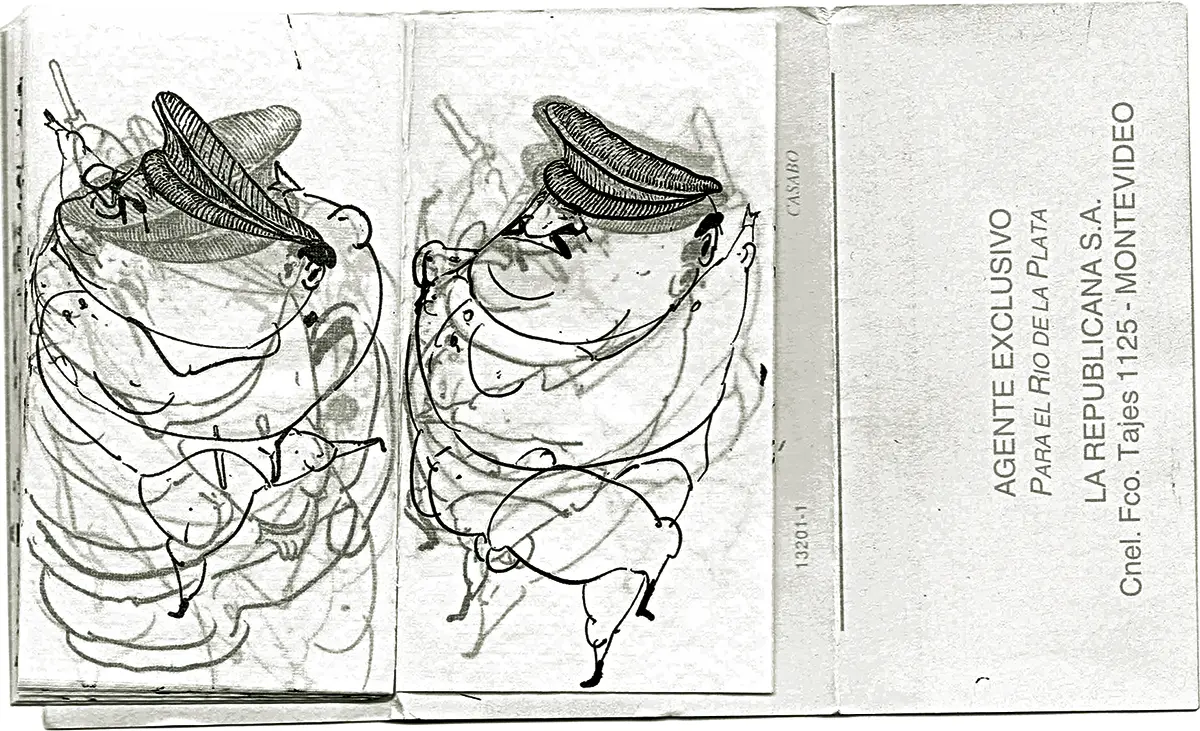
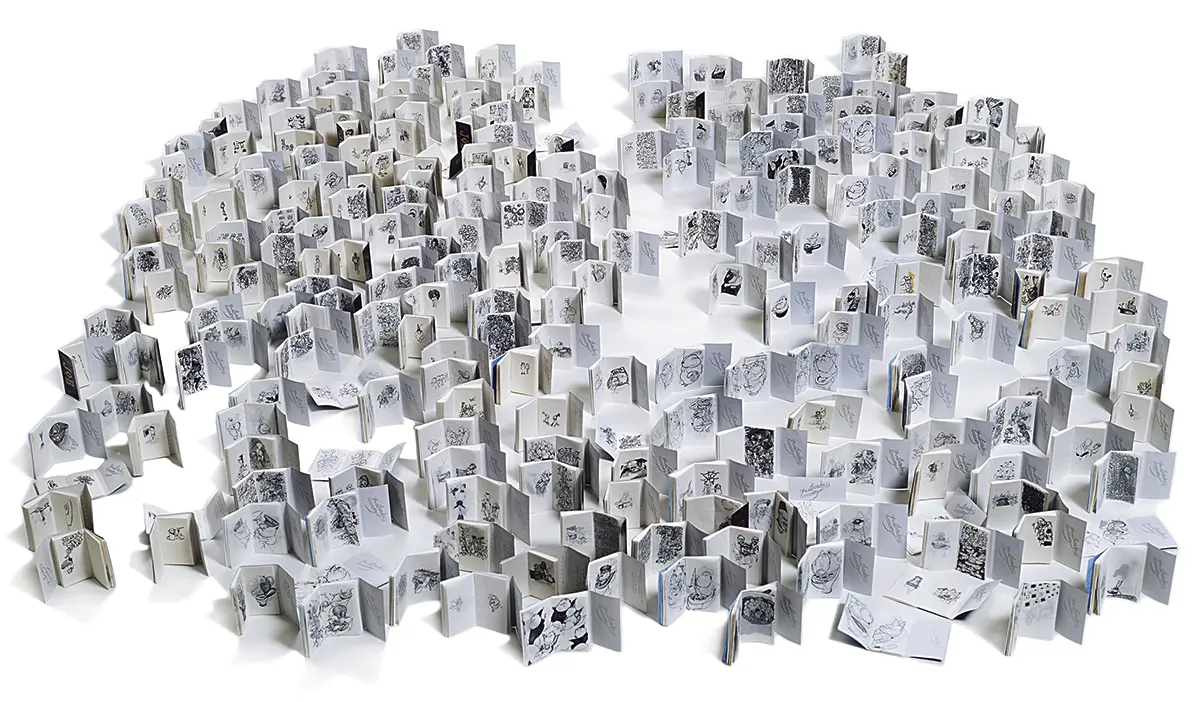
In recent years, Lanzarini’s participation in biennials and exhibitions has featured drawings, installations, site-specific works, and ambitious projects such as La Colección Job (The Job Collection, 1994-present). This work was presented at the18th Biennale of Sydney, “All our relations,” as part of one of the event’s main exhibitions, subtitled “In Finite Blue Planet.” Lanzarini’s installations include drawings, and in some cases—such as La Colección Job, made of hundreds of leaflets used to make cigarettes by hand, drawn with characters (human or not) satirized in tiny dimensions—end up becoming a “summa” or “compendium” of the artist’s universe.
This word of drawings at a small/minimal scale appears not only in Job but also in a large portion of his current, meticulous and detailed work. Although one might be tempted to think of a Baroque proposal or a sort of horror vacui, the work of Lanzarini does not go that way. Maybe it rubs it.
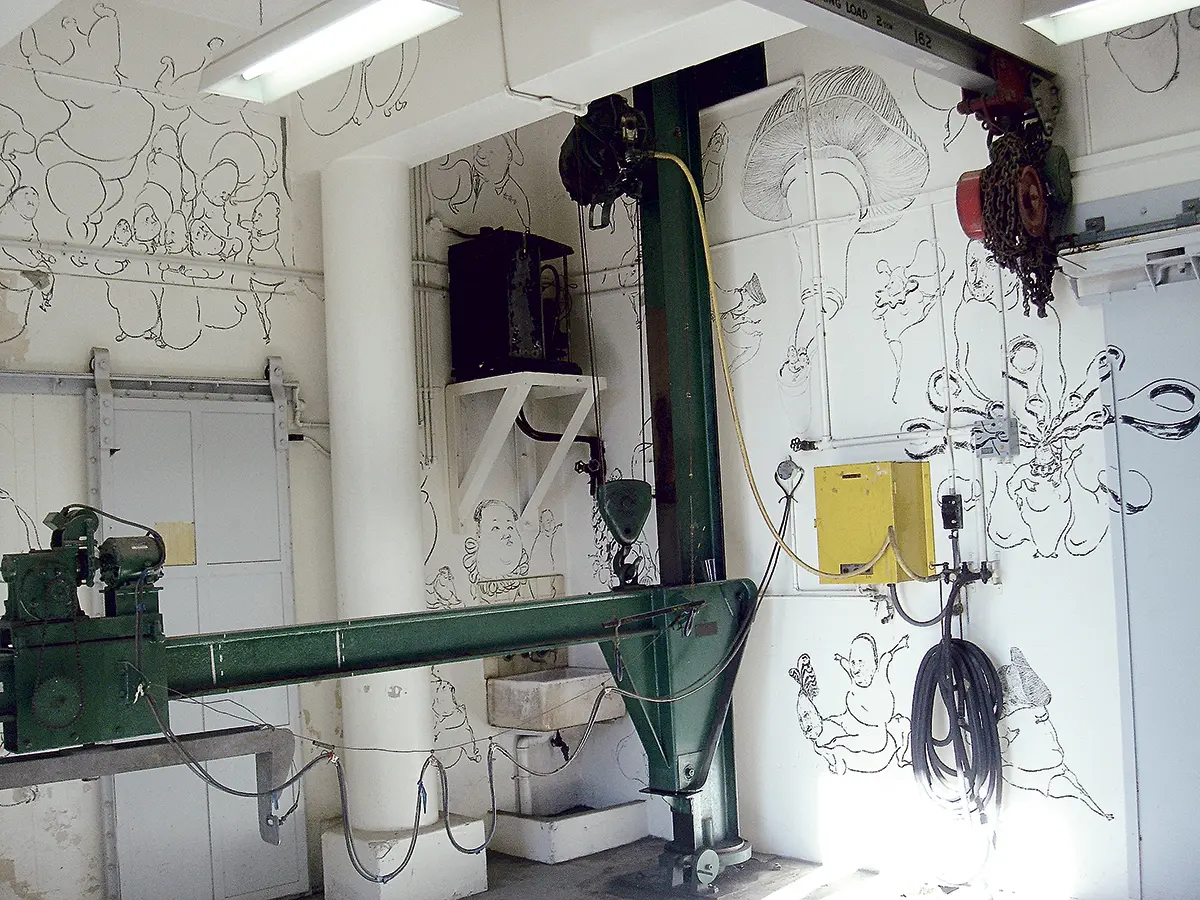
Perhaps, because the acid and sarcastic representations of contemporary society’s personalities-eternally contemporary—that populate his work—sometimes invaded by the remaining curls of sharpened color pencils-coexist with the enormous or gigantic lines that appear in the site-specific installation Arte con una carga simbólica en sí misma (Art with a symbolic charge in itself) (Bienal de Montevideo, 2012). These represent, in a baroque style, a group of “greedy-colossi” nudes that fight among themselves for a place to be displayed on the walls, or as if they were saying, in the words of Lanzarini, “Dance is the continuation of politics.”
The world or worlds on display in Lanzarini’s drawings speak not only to the artist’s virtuosity but also to a social awareness that challenges the eye (at times, a magnifying glass is required) and at the same time invites aesthetic reflection.
In Drawing People, the Human Figure in Contemporary Art (Thames and Hudson, 2015), Roger Malbert writes: “Ricardo Lanzarini’s images bear the traces, as he has said, ‘of the oppressive experiences lived under the Uruguayan military dictatorship of 1970-80’. The tumultuous overflow of tiny officers jumping playfully in interminable costume parades can be satire, but it may perhaps be best described as an act of revenge: to dispel demons through ridicule.”
Installation or device? Urban intervention or drawing? The answer is always the same: an artistic creation that cannot, must not be read in ignorance of the dialogs the artist sustains with the history of art and with socio-political history. Lanzarini’s at times brutal irony is the foundation of his production.
What does this represent?
In a talk titled Site Specific–Una experiencia aquí y ahora (Site-Specific–A Here and Now Experience), given at Universidad de San Carlos’ Architecture School, in Guatemala, as part of the 21st Paiz Biennial, Lanzarini wonders about contemporary art and its production. “The question about contemporary art is no longer: ‘What does this represent?’ but rather ‘What is this shit?’ In the former, the audience is located at a certain distance, while in the latter, they inhabit the question. They are inside the process and the undecipherable, enigmatic reality of the artist with his history, which they traverse with their histories as a starting point.”
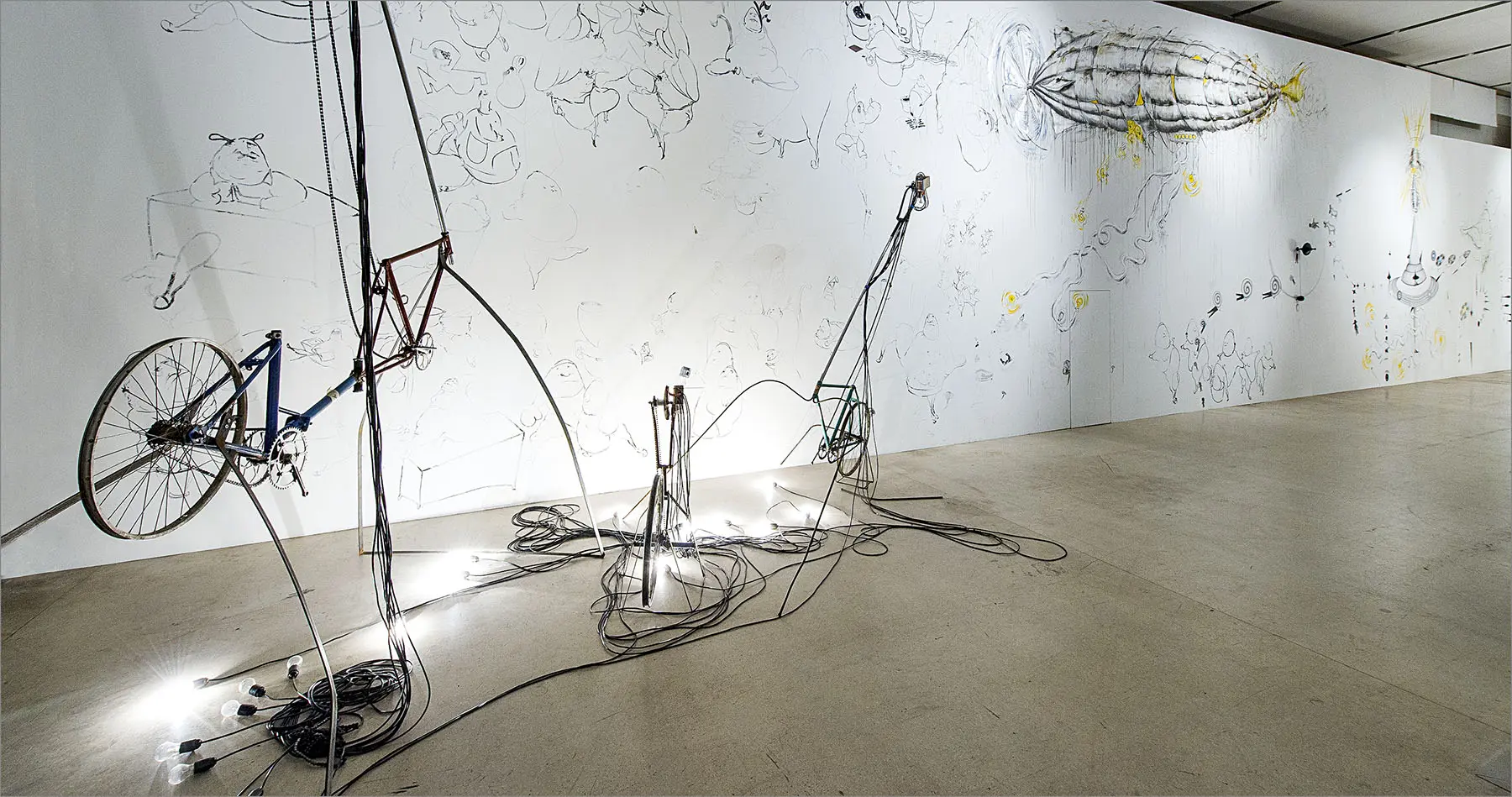
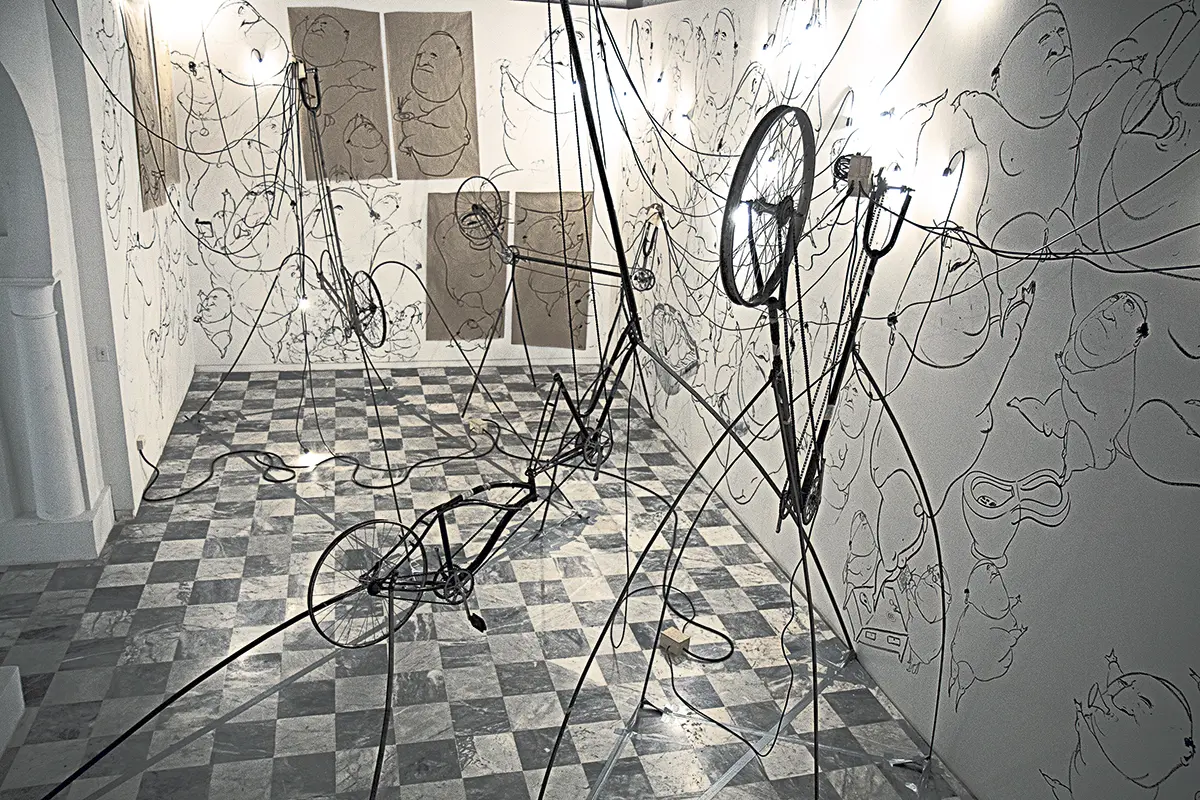
In Lanzarini’s installations, in particular, his site-specific ones, drawings of both large and minimal dimensions coexist with interactive devices that generate the work’s lighting, invading the space as an invitation for individuals to become creators and participants.
Metal sculptures made from fragments of bicycles and different everyday objects are also often integrated into the space of the installation. This was the case, for instance, of the works presented at the 4th San Juan Poly-Graphic Triennial (Puerto Rico, 2015) and the 21st Paiz Biennial (Guatemala, 2018), and even earlier, in a collaborative installation—Dialogic Drawing Experiment (Museum voor Schone Kunste, Ghent, 2014)—created with Andrea Bianconi (Italy) and Mark Licari (USA), where the audience’s interaction was vital. Dialogic Drawing Experiment also includes, besides a collaborative mural for the museum’s central vestibule, various pieces of furniture that visitors intervene. In Guatemala, visitors were invited to manipulate the light source in the interactive sculptures and to probe the installation and the walls, which allowed them to discover, and in a way create, their own work of art.
Lanzarini breaks through the so-called “fourth wall,” which Paulo Roselló describes—paradoxically when discussing Rothko—in the following manner: “‘Beyond the fourth wall (…) refers to the spatial ambiguity on display in his exhibitions. (…) It is the invisible barrier separating the actor from the audience, and breaking it makes it possible to establish lines of communication. Here, it is proposed as a performative device (...).”6
In Lanzarini’s, however, there is no hard border between illusion and reality. His exploration goes beyond what some artists attempted with kinetic art. Audiences’ intervention and participation are not focused on their motion, but in their integration into the work itself. It is not a happening or a work destined for contemplation; viewers are prompted to leave behind all passivity and make themselves protagonists and producers of meaning. 7
Representation does not disappear in Lanzarini’s installations; the drawings often included retain the traditional function of the gaze. Nevertheless, Lanzarini’s proposals feature—and here the art of the Baroque comes to mind again—an ephemeral element. Participant others (i.e., “us”) are part of the creation by their action, for as long as this action lasts. “Ephemeral art,” then, like is often the case with installations, which—well-known exceptions aside—last for as long as they occupy the space given to the artist.
What is all this? Emotion and reason, without a doubt. Reflection and play, but also a contemporary way of answering the questions: What is art in an era of accelerating shifts and mutations? What happens in this context to the dialog between art and society?
Is there a single way of making art in this era? Today, this last question has lost its meaning. Diversity, hybridization, a constant back-and-forth have rendered many categories and concepts finally inoperative, readying them to be rethought, reinvented, and transformed.
Lanzarini’s art invites us to think, to participate, to have fun, to see the world and ourselves without agendas, slogans, or bridles. It invites us to be free and to recover ways of life that combine humor, irony, and an awareness of society.
NOTES
1. G. Peluffo. “La utopía tomada por la cola”, in Ricardo Lanzarini. Catalog (Museo Blanes, 1995).
2. R. Lanzarini. Site Specific - Una experiencia aquí y ahora. A talk at the Universidad de San Carlos’ Architecture School, Guatemala (2018).
3. Eric Hobsbawm: The Age of Extremes: A History of the World, 1914-1991.
4. Adriana Gallo, Galería Xippas Catalog (Montevideo). April-July, 2018.
5. R. Lanzarini. Site Specific - Una experiencia aquí y ahora. A talk at the Universidad de San Carlos’ Architecture School, Guatemala (2018).
6. Miriam Paulo Roselló. “Más allá de la cuarta pared: espacio, repetición y perforamtividad en la obra abstracta de Rothko”. (http://congresos.um.es./filosofiajoven/filosofíajovenen201/paper/viewFile/6941/6661).
7. Lanzarini’s installations differ from Le Parc’s La salle de jeux ; audience participation is considerably different. (http://www.julioleparc.org/salle-de-jeux.hmtl).
HUGO ACHUGAR
Writer and cultural and art critic