The Print Center, a non-profit gallery located in the heart of Philadelphia’s historic district, presented two series by Seattle-based Peruvian artist Rafael Soldi. Soldi was one of the three winners of The Print Center’s ANNUAL International Competition, among the country’s oldest and most forward-looking such events. As this gallery focuses on exhibiting the work of local and international artists who critically test the boundaries of photography and printmaking, its selection of Soldi does not come as a surprise. He uses photography in eloquent and novel ways, as a vehicle to represent his identity, as well as his imagination and memory. Indeed, imagination, identity, and memory are not only Soldi’s personal paradigms, but also inflect the notions of the body in all adolescent queer subjectivities.
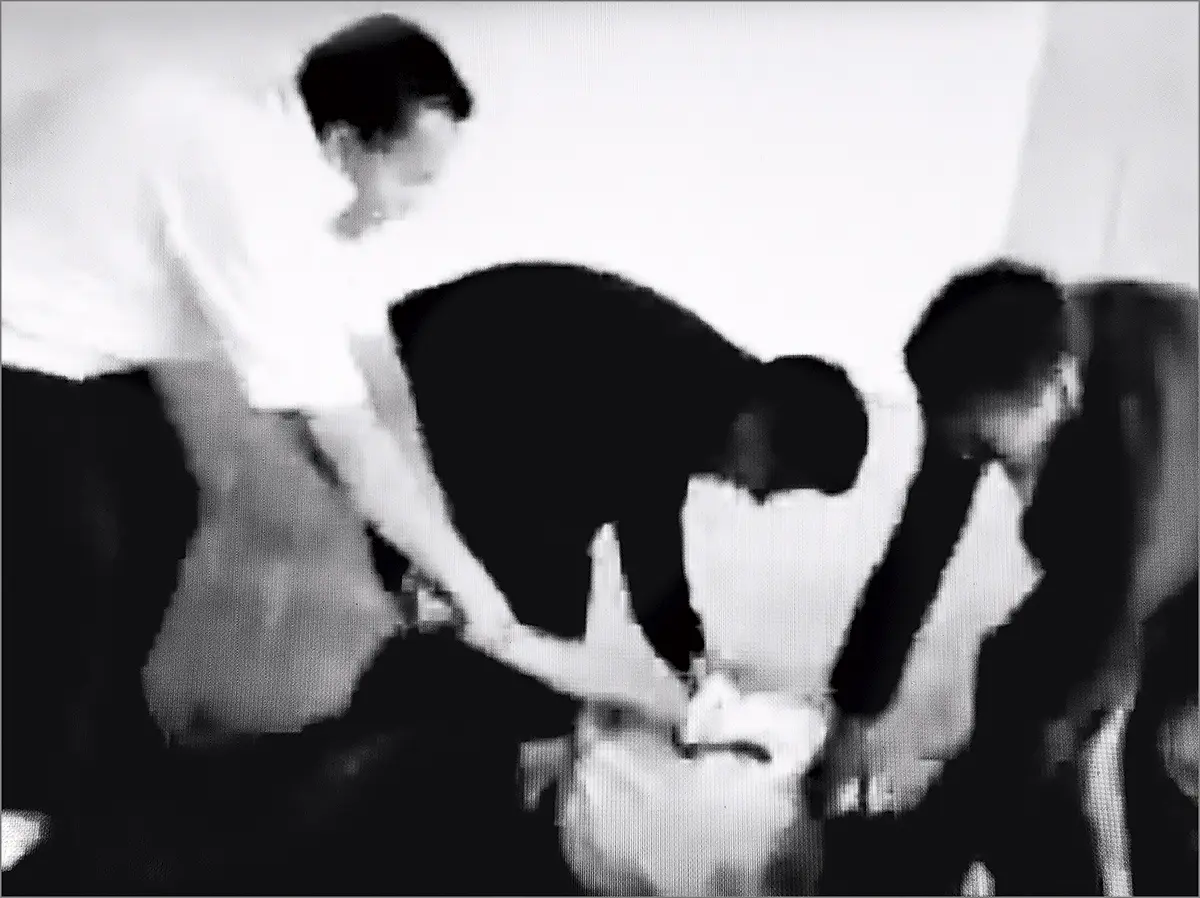
Soldi was born in Lima in 1987 and began his high school education at an all-male, upper-class Catholic school there. When his father, a renowned professional, was hired by the Organization of American States, the family emigrated to Washington, D.C. After completing high school, Soldi decided to remain in the United States while the family returned to Peru, and enrolled in the BFA program in Photography & Curatorial Studies at the Maryland Institute College of Art. He did not want to return to Lima and rejoin the patriarchal, upper-class milieu that had so often mocked him for his queer identity. He did not want to return to the stern Catholic city of his childhood, where sexual minorities were frequently assaulted in “playful” activities like the cargamontón. In the Peruvian vernacular, a cargamontón is a quick-fire physical assault by many against a single person. It is a common “game” among school children, with the victim finding himself under a pile of attackers. Thus, the bodies are in contact. They can feel one another, they twist and intertwine, they touch, and what begins as a spontaneous physical confrontation can turn into desire. It contains the potential to subvert the dominant heteronormative discourse, transforming it into pleasure.
Cargamontón is also the title of Soldi’s exhibition. Here the concept becomes photography, migration, memory, and identity. But in this case, photography is also mediated by social media and its potential for exchanging images and memories. Some time ago, Soldi received a Facebook message from one of his old classmates. This brought back photographic remembrances of his early adolescence. He then searched the Internet for images of cargamontón in Lima, showing children in school uniforms that signal economic and social privilege. These upper-class mestizo children are sometimes captured laughing, sometimes not; sometimes, they are left on the ground, and teachers must come to rescue them from the shame of their queer condition. One of the eight images in the Cargamontón series (2018), from which the exhibition takes its title, depicts precisely that child on the ground. That child is Soldi’s own memory and reality, as it is for many. The image represents the moment after, the consequences of bullying in a classroom corner. Soldi’s black and white photography underscores heteronormative Lima’s strict binaries. Some are on top, some are below. Some “belong,” due to their sexual identity, others don’t—and suffer the consequences, suffocating under a pile of bodies. Yet, that same pile of bodies is a source of desire and a longing for sexual freedom. It is here that bodies are the closest, it is here that they touch, and Soldi brings this ambiguity to the fore through pixilation. In this way, the pixelated aspect of his images signals both the distance of a childhood memory that reaches us through social media, on the one hand, and the abstraction of a desire that causes collective suffocation, on the other. Pain, desire, and body coexist. As The Print Center curator Ksenia Nouril explains: “For a young, queer man growing up in a conservative, Catholic environment, it was one of the few socially acceptable instances of physical contact.”
“Had I stayed in Peru, what would my life have been like?”, wonders this outstanding young artist in Imagined Futures, the exhibition’s second series. Created between 2016 and 2018, it is comprised of twenty-five almost identical photo-booth self-portraits. For Soldi, the question about the imaginary life left behind is a constant for all immigrants, and this, once again, renders his work an exploration not of personal, but of collective memory. In these portraits, Soldi’s eyes are closed. The artist photographing himself is not intent on seeing, but on imagining, and on doing so collectively. Ultimately, this is an exhibition where remembrance is also imagination, and what is imagined has the potential to become real. Photography is here the medium “witnessing,” serving as “proof” of that intermediate possibility: to imagine from a distance a conservative past where desire was, nevertheless, more than mere prohibition.
FLORENCIA SAN MARTIN