
In Cuba, there are two popular expressions associated with “la mata” (the shrub): “Go to the shrub” and “That falls out of the shrub.” The first refers to always going to the origin, the root of an issue and/or problem, while the second refers to something that obviously does not need explanation. Thus, “la mata” has become a sort of panacea or philosopher’s stone in the popular Cuban heritage: the origin, core, and solution of a problem.
La Mata (The Perennial Sprout) is the title of the exhibition presented at Fred Snitzer Gallery, in Downtown Miami. La mata… is a collaborative installation by Ernesto Oroza (Havana, 1968, lives and works in Miami) and Rafael Domenech (Havana, 1989, lives and works in New York). What these two well-established artists have in common is a concern with the environment, expressed in their use and resignification of the constitutive and the disposable matter of urban culture. It is precisely this interest in the interstice between production, recycling, and creation that leads to this installation of immersive character.
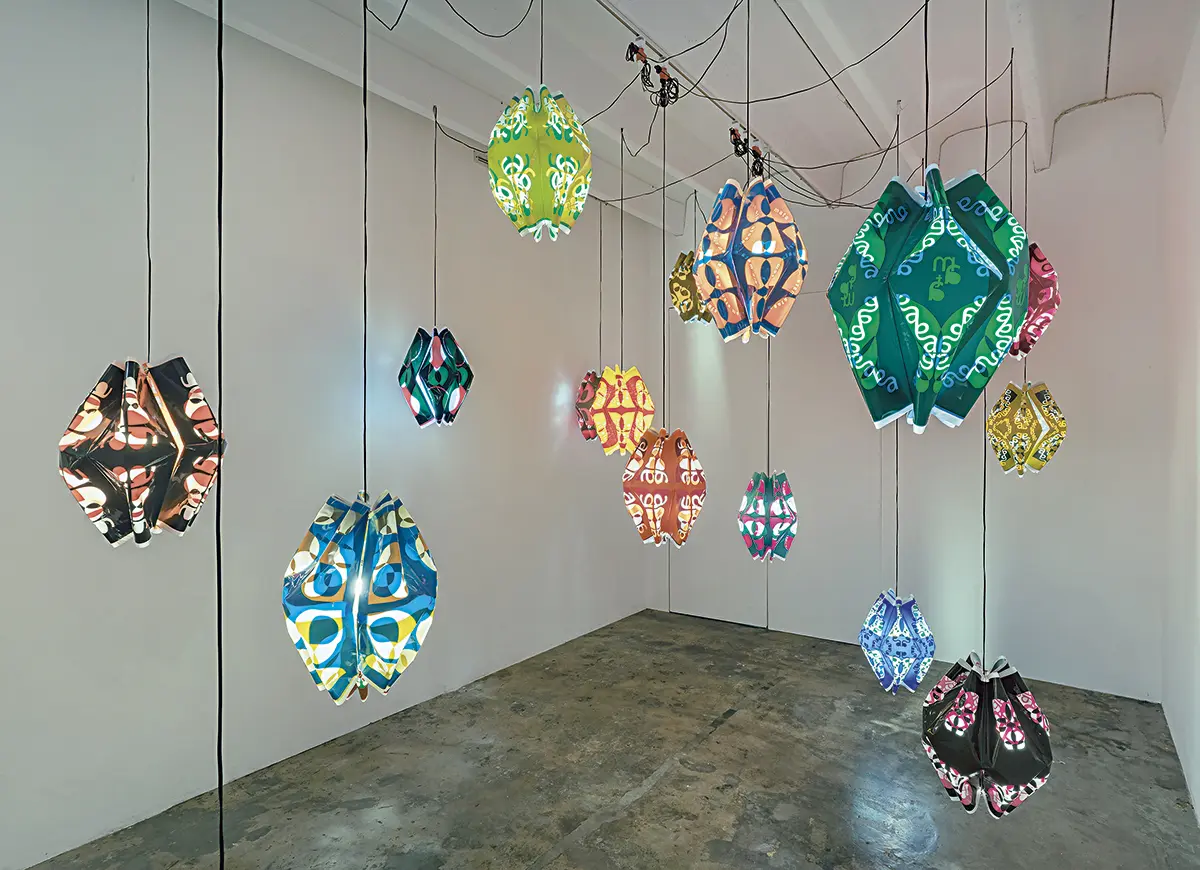
Motivated by the productive processes and materials that shape the urban environment, Domenech and Oroza take industrial vinyl or PVC—one of the modern industry’s most versatile and widely used substances—as their raw material, and Hialeah as their starting point. Florida’s sixth-largest city and the urban enclave with the highest proportion of Cuban-American inhabitants in the United States (more than 70%), Hialeah is an industrial and service town, where the demands of the industry and the savoir-faire of a community proud of its traditions and roots merge.
Morphologically, Oroza’s and Domenech’s installation assumes the typology of the fruit tree, understood as the metaphorical beginning of Hialeah’s industrial and commercial culture. Visitors move under a canopy of filtering light, made from a large number of colorful vinyl lamps—all unique—that hang from a tangle of cables/branches, like fruit ready to be picked. For those who know, the complex, at times haphazard mess overhead is also a clin d’oeil (wink) to the electrical-cable snarls often improvised in Havana as a survival strategy
Inside the warm, welcoming room, visitors must navigate between the various elements, hand-painted with geometric motifs. All the materials come from the local industry: vinyl, plastic, LED lights, electrical wires, and stainless-steel rods. Together they generate a kind of living, mutating grid with an ethical-aesthetic substratum.
La mata (The Perennial Sprout) must be situated within the vast tradition inaugurated by the Arts and Crafts movement in the late Nineteenth Century.
Born as a reaction to the first industrial style marked by the delirious and relaxed eclecticism, the Art and Craft proposes to rescue the artisan in the face of growing mechanization and mass production. At the same time, it advocates the coexistence between art and craftsmanship and the notion of aesthetic production that rejects the vacuous concept of beauty per se.
La mata looks like a metaphor and a tribute to the work by John Ruskin The Seven Lamps of Architecture (1851), where sacrifice, truth, power, beauty, obedience, and memory go hand in hand. Proposed, where the playful, the functional, and the ecological are inscribed within the flourishing contemporary neoartesanal trend.
JANET BATET