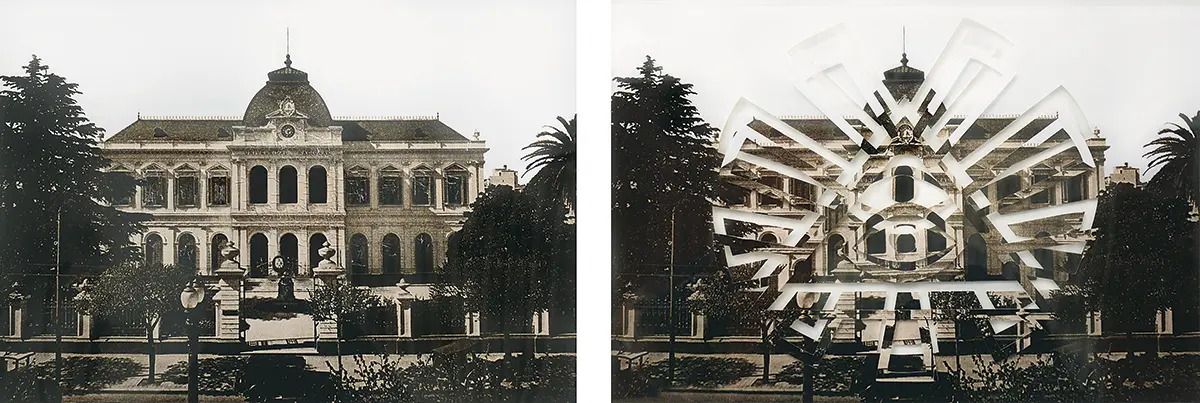
Paula Toto-Blake (1972) was born and lived in the city of La Plata, where members of her family still reside. The capital city of the Buenos Aires Province, the town was planned at the end of the 19th century following guidelines established by its founders, all members of the Freemason organization. From the plans, and in all the references to the urban grid intervened with diagonal designs, it is possible to observe a series of recognizable symbols associated with a fraternity that has been involved in the building trade since the Middle Ages. As curator Carina Cagnolo pointed out in her essay, “Its design reflects the awareness of a progressive period that favored the secular, ethical, political, and social values of the enlightenment.” The process for “The Symbolic House” derived from earlier series by Toto-Blake that evidenced the theme of temporality and its metaphysical implications in our lives as a focus point. She began by researching historical documents of the city, recovering some emblematic photographs of symbolic architectures that are monuments to knowledge and power: the Museo de la Plata, the Palacio Municipal and the Palacio Legislativo, banks’ headquarters, and the provost’s office building of the Universidad Nacional de La Plata. She verified that, initially, there were some distinctive iconographies on the facades, including precision instruments for drawing and measuring such as the compass, the triangle, the level, and the plumb. Despite being a native of that city, this data was new and encouraged her to rediscover other codes in things she thought she knew.
Paula Toto-Blake draws inspiration from essays by French philosopher Gaston Bachelard (1884-1962), especially from his theoretical framework centered on the analysis of forms of habitation and their variants, arriving at an interpretation of the house as “the other body” charged with human traces. Some of these meditations were present in some of her previous series, especially those exhibited in 2013 in the show titled “Fragility,” presented at the Centro Cultural Recoleta, in Bueno Aires. That exhibition shared with the current one the sepia tone of the photographs and the game of surfaces applied to the reproduction, but they differ in that the 2013 show was based on her own images of a cemetery in England. Tombstones covered with snow, very particular graves that represent that other house of existence, the one where human remains are laid to rest.
The very day of the closing of that earlier show was also the day that torrential rain, as well as the collapse of a retaining wall from a distillery, flooded a significant part of her hometown and caused severe consequences. Based on this terrible and unforgettable collective experience that also affected her family, Paula played to divest monuments of their power and authority by subjecting the recovered records to a process of isolation that eliminated any environmental references. She operated on them, assimilating the masonic symbols of the founding spirit and transforming them into fragments over the original image. This is cleverly described in the curatorial text: “As if temporality could only be framed by the physical trace of monumental concrete turned into scrap: the anti-monument.” The interplay between the cutouts and the movement through layers operates optically and aesthetically on the image. They are interventions neatly cut, and only in some cases she adds hammered methacrylate plates that make them even more fragile.
Presented in diptychs of similar dimensions, hung or in books, the images grab the public’s attention. The viewer must process them using several clues gathered from available data that renders the architectures. By bringing a fragment of the past into the present and combining it with her poetic universe, Toto-Blake makes us participants of a collective memory sensitively activated upon learning the history in question. The installation in the contemporary galleries of the traditional Museo Caraffa, in the city of Córdoba, was a wise choice. Through a set of articulations and exhibition tables for books, the pieces of this series are reinforced by the white of the wall, operating as silences in some sections, making the discursive emerge austerely from her proposal, which needs this muteness to be in tune with the paradox of the work. As in the memory, the past is reconstructed by new articulations, in which history ceases to be exclusively personal to be invaded by new meanings that the method operated by Toto Blake reveals, both from the dispossession and from the burden of disintegration, a hefty symbolic load.
PILAR ALTILIO