Retrofuturism gained a foothold in the basement level of the museum as if this revision of the conquest of outer space had transformed the building’s basement into a 1960s NASA operations room. A look into the past, varnished as art. The raw materials are documents (maps, video recordings, sketches, or satellite images) selected from the abundant archives of the United States’ National Aeronautics and Space Administration. The authorship of the works exhibited is shared, then, by the creators of those documents and artist Nicolás Sánchez, who screened them and arranged them.
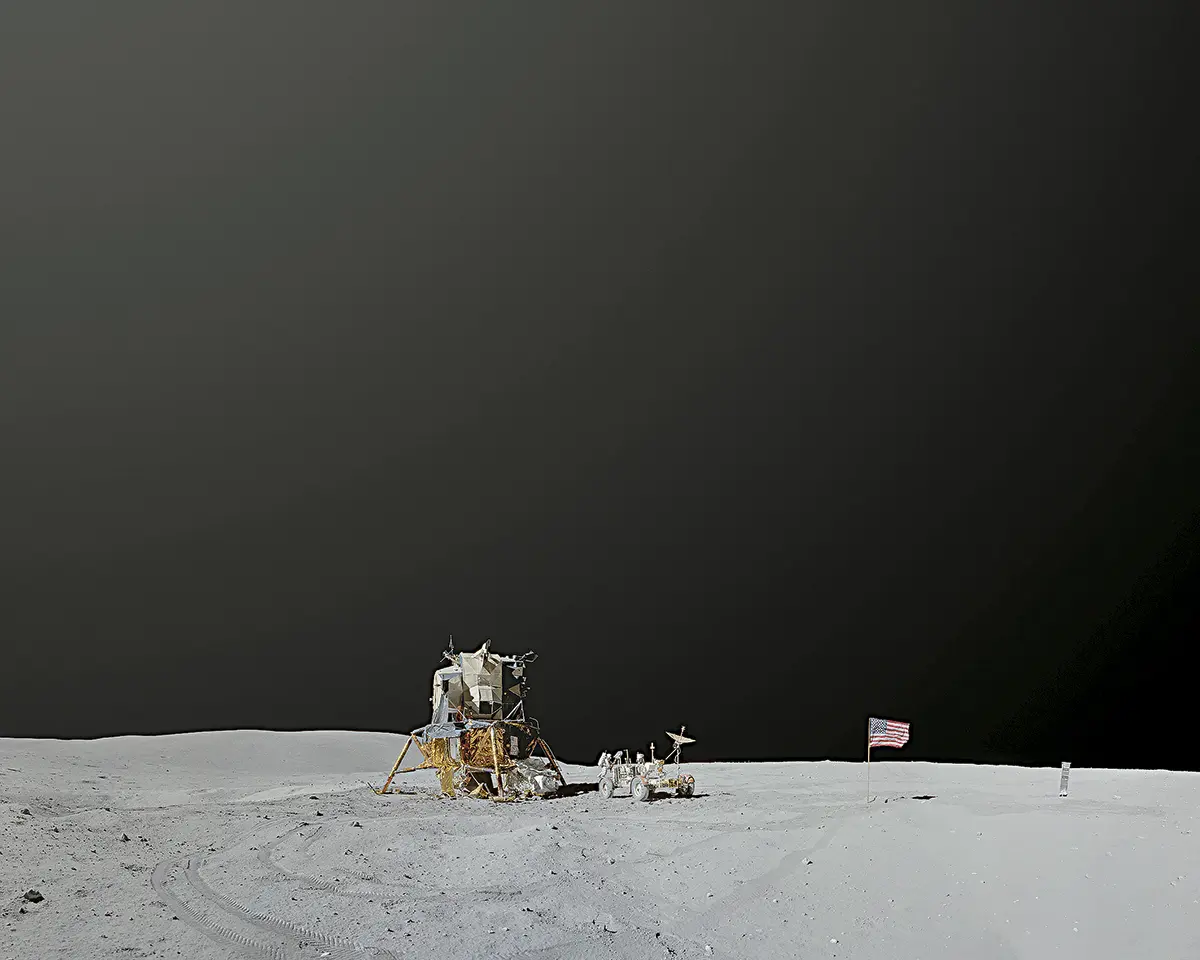
The first thing to note in this work of fictional archeology is the way it is assembled and set up, which seems adapted to the circular nature of the show’s protagonists: The Moon, its craters, and orbital flight. In the central area of the exhibition space, the screens of several old TV sets are arranged in a circular shape. “Facing out,” they broadcast images of lunar missions from the 1960s and 70s. The display brings to mind the work of Juan Downey, for instance, Video Trans Americas, from 1976, or The Circle of Fires, from 1979. The differences between both experiences are apparent: Downey’s proposal moved towards a ritual of recognition, raising doubts about the identity of the observer and the observed, while Sánchez attempts to experiment with the idea of technology as a medium through the use of old-style devices, in a cathodic exercise of nostalgia. Yet, there is a connection that goes beyond the mere installation of objects: in both cases, Downey’s and Sánchez’s, the stimulus is to approach something remote, a strange language, using an open representation. Illuminated from behind by the screens, we explore works arranged on walls or cabinets. Notable among the former are the aluminum-paper prints of images captured during various missions to the lunar surface. These are the most interesting works in the exhibition, and also those in which the artist’s intervention is most “invasive.” The extraterrestrial ground has a three-dimensional appearance and an artificial sheen that connects with the equivocal nature of the space odyssey. The exploits of the men who, more than half a century ago, set foot on the Earth’s satellite to appear so improbable even today that they could well belong to the realm of art—of fiction—rather than to the historical archive. Seduced by this ambiguity, Nicolás Sánchez limits himself in the remaining works featured here to the role of selector and rebuilder of images, using photographs taken—blindly, since their cameras lacked viewfinders—by the twelve astronauts chosen for glory. The intention behind this effort to reconstruct panoramic views by stitching together the astronaut’s incomplete snapshots, to generate a full vista of what visitors to the Moon really had before their eyes, is to evoke the vertigo they must have experienced as they confronted the vastness of space. To underscore this sensation, Sánchez introduces two “alien” elements: Jules Verne’s From the Earth to the Moon and reproductions of two of Caspar Dier Friedrich’s “Lunar” paintings. The fascination, the imagination, the sublimation of man, tinged with romantic notes that remain even after his imprint has been left on the cosmic dust. Any viewer able to evoke the static attitude of Friedrich’s protagonists will perhaps also feel “brief flashes of beauty and terror,” even though Sánchez’s proposal is not notably—nor spatially—divergent from NASA’s original archive. In other words: except for those works where the artist’s intervention is evident, visiting this exhibition will not elevate our feet off the ground any more than what a documentary or a raw display of the original items, themselves already imbued with uncanniness, would.
JUAN JOSÉ SANTOS