The Hall of Fancy is the anthological exhibition by Max Gómez Canle (Argentina, 1972) presented at the Museo de Arte Moderno de Buenos Aires. A memory of memories, the show features twenty years of artistic production, including the most important works created by Gómez Canle between 1999 and 2019. Nearly 150 pieces, mostly small and medium-sized paintings, showcase his formal refinement and continuous exploration of painting. The show includes objects (made with copper, wood, and bronze) and architectural interventions (ornamental surfaces such as moldings, shelves, and other structures, walls protruding from behind the torn canvas) that always contemplate and reinforce the painting’s role as protagonist.
Throughout his artistic career, Gómez Canle has relied on the inexhaustible gallery of images of Western art history—Renaissance, Romanticism, Mannerism, Baroque, Surrealism, metaphysical painting—, explored the traditions of art made in Argentina, and examined illustrations from the digital universe (in pixelated characters), to build a mostly pictorial body of work. “I work decidedly and openly supported by my predecessors,” confesses the artist, who in this show gave free rein to his “caprices.” They are the ones that dictate his artistic autonomy, and the subgenre of the capriccio (Italian for caprice), broadly defined as an architectural fantasy with archeological traces, ruins, and other devices combined to the artist’s liking.
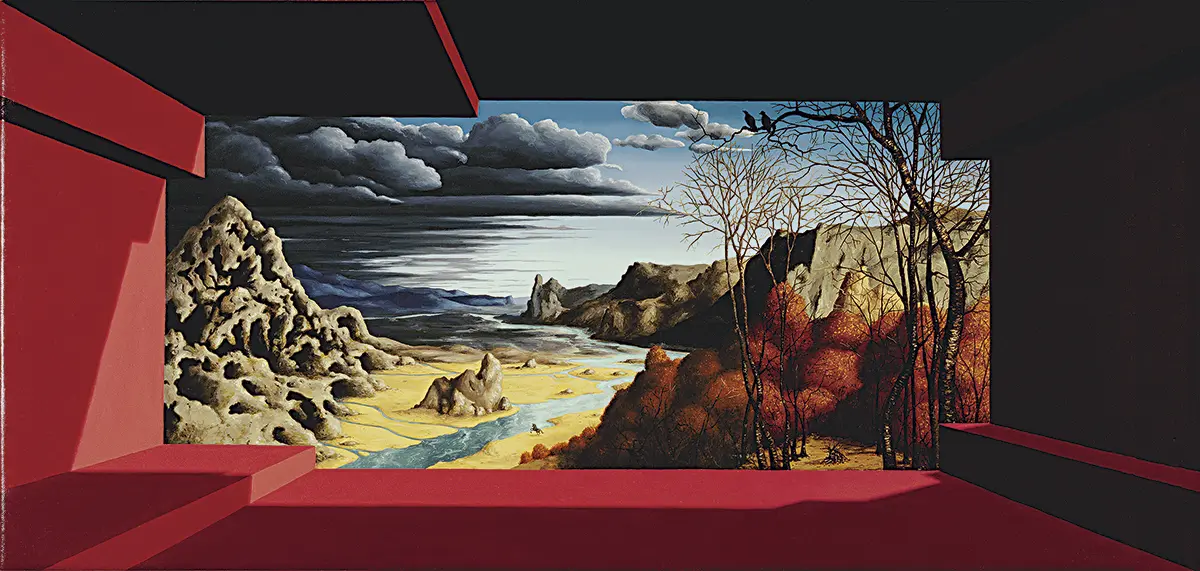
Due to the dimensions of the work, the observer has to get close enough to see the imaginary landscapes. Ruins that proclaim a transformation, placid and disturbing skies, rocky formations and dense clouds, animals and fantastic characters, paintings interfered with by forms of geometric accent, frames and rods of golden wood to the leaf, hang in a large room without partitions. According to curator Carla Barbero, “The idea is to evoke a traditional painting salon, which is why the works are installed according to a non-chronological perimeter arrangement.”
Before entering the exhibition gallery, on the second basement of the museum, visitors are surprised by the installation titled Los fósiles (Fossils, 2019). It is a wooden column—like the “tower” he spatially recreated at the Fundación Proa, alluding to Robert Aizenberg’s paintings and mysteries—and five grey-colored oils painted on the wall, that generate numerous ghostly appearances. Are they shadows of emerging works or traces of something that no longer exists?
“Just as a landscape can be the backdrop for a city and its inhabitants, this exhibition by Max Gómez Canle is the natural environment in which his desire to conquer space and form crystallizes from a sequence of happy encounters,” says Barbero. And, speaking of backdrops, there is one measuring eleven by three meters; and that is how it is presented. It is part of the installation titled Capricho sudamericano (South American Caprice, 2019), which also includes red bleachers to sit on and a cord used to move the cloth. The imaginative panoramic landscape, in which contradictory geographies and dissimilar skies cross paths, recalls the painting by Cándido López, famous for his vast landscapes with colors and furies, lights and fires, of the luminous landscape of the sterile and cruel War of the Triple Alliance.
In addition to Aizenberg and López, other Argentine masters mentioned are Lucio Fontana (known mainly for his characteristic tacked and pierced paintings, which allow him to see his “illusory space” through real perforations in the painted plane), Prilidiano Pueyrredón (great portraitist, also addressed the gaucho theme with romantic overtones that I had seen in Europe), and Raúl Lozza. In Ventana (Window, 2019), Gómez Canle revisits on a colored plane the irregular shapes of Concrete Painting by acclaimed artist Raúl Lozza. Gómez Canle uses these forms only as an opening towards the amazing landscape painted in oil, which includes magnificent and disturbing skies and mountainous formations—perhaps dramatic, but decisively neo-romantic—that refutes Lozza’s Structural Theory of Color. Here, too, the concrete forms of Lozza’s paintings were transformed into three-dimensional metallic objects embedded like arrows in other paintings by Gómez Canle.
In 2009, Ventana was seen by millions of people, hanging like a giant poster printed on microperforated vinyl canvas (known as Mesh) and placed on the facade of a building, steps away from the symbolic Obelisk located on 9 de Julio Avenue, in Buenos Aires. The dreamlike image—measuring 34 meters high by 88 meters wide, with an area of 2,990 square meters—burst into the urban landscape with its magical atmosphere, perhaps making the hurried pedestrians and agitated motorists stop for a second. Gómez Canle’s anthological exhibition requires more time to be seen, but every second is well worth it.
VICTORIA VERLICHAK