The two younger generations of Mexican female artists and architects pose a diversified and exciting panorama. Not only they do not detach themselves from their origins, but they also reveal them in languages of a broad global spectrum, in terms of the plurality of the issues, materials, and approaches. Mariana Castillo Deball (Mexico City, 1975) is a visual artist who began her studies in Mexico and finished them in Europe. She currently lives in Berlin. Although she is rooted in her country of origin, as she has stated in some interviews, “I need distance from Mexico to be able to do my work [...] so I am not understood as a muralist artist,” a statement that has circulated worldwide for decades, due to the active diffusion that governments gave to those artists.
Mariana Castillo Deball explores the anthropology and archeology of Mexico with a profound sense of engagement and a progressive gaze. From the beginning of her career, she has researched historical archives, ethnographic collections both public and private, and libraries in Germany, The Netherlands, and other countries. Each exhibition involves a series in which she offers her diagonal gaze on documents that reveal and/or recall the richness of Mexico in its various factual stages.
Castillo Deball works her post-conceptual installations, drawings, prints, photographs, and sculptures in multidisciplinary ways. The works she presents in each exhibition show the importance of the work process and its results.
Castillo Deball’s exhibition at the Museo El Eco (Mexico City, 2011), was followed by several prestigious international shows. In 2014, Mexico City’s Kurimanzutto gallery presented Vista de ojos (Eyesight), her first solo show. The arts of the era, the vernacular element, and the indigenous component generate one of her most notable expressions: a pavement. Voluntarily away from her native “ground,” Castillo Deball traces it—varied, different, but always Mexican—in almost all of her exhibitions. As in the wall-to-wall work in wood, engraved with a drawing of Mexico City and its surroundings circa 1550, based on a map found at the University of Uppsala, in Sweden.1 She also presented the “book map” bound by sections, which analyzes the city’s pre-urbanization.
In 2019, Castillo Deball exhibited “Point” at Kurimanzutto, in New York, with three interrelated elements: mixed techniques on paper supports; intervened printed matter (perforation/drilling) from her series The Museums of the World; and mini-installations of mosaics in concrete, watercolor, and ink, such as And the in Is Between the Two, 38 x 45 cm. Also energizing the exhibition were the titles in Nahuatl, Latin, and English, such as Pentlacoatl III, a woven mat of snakes–whose heads point in different directions–that has various mythological senses. This watercolor and ink on paper borders the indigenous tradition catapulted internationally by Francisco Toledo, while Castillo Deball summarizes its multiple orientations in this exhibition.
Also, this year, at the New Museum in New York, the artist presented “Finding Oneself Outside / Finding one out.” The title can be understood from several angles, among them, the most direct is “being outside certain cultures,” which is extended by the fact that diverse portfolios of the author coexist in this exhibition. Everything works like a great installation. Her research coexists with her reflections about materials and molds, the original and the copy, as well as the space occupied by an object being more important than the object itself, and her applications of geometric structures and mathematical laws. These notions of diversity engage the viewer. Like islands, the collection of perforated books with cedar wood bases provides the visitor with another approach. Castillo Deball does not go back to the molds of pre-Columbian originals or to floor installations or to Mathematical Distortions but to the printed book, and with it, she attends to the publication of works in different spaces and collections, that is, to the intervention of an externalization of the reproduction of art scenes in certain spaces.
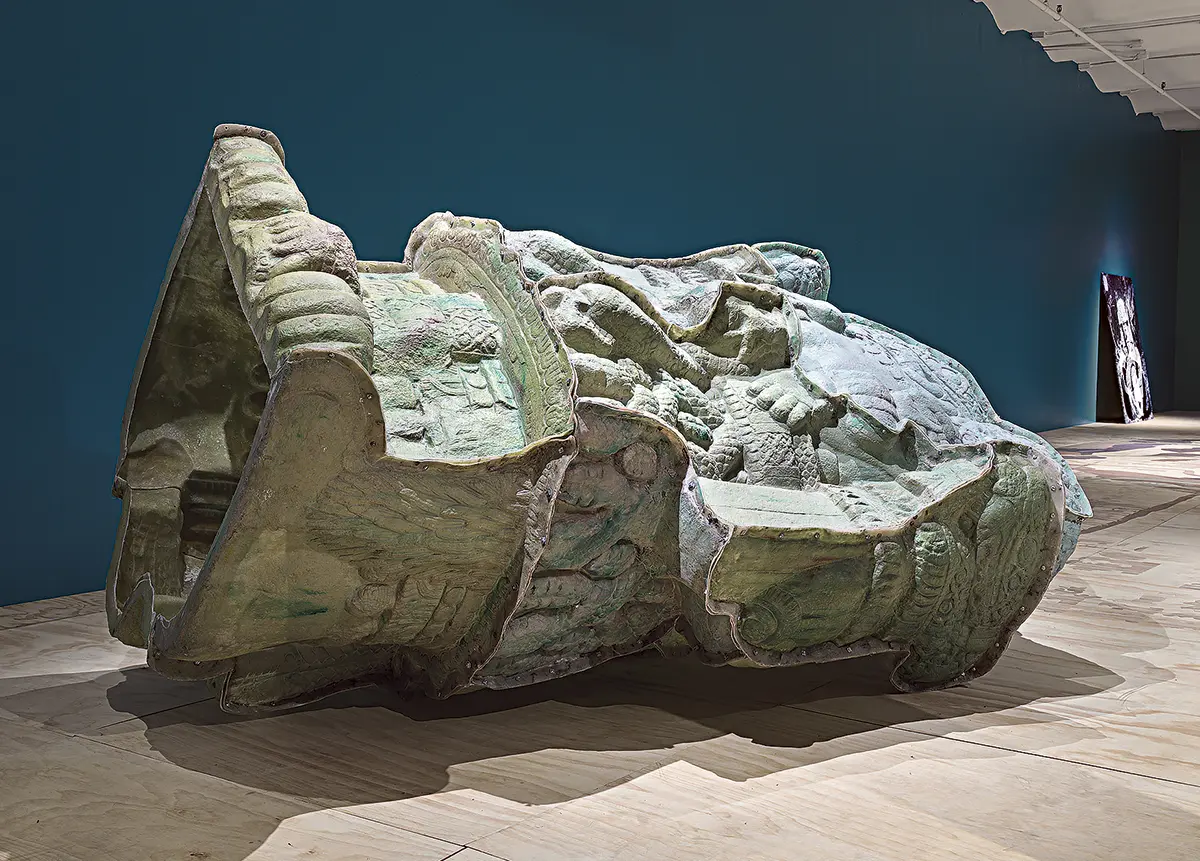
No solid form can contain you is a greenish fiberglass mold taken directly from the original Cuatlicue (a representation of the Aztec mother goddess), found precisely in the position in which Castillo Deball presents it. The mold dates from 2010 and belongs to the Museo Amparo collection, in Puebla. Some of its sections appear to be in the correct position, and some don’t, as though it had been reconstructed by contrasting its hollows and with some carelessness in certain areas, which befits the historical condition of the original and Castillo Deball’s piece. The intertwined references to visual arts, archeology, and anti-colonial critique—among others—render Castillo Deball’s language profound yet not heavy-handed; it is lightened by her interaction with current approaches, such as interventions and dematerializations.
Castillo Deball’s Teozacoalco Map is a floor installation in various types of wood that refers, reproduces, and unsettles. It is yet another Mesoamerican event interwoven into a contemporary presentation. Her linoleographs on cotton paper and her paper molds demonstrate the wide range of this artist’s exercises, beyond traditional techniques in this or any other medium, and provide enough material for a much more detailed essay, not because she is a woman, but because of the power of her artistic expression.
NOTE
1. Not much is known about this map, but it is commonly understood to have been made by a Tlacuilo, the name given in Mexico to indigenous draftsmen.
GRACIELA KARTOFEL