Margarita Paksa (1932) worked following the precepts of minimalism in the early years of the ‘60s. But the will to get rid of everything, to go only to meet the essential that pursued this type of art, is problematized when the events in the world become too intricate, turbid, turbulent. When the signs, although codified in different languages, are opposed and overlap, they confuse us.
The artist reflects on the changes in her way of producing work: “I asked myself, if after the events of May ‘68 I had had difficulties to continue with my work, and I must answer that I did. I had an ethical dilemma: What was the point of expressing myself through minimalism when confronted with a moment of profound unrest worldwide and the hunger and misery that prevailed in our country?”
Marcel Duchamp was the first artist with the wisdom to see the conventional nature of images and to use them as signs. He added a mustache to Leonardo Da Vinci’s Mona Lisa at a time the famous image had been reproduced enough times to be recognized as a paradigmatic work of Western art—but also as one among so many others in the world pulled by the tide of technological reproducibility. Layer after layer, the mustache and Mona Lisa are superimposed one on top of the other; the masterpiece and the joke inhabit the same image, two recognizable signs that propose the establishment of a new type of codification that would never become form. The seed of contemporary art had been planted.
Signs and their codification are a central theme in this exhibition, as are language and images. But there is another fundamental element that makes seeing all things possible: light.
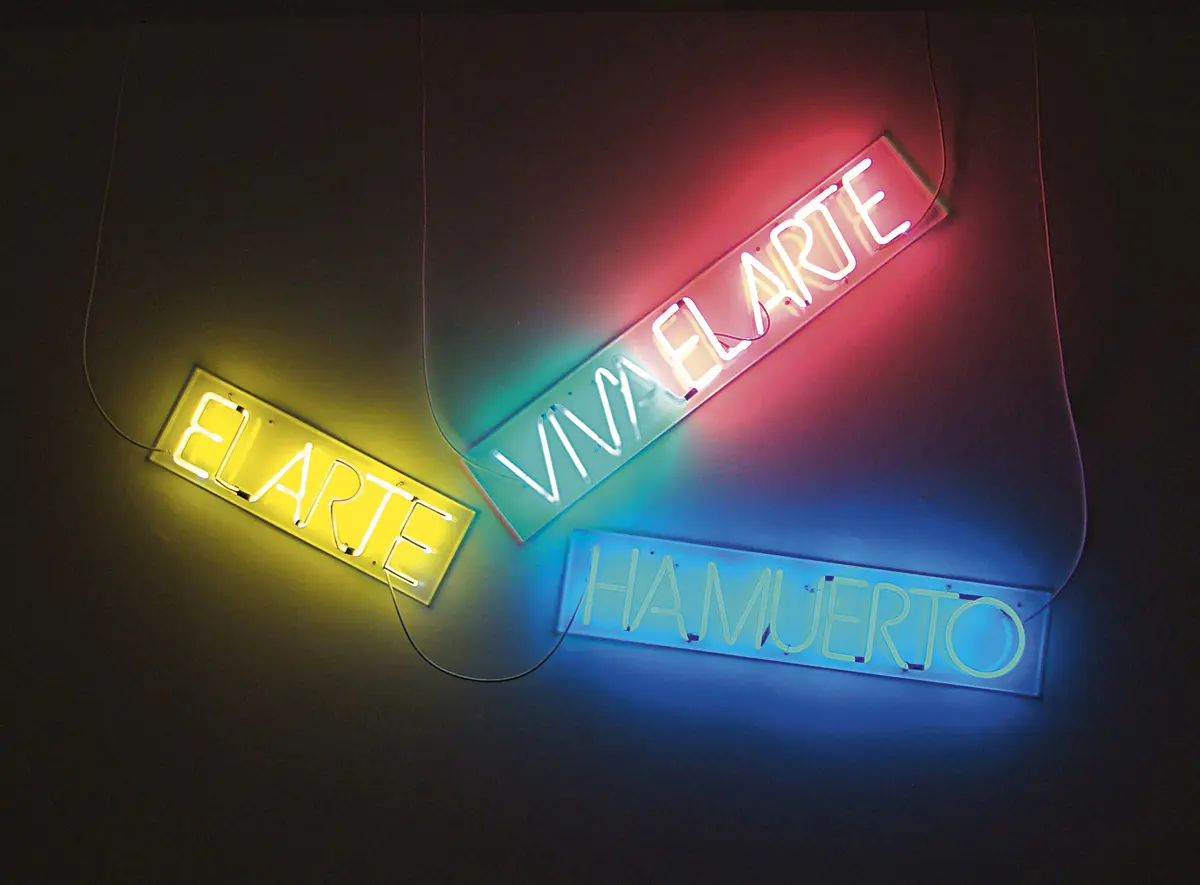
Strident neon letters on one of the walls in the Herlitzka + Faria gallery shout a double message, El arte ha muerto, viva el arte (Art is Dead, Long Live Art, 1979–2005). The interpretations and repercussions of these statements connecting art with life and death mutated throughout the nearly thirty years that took to complete the piece. It contains innumerable references in itself. For instance, the vitality of art is associated with the local vanguards of the late 1970s. Margarita Paksa belongs to Tucumán Arde, an artist collective committed to social issues and shedding light on the injustices that Argentina’s military government tried to hide. Art is intertwined with politics operating specifically in the social field.
On the other hand, the question of the death of art—as proposed by Arthur Danto in the 1990s—is associated with the end of a story, the conclusion of a romantic novel in which the hero (art) completes a journey to find himself. It is there where the contemporary paradigm imposes its gesture and art bursts.
The exhibited works are mostly made up of series. In “Secret Writings,” small colored wheels of equal size were mounted on aluminum plates. The language configuration is put into play; the subtle nature of perception will unfold in the search for the right angle and distance required to decipher the message. In “Blind Eyes,” in which drawing and painting make an appearance, images on four sheets of handmade paper, signs, everyday objects, and fragments of blank-eyed faces, express human emotions with minimal lines. The series “Rorschach Drawings” refers to the test created by Swiss psychologist and psychiatrist Hermann Rorschach, in which subjects are analyzed and interpreted using ten inkblots images printed on cards. Paksa uses these spots in the manner of maps. As Julia Detchon mentions in her curatorial text, “once again, she layers disconnected images that mix behind closed eyes, this time using the metaphor to explore the structure of the unconscious.” The last series, “The Iraq War,” consists of a group of texts-collages in which three languages, Spanish, Arabic, and Hebrew, are superimposed.
Two installations complete the exhibition: Pisa Fibonacci II (2009), which remits to Paksa’s work within the minimalist art current, and El avance urbano (The Urban Advance, 1996), a square measuring three meters by three meters of real grass partially covered by an iron square of the same size.
Despite being deprived of light, the buds of the edges manage to stay alive thanks to the profuse daylight that filters through the gallery’s ceilings.
VIVIANA SAAVEDRA