In this mini-retrospective of the remarkable work of Argentine artist Marcelo Bonevardi (1929-94), it is immediately apparent that a unique personal vocabulary has emerged in response to the dominant trends of mid-century Latin America and New York. After moving to New York in 1958, Bonevardi absorbed, and rejected, elements of Minimalism, Geometric Abstraction, and Constructivism to create complex compositions made of a variety of materials in his own versions of the trends. Infused with a personal lexicon of symbols and visionary spirit, the works express a fascination with mathematics, architectonic constructions, astronomy, rituals and metaphysics, and ancient art, among other intellectual pursuits. Further distinguishing his art from those of his contemporaries, is his masterful command of drawing and the formal elements of art-making that result in works that are as dramatically composed as they are elegant. A background in architecture informs his process, while each work goes beyond a mere constructivist description that implies a strictly geometric formation based on architectonic subsets, often with little narrative context. For the Latin American Geometric Abstractionists and Constructivists especially, their work was almost strictly about mathematically structured compositions. Bonevardi uses constructivist systems to configure shapes taken from mathematical reality and translate them into a more symbolic schematic drawn from his knowledge of timeless sources of ancient art with its own ideogrammatic language, combined with references to life experiences that haunted his homeland. Akin to the work of Uruguayan master Joaquín Torres-Garcia who included the intrinsic message of ancient art forms, the indigenous languages of the Americas in particular, with a genuine appreciation for their cultural and religious connotations, Bonevardi also created works informed by his own studies of their significance. There is never an indiscriminate appropriation of the motifs and elements of indigenous and ancient art, from the mythical to the astronomical, but their inclusion to elevate the abstract shapes and forms into new architectural structures that are basic to his unique and personal creative process.
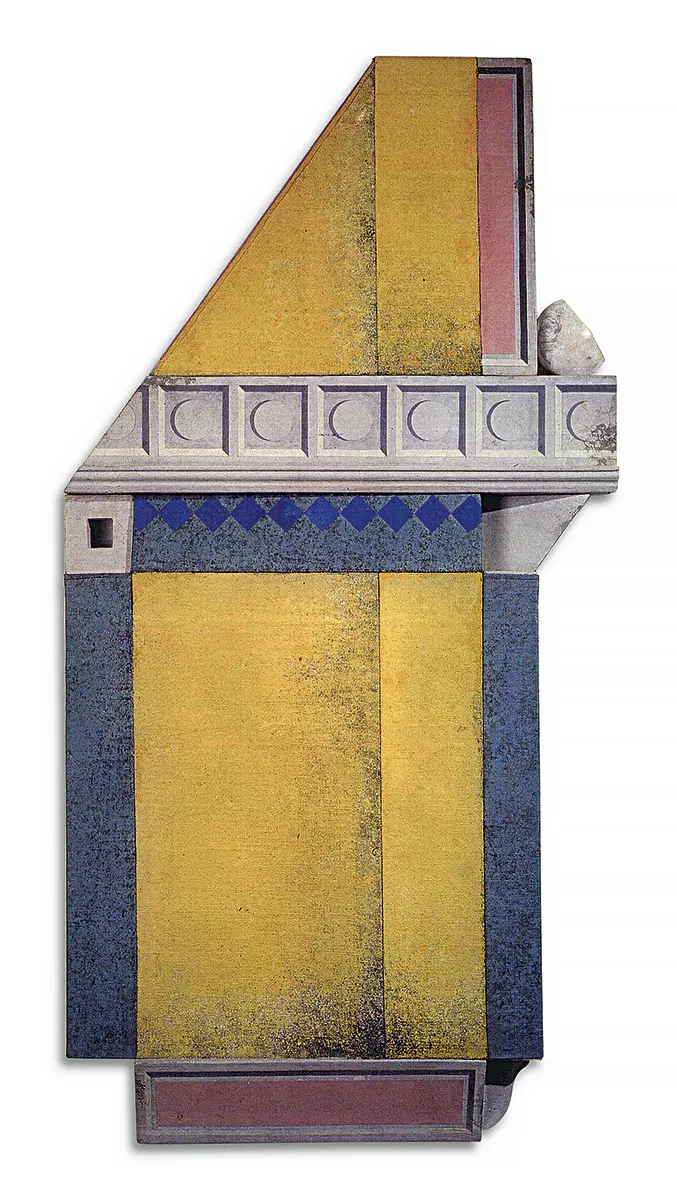
The exhibition installation ingeniously takes advantage of the encyclopedic collection of the Lowe Art Museum, a university museum that proudly exhibits works that span 5000 years in the history of art. Before entering the main galleries of the exhibition, visitors are introduced to Bonevardi with a monumental shaped canvas. Entablature II (September 1986) serves as a preface to his method of construction and his incorporation of symbols, circles, repetitive patterns, and other arrangements that echo the historical objects in the museum’s permanent collection, creating a dialogue between the old and the new that is particularly relevant to the artist’s work. Then the visitor is invited to walk into the Kress Collection of Renaissance Art, where one of Bonevardi’s most fascinating works, the Annunciation (July 1980), is installed among a selection of the museum’s Early Renaissance religious works. The collection includes The Annunciation (Italy, 1370/73-1452) by Bicci di Lorenzo, The Annunciation and the Journey to Bethlehem by Guidoccio Cozzarelli (Italy, 1480-90), and The Annunciation carved into a marble arch (1461), all in direct conversation with Bonevardi’s architecturally structured works. Clearly revealing the artist’s attraction to the subjects of ritual, spirituality, and metaphysics as part of a universal language that transcends time and place, The Annunciation is a small work. It is accompanied by drawings and ephemera that help to elucidate his conceptual process of abstracting the key aspects of a traditional Annunciation image. Described in the essay by Terence Riley in the enlightening catalog that accompanies the exhibit as an “assemblage of assemblages,” the word assemblage not only denotes the structure of work done with acrylic and charcoal on newsprint and cardboard and combined with painted wood elements, but also the formation of signs used to re-create and re-interpret this most revered subject into the simplest most basic narrative: the Madonna, Angel Gabriel, the traditional arched interior, the mystical announcement. The work is enigmatically reduced to basic geometric shapes: the oval is Mary; the Angel is a simple rectangle with wings rendered as colored bands. This same mystical and symbolic assemblage of materials and language is repeated in other works that focus on spirituality, including Talisman (1969) and Trapped Angel I (1979), so the various parts become recognizable elements in his oeuvre and evidence of his preoccupation with the subject.
The main galleries of the exhibition are divided into recurring themes that feature monumental works, drawings, objects from the artist’s studio, and a collection of newsprint and other materials, all of which enhance our understanding of his conceptual process. Large assemblages, such as Astrologers Table III (January 1965) demonstrate Bonevardi’s skill with compositional balance and quiet reverence, while referring to ancient altars, walls, and windows reminiscent of the Incas, a civilization that intrigued him. There are sections on Celestial Navigation, Heads, Skins and Screens, Habitats and Cages, echoing the breath of Bonevardi’s influences and a range of works that may also be understood as a reflection of the times. Among his fascination for the astrological and mythical, he presents the haunting reminiscences of disaster in shadowed images laden with hooks and other menacing devices of torture that are a personal response to the frightening events that took place during Argentina’s (and other Latin American countries’) military dictatorships in the 1970s-80s.
In this exhibition, Marcelo Bonevardi’s painted and shaped constructions and assemblages introduce one person’s intellectual pursuit of geometric forms within architectonic spaces, always replete with deep conceptual meaning that pronounces the magical intersection between form and space.
CAROL DAMIAN