The landscapes we inhabit, the people with whom we relate, and the situations we experience throughout life tend to be kept in more or less obvious places, in our affective repertoire, taking this term as everything that affects us, be pleasant or painful. This “emotional patrimony,” which influences our choices and molds our actions, can be activated in ways that are not always obvious and can be translated into the way we are constructing our existence in the world. Even what is presented from the exterior gains meaning through references, which are different for everyone. Each person creates a perception of the world based on the unique and subjective interpretation of a series of elements and events that confront him/her.
The art created by Macaparana (Pernambuco, 1952) contemplates his history—Pernambuco’s Sertão1 where he grew up, so emblematic to the social constitution of Brazil—in a very subtle manner. His artistic career has unfolded rather fluidly, maintaining a serene balance between what he has gained through his own experiences and what he has absorbed from other artists, the art scene, and the world’s transformations. Wholeheartedly committed to capturing the vast and arid universe in which he grew up, Macaparana learns his trade on his own, beginning with experiments with painting. From landscape, he goes on to focus on culture (even religion), specifically the tradition of votive offering.
Meanwhile, the material used in his work—and not the human element which plays a predominant role—wood, its textures, colors, and forms. He experiments with the volumes in compositions increasingly distant from the subject suggested by the raw material, which becomes the protagonist of his visual research. In painting, he also explores the grains, tones, and other particularities of each type of wood. Geometric forms will become progressively more important in his projects. According to the artist, he always begins his work on paper, adding several versions that can be split into different compositions, both in the two-dimensional plane and in the forms that invade the space. In Macaparana’s art, color is always simplified and rarely set in gradations. Macaparana favors primary colors, and at times he explicitly pays tribute to Neo-Plasticism artist Piet Mondrian, like in the 2017 painting entitled p.m. The influence of Joaquín Torres-García’s Constructive Universalism is also evident. In 1983, Macaparana dedicated a series of small gouaches on paper to the Uruguayan master. His creative process involves the study of the structures of the artists he admires. Meanwhile, this influence is translated into the study of those structures, but as a practice that allows him to create a repertoire of compositions that highlight the markedly urban nature of his poetry.
The encounter with Willys de Castro’s work had such an impact on Macaparana, he chose to immerse himself in geometric abstraction. He approaches the Neo-Concrete Movement, and his practice focuses on the essential aspects of drawing; exploring all the possibilities of straight lines, using basic shapes like the circle, square and triangle; and even experimenting with elongations and distortions. Their enlargement and projections onto the space are also frequent practices.
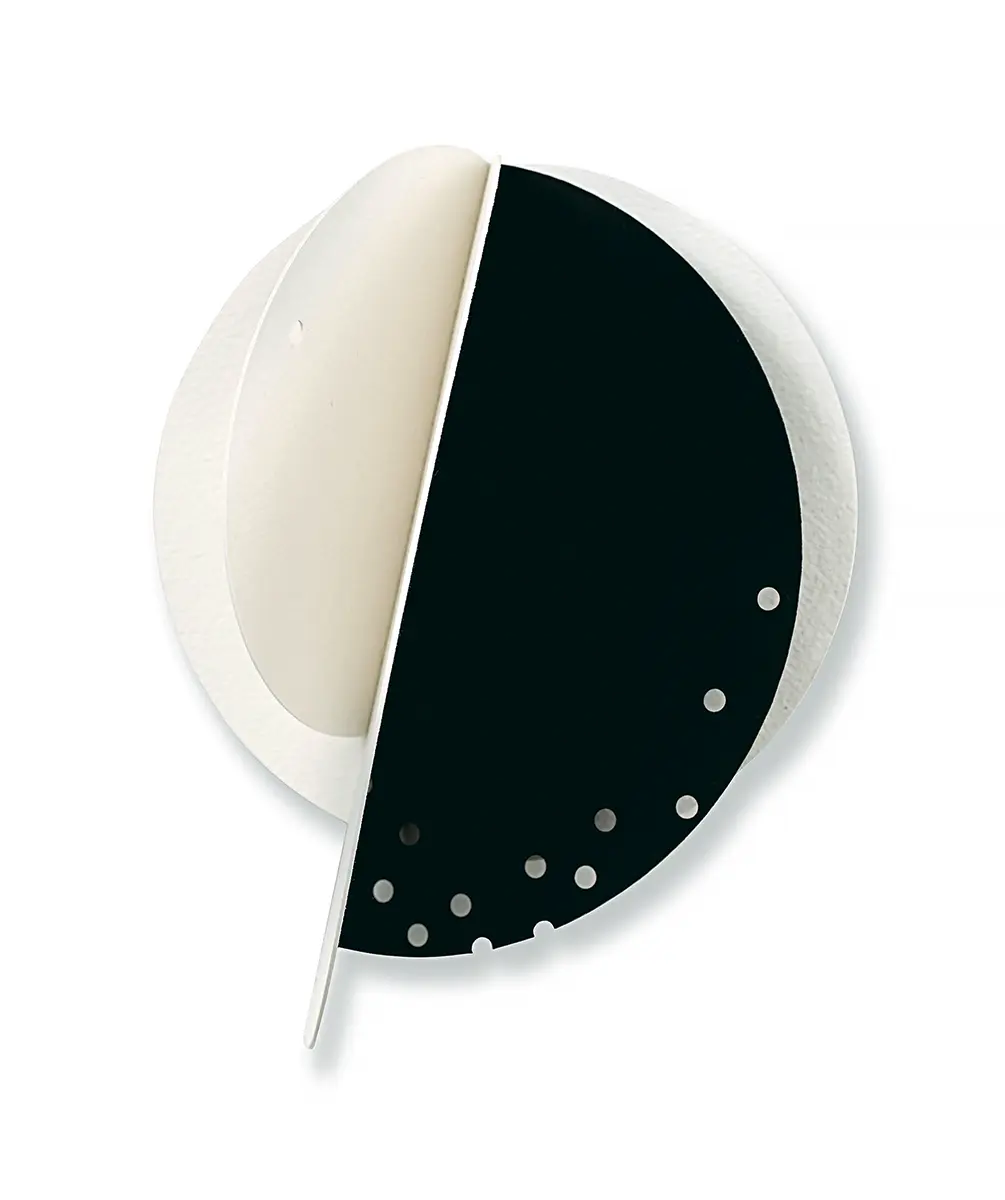
“Forms/Supports” is the title of Macaparana’s solo show at Dan Galeria, in São Paulo. The title describes the content of this exhibition, consisting of more than thirty works created between the 1970s and today. The selection of works offers a panoramic view of the career of this self-taught artist who, inspired, at first, by the arid landscape that surrounded him and eventually focusing on local and ancestral traditions. Little by little, he refined a method that could almost be regarded as a process of “purification” of the visual vocabulary. From themes associated with nature, he moves on to composing the pictorial space, guided by forms and lines, until arriving at the core of his research: the countless possibilities of each of these basic elements. This solo show features works from the beginning of his career to recent proposals A small gouache and pastel on paper from 1978 portrays the twisted and sparse vegetation that is typical of Sertão. There are also more recent works dominated by the use of industrial materials in completely abstract compositions, like the three-dimensional piece titled Relieve en negro y Blanco (Relief in Black and White, 2004). This work challenges its classification as a sculpture, given the prevalence of empty spaces over matter.
The exhibition offers a rather comprehensive view of the work by Macaparana, a pseudonym that José de Souza Oliveira Filho chose to be known as in the art world. Interestingly, this is the name of a small town whose agricultural way of life stands in stark contrast to the urban drive of his proposals. While he spent his early years surrounded by that rural reality, it was the metropolis what yielded him good harvests.
NOTE
1. N.T. The “sertão” is a large, rugged region located in the interior of northeastern Brazil.
SYLVIA WERNECK