It has been forty years since Lotty Rosenfeld created her earliest crosses. Forty years have passed since that early morning, in 1979, when she made a cross on the pavement, and then another one, and then another one, thus starting her long, immersive engagement with the possibilities of a sign that, redefined continuously over the years, was to frame the entire path of her career.
The structural operation of intervening a traffic sign with cross functions as the backbone of Rosenfeld’s oeuvre. Continuously updated, it serves as an x-ray of the political and gender issues that concern the artist. In my view, the significance of the journey that began with that initial action, forty years ago, gains greater density in later works, as Rosenfeld daringly expands its possibilities. I believe that those works best reflect the depth of the exploration started in 1979, as it unfurls and expands in terms of the spaces engaged and the supports used. I will mention two particular instances that seem especially significant for the materiality they give to the sign.
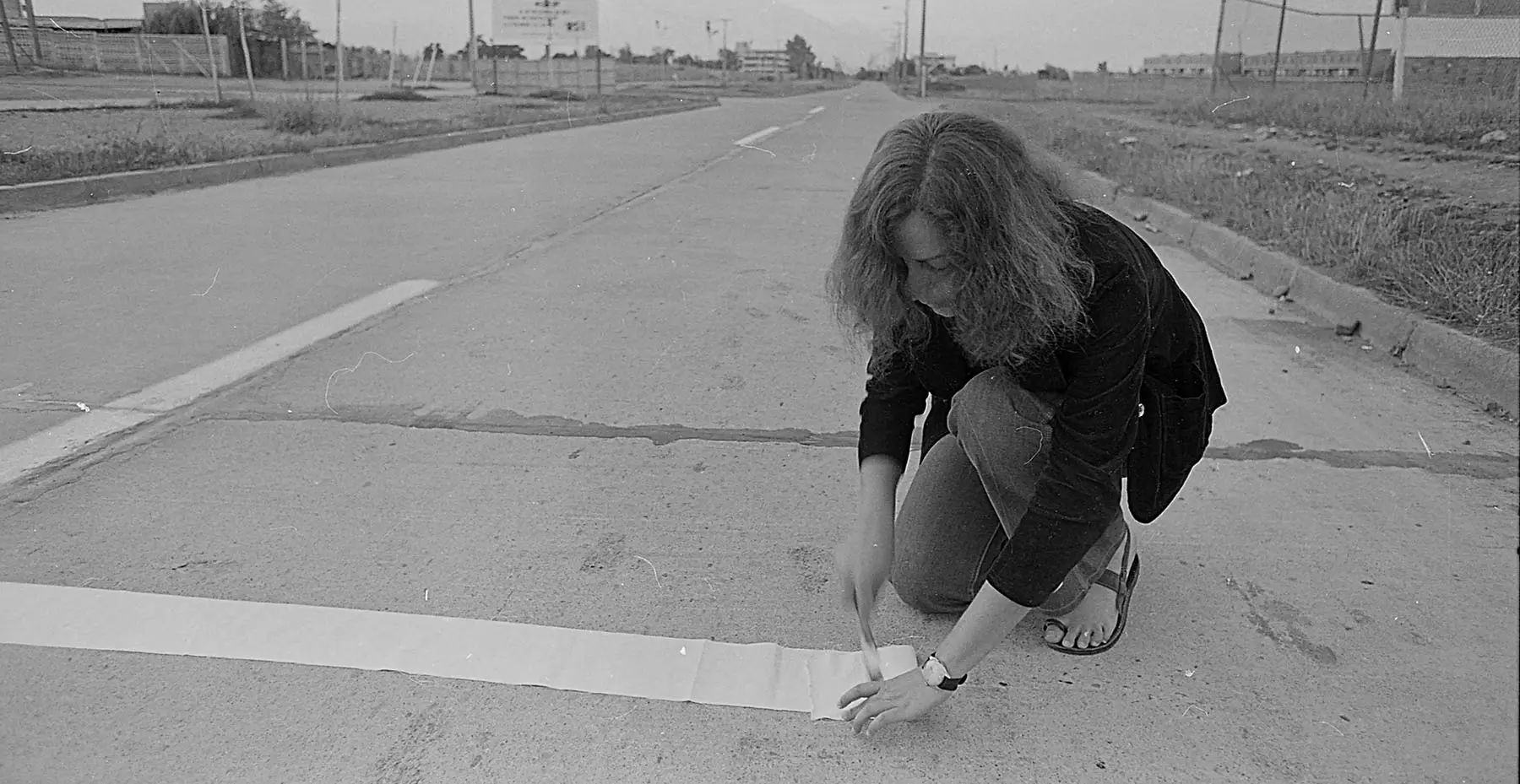
But before getting to that, it is necessary to revisit the point of origin, which, because of its very nature, requires to be understood in context. Una milla de cruces sobre el pavimento (A Mile of Crosses on the Pavement) was posited as a direct, concrete action that begins with the intervention of the broken white road lines on Manquehue Street. Manquehue means “place of condors” in Mapudungun, the language of the Mapuche native people; the stretch intervened by Rosenfeld was paradoxically located between two major thoroughfares of Santiago de Chile’s eastern sector whose names are evocations of power: Los Militares Avenue and Kennedy Avenue, calling forth the armed forces and the United States, respectively. As the title indicates, Rosenfeld marked the street’s broken white lines over a mile-long stretch, in a process that took about four hours. On her knees, the artist glued vertical white strips to the pavement, altering each existing white line to form the + sign.
A month later, in January of 1980, Rosenfeld presented a video installation at the same location, projecting a video recording and a 35-mm film of her action onto large screens on Manquehue street’s road median. The installation featured about one hour of moving images without any special treatment, as the artist was only then beginning to use video to register her actions. Una milla de cruces en el pavimento is about how, through a direct and well-aimed act of insubordination, a public sign with disciplinary meaning can be displaced towards a new interpretive axis, ranging from references to voting to the symbol of death.1
Rosenfeld has reproduced her action in front of many locations around the world, creating a single cross opposite such sites of political power as the White House in Washington, D.C.; the Capitol in Puerto Rico; The City of London; and the La Moneda Government Palace in Santiago de Chile, among others. The action has also been reenacted as a mile of crosses in Kassel, Germany, in 2007, for documenta12; in New York, in 2008; in Cali, in 2008; and in Seville, in 2013. The various moments and contexts gradually expanded the meaning of the sign and imbued the initial action with increasing levels of complexity.
That initial intervention is the connecting thread that runs through Lotty Rosenfeld’s artistic proposal. Over the years, new layers and complexities have been added to its interpretation, while retaining a critique of institutions as its core. Rosenfeld’s Una milla de cruces en el pavimento quickly gained a place in the history of public space interventions in Chile, in the context of what came to be known as the Chilean neo-avant-garde emerged in response to an era of repression. It was an important episode in the neo-avant-garde chapter, described by the critic Nelly Richard as an "forward scene".
In its first iteration, Una milla de cruces en el pavimento was closely associated with the era of the Pinochet dictatorship, established after a military coup that overthrew Salvador Allende’s democratically elected socialist government. Deeply imprinted in the tone of the work, the coup and the realities of the military regime—the curtailing of freedom of expression and the drastic regulations imposed on citizens—are more than a mere backdrop here. Exploring the issue of censorship became a priority for some artists. Rosenfeld made her crosses above all about this context: a society suffused with fear and forced into silence. In her own words: “(…) I use a traffic sign as a model, the white lines that divide the road on which vehicles travel, which I modify physically to generate a + sign: the crossing of two lines, one imposed by a code of social control and one offered by art as an act of refusal. By introducing a ‘crisis’ into a subsystem of civic order, the work prompts subjects to rethink their subservience to the code.” 2
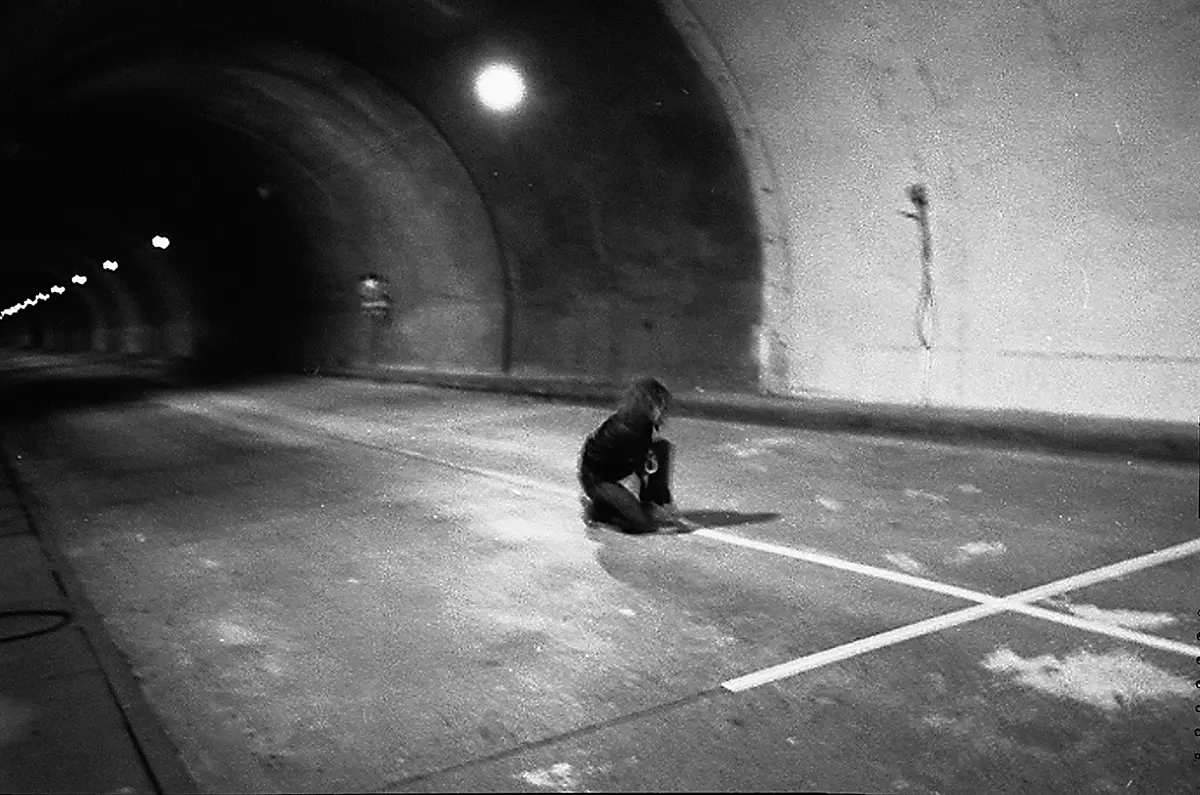
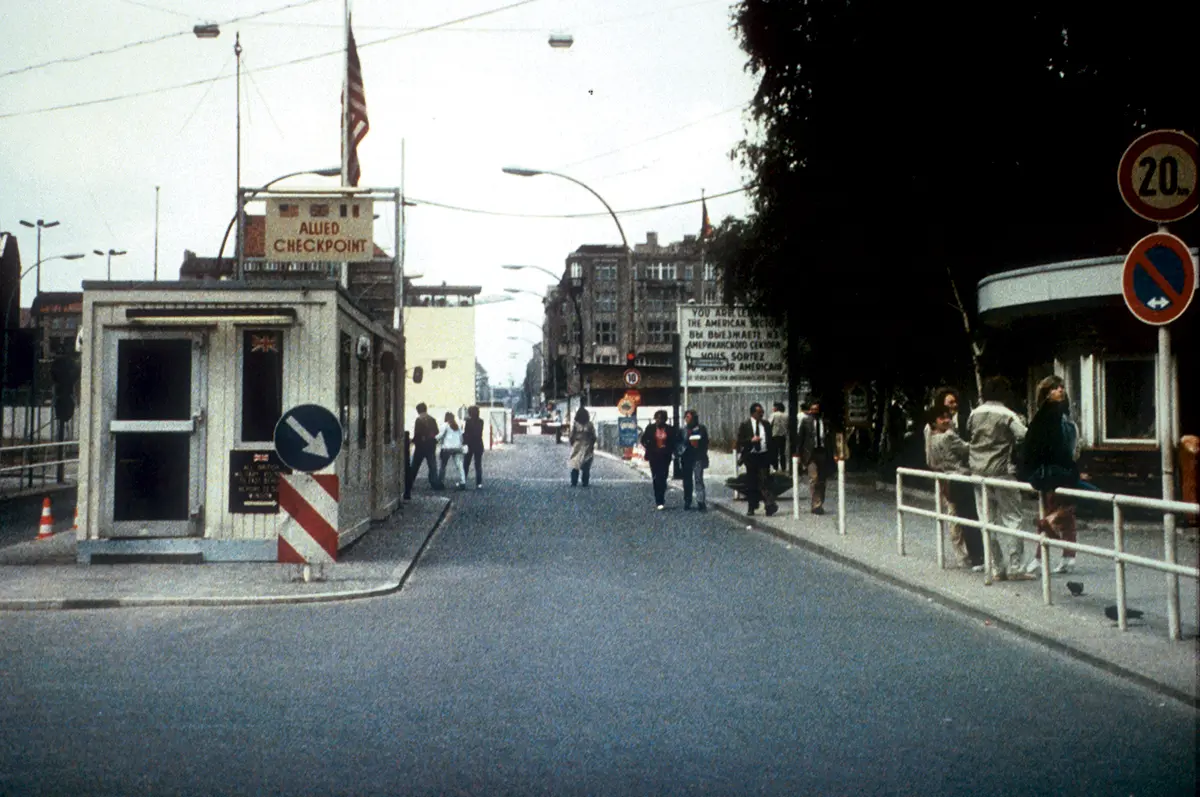
In 1983, as part of the interventions and videos that followed her initial action, Rosenfeld made Proposición para (entre) cruzar Espacios Límites (Proposal for (Between) Crossing Bordering Spaces), which, while retaining the operation with the + sign, expands its materiality and mode of execution. At a time when both Argentina and Chile were under dictatorial regimes, Rosenfeld drove a car from Santiago to the border between the two countries, crossing the Andes mountains to conjoin two actions in one work. One of those actions took place at the Cristo Redentor tunnel separating Chile from Argentina, the other at Checkpoint Charlie, the crossing point between the East and West sectors through the Berlin Wall. The action at the tunnel features the only cross produced entirely by the artist (i.e., without the use of an existing sign) since there was no dividing line on the road. The Berlin action was made symbolically, using Rosenfeld’s own body as one of the axes for the cross. Performed in two different geographic locations, these two interventions were strongly linked by a critique of the notion of a border. Although often oblique in the artist’s oeuvre, this critique is presented here overtly: the border as the outer edge of the nation, territorially and ideologically; and unmovable, a nation-defining region that takes care of any and all demarcation dilemmas. The Cruzar el Túnel/Cruzar el Muro (Crossing the Tunnel/Crossing the Wall) actions, as Rosenfeld calls them, combine still images and images in the motion of the performances, and their meaning is reinforced and enhanced by the accompanying audio, featuring fragments of short-wave broadcasts from Russia, England, Germany, and Chile. More than just speech, these recordings also appear as symbols of the border, in a kind of sound collage: English-language newscasts about museums and their policies; Spanish-language transmissions about the agreement between and unity of all Chileans; clips in various languages unknown to the artist, which does not matter, since the ultimate goal is confusion.
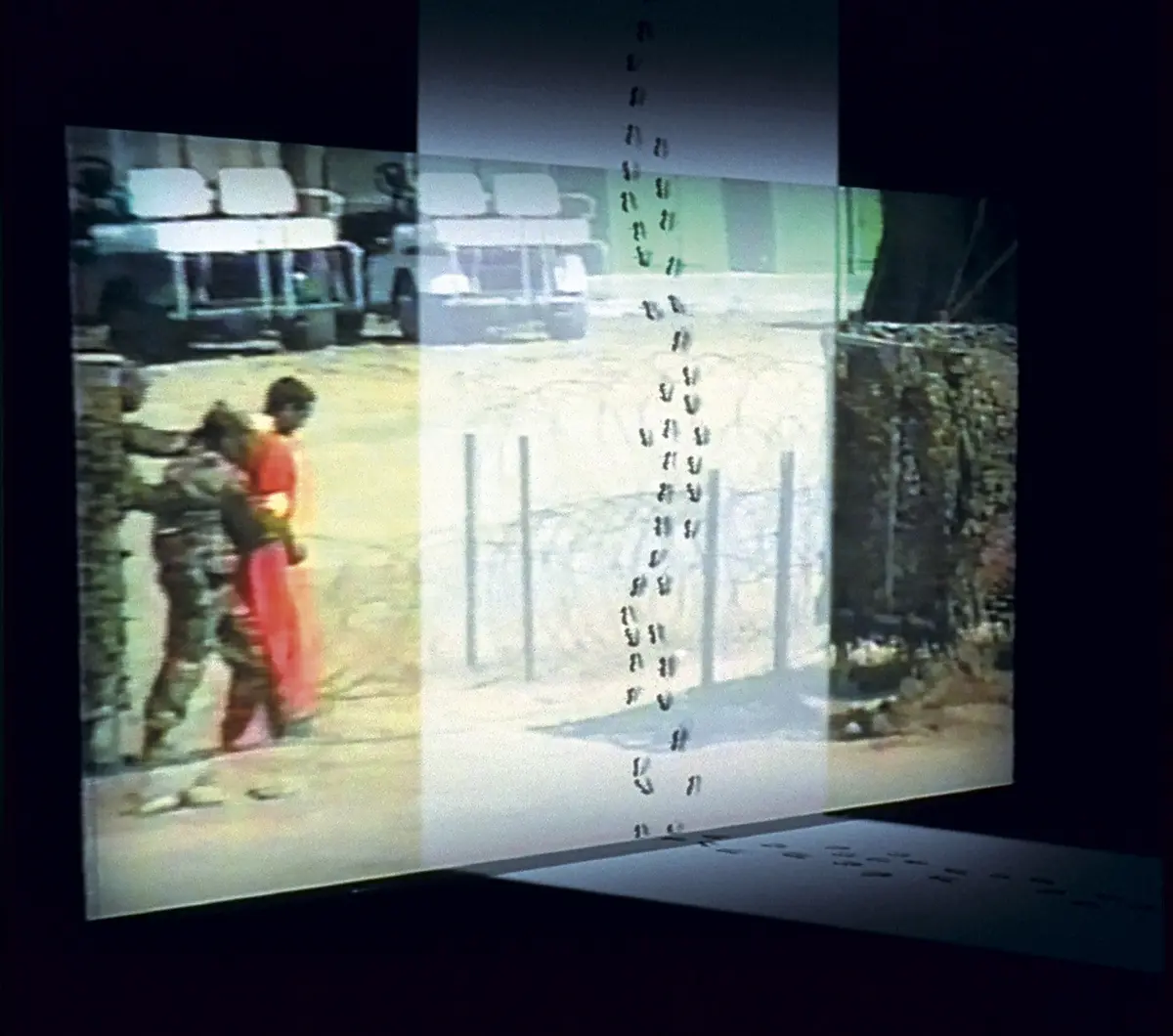
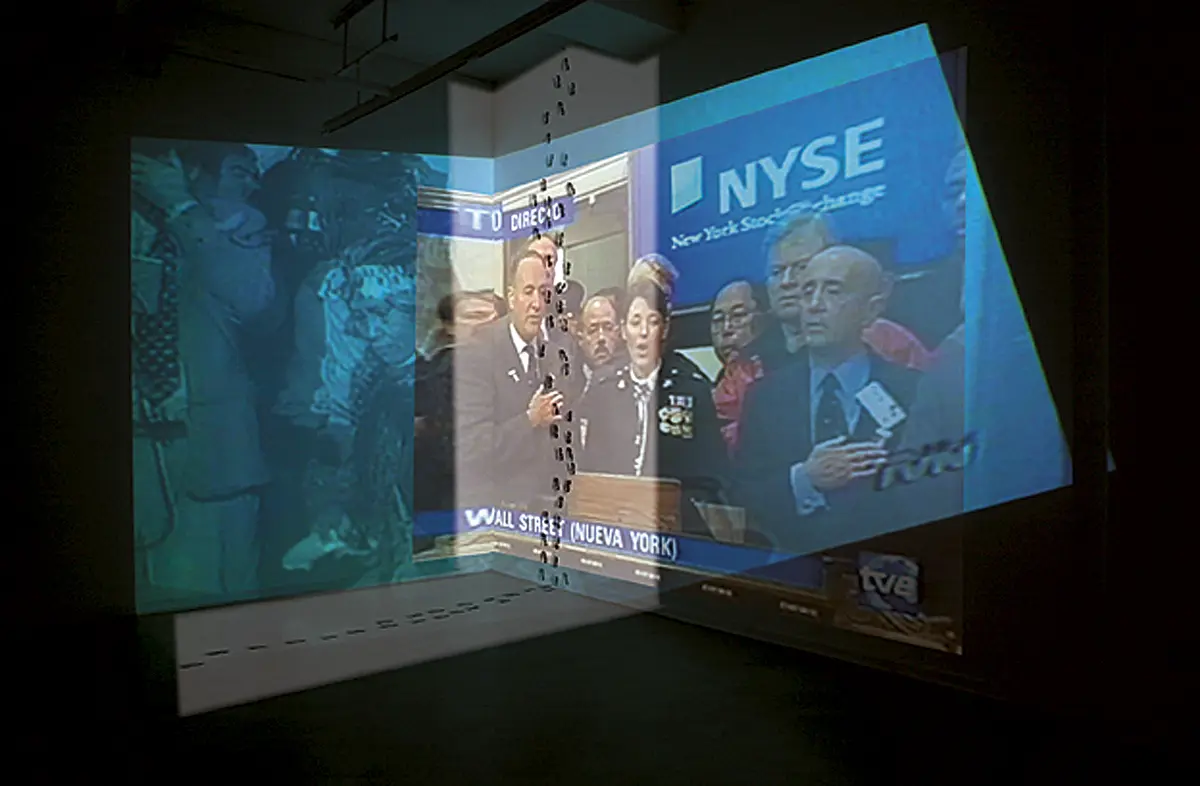
Two lines of work can be identified in Lotty Rosenfeld’s oeuvre: one dealing with space (intervention) and one dealing with the image (audiovisual). In terms of the latter, she has produced a body of images comprised of fragments of diverse provenance, such as the Internet, TV, and her own creations, articulated using montage strategies. There is, in this group of works, an autonomous reflection about three main subjects: the image-fragment; composition, and montage; and, perhaps most importantly, the notion of archive. Moción de orden (Motion of Order, 2002) features perhaps Rosenfeld’s boldest exploration of supports. It is a hybrid work that combines the audiovisual element with a site-specific intervention. The latter is an expanded video installation based on multiple projections in a variety of public and institutional spaces: the Museo de Bellas Artes, the Museo de Arte Contemporáneo, the Gabriela Mistral Gallery and the Santiago Civic Center, as well as the Strait of Magellan, at the southernmost tip of the country, the Santiago Metro, trucks, walls, etc. All are intervened by ten multimedia players, ten DVD players, and 16 audio sources. By expanding it into space, which in turn becomes a visual vocabulary, this work establishes a paradigm in the evolution of Rosenfeld’s art.
Moción de orden is a multi-part unit involving records of the interventions (in the Strait of Magellan’s oil rig and others), an intervention using those recordings, and a video projection staged in a gallery. While a camera records from a helicopter, another one, held overhead by a crane, captures a line of ants interrupted by a finger to form a + sign; the ants disband quickly, only to go back to their original formation after a few seconds. The “no” gesture alludes to the transgression of disciplinary forms of power. The accompanying audio is comprised of different sounds such as radio broadcasts, crickets chirping, the ocean, but above all a woman’s monologue: Molly Bloom’s narrative from James Joyce’s Ulysses, interpreted by Diamela Eltit. As the woman says sí, sí, sí (yes, yes, yes), the line of ants is interrupted, metaphorically replying “no,” and the insects are forced to change course, in turn, a metaphor of the transgression of imposed hierarchies and the revolt against all forms of submission.
Including literary texts in her art was a determined decision on Rosenfeld’s part. Other images came to be added to that of the ants, including TV news clips and documentary historical images. Images of Abimael Guzman, Muhammad Ali, George Bush, and snipers from the Bosnian war intersperse with those of Mapuche individuals already used in the previous work, La Guerra de Arauco (The Arauco War, 2001). The background audio repeats the phrase “Este país no tiene memoria, realmente no tiene memoria” (“This country has no memory, it really has no memory”). Diverse and scattered in character, the images are noisy, projecting a kind of intensity based on the nature of their support. The audio also approached in a collage-like fashion, plays a key role.
In the context of Lotty Rosenfeld’s evolution as an artist, this work marks an important step in terms of the supports used. From this point on, she explores the idea that the power of images is articulated not based on the image itself, but on how it is connected and staged for display. It is as though, prodded by an ever-growing accumulation of archives upon archives, the dialectical exercises activated by the forced linkages never relented; instead, as a new dialectical relationship is always demanded, the effect is a continually shifting interpretation.
Meanwhile, Rosenfeld has also used photographic and audiovisual supports as a record of her interventions in public spaces. In those instances, the purpose is to document ephemeral interventions that would not otherwise endure in time. In these actions, the support remains, but only as a means to capture the here-and-now that is the condition of all public interventions. Here, the cross sign is the sole protagonist, the idea being for it to break into the public space and tear down its order based on the signage, which is a minimal portion of the street. What is special in Moción de orden is the connection between these two uses, audiovisual creation, and the documenting of an intervention. It is a video intervention and at the same time a visual archive, both narrating themselves. In this way, Rosenfeld’s archive feeds itself and grows exponentially; this is what I have called her “archive-vocabulary.”
Works like Moción de orden reveal, then, the potential of the sign in its materialization. In connection with Rosenfeld’s first intervention, it can be read as a single, grand archive in permanent expansion and development, which also includes records of the works themselves. An intervention that takes place in a public space is registered on video; the video appears again in a public space and reappears in the staging of the video projection. Intervention and document put pressure on each other, revealing possibilities for interpretation and for the physical-sensorial experience. Based on the displacement of the supports we commonly associate with Lotty Rosenfeld’s work, it is possible to read here still an act of organic alteration of the signs of the images as redefined signs.
Lotty Rosenfeld’s audio and video installations, as well as her art actions, continue to gain relevance today through the use of new media. In the past, she was able to break through the geographical and political constraints imposed by the realities of Chile; now, she is well established and renowned in the global contemporary art system. Her work is recognized for operating discursively, for being contingent and critical at the same time, for insisting—as Rosenfeld herself has pointed out—on nomadism and fugacity. In our recent conversations, she has even mulled the idea that an intervention may continue to exist forever, under certain specified conditions.
The possibilities of the cross sign are inexhaustible, and Rosenfeld has been able to explore its symbolic and material meanings in great depth. This is a clear indication of a consistent creative process: forty years ago, Lotty Rosenfeld set out on a path, and she has continued ever since to investigate the options that emerge from her rhetorical experiments. Her work is not just the condensation of her era, the image of a historical period defined by repression and its many forms of violence; it is updated and made more complex in response to local and global situations today.
NOTES
1. Nelly Richard has written extensively about this subject
2. Annotations by the artist in her personal archive, undated.
ALEXIA TALA