“Pues lo que importa no es la luz que encendemos día a día,
sino la que alguna vez apagamos
para guardar la memoria secreta de la luz.
Lo que importa no es la casa de todos los días”.
(“For what matters is not the light we kindle day after day
But the one we once extinguished
To keep the secret memory of light.
What matters is not our everyday house.”)
Jorge Teillier, Los dominios perdidos (The Lost Domains), 1963
Towards the end of the 1980s, something was changing in Chile. More than a decade after the overthrowing of the Salvador Allende government by a military coup and with General Pinochet and his “Junta” still in power, people were starting to rise from their slumber, and the first anti-government rallies were taking place in several cities. The counterculture joined the effort from the depths of its underground, with a blast of irreverent energy through the fledgling punk rock scene, the fashion for second-hand clothing, comics and graphic works, and a vibrant cohort of young painters. This latter group, artists who coincided in the same educational institutions, neighborhoods, and bars between the 1980s and the early 1990s (and whose work has not been studied in any depth by historians of Chilean art), is the focus of Cuban curator Dermis León in Los dominios perdidos (The Lost Domains).
Occupying in their entirety the six galleries of Santiago’s Museo de Artes Visuales (MAVI), the exhibition focuses on the artists in the present, while at the same time striving to understand the specific period when they shaped a foundational, yet often overshadowed, scene. It is precisely in that aspect that the main contribution of León’s project resides: on the one hand, it proposes a historical review of that scene; on the other, it recontextualizes the era from a contemporary standpoint, spotlighting the sustained artistic production it has given rise to and the different paths followed by its protagonists. The verses from Jorge Teillier’s 1963 poem that provides the show with its title refer indeed to that human need to recover the past, not as an act of nostalgia but as a life-long learning process, or, in this case, a process of learning in the arts.
In the development of the text and concept for the exhibition, Dermis León distinguishes between two waves in the scene mentioned above. To situate the first wave, she brings out works from the museum’s own collection. More space is devoted to the second wave, represented by sixteen artists: Carlos Araya (“Carlanga”), Ciro Beltrán, Víctor Hugo Bravo, Rodrigo Cabezas, Arturo Duclos, Coco González Lohse, Klaudia Kemper, Sebastián Leyton, Claudia Peña, Malú Stewart, Mario Soro, Bruna Truffa, Marcela Trujillo, Alicia Villarreal, Enrique Zamudio, and Paula Zegers. León’s review reveals a heterogeneous movement of artists who, while remaining in each case loyal to the specific individuality of their work, continue to share a rebellious spirit, summarized by the curator as a Vitalist Revolt. These artists used painting as their primary mode of expression, something that has always been interpreted as a response to the firmly political conceptualism of the generation known as the Escena de Avanzada (Forward Scene),1 who broke with the pictorial genre to embrace performance and video art.
While the Grupo de Avanzada has been widely studied and is well known both in Chile and abroad, the Vitalistas have been almost entirely overlooked. This is due perhaps to the very fact of their return to painting, yet their move involved a high degree of experimentalism within the field. During the dark years of the dictatorship, the artists of the Vitalist Revolt were able to disengage their work from the immediate political context and give free rein to their creative imaginations, in a more colorful and visceral spirit than was common at the time in Chilean art.
The MAVI galleries were assigned different colors to create an atmosphere evocative of the 1980s. They were also titled by concept, to underscore the creative diversity of the movement in terms of its aesthetic responses and its experiments with traditional media.
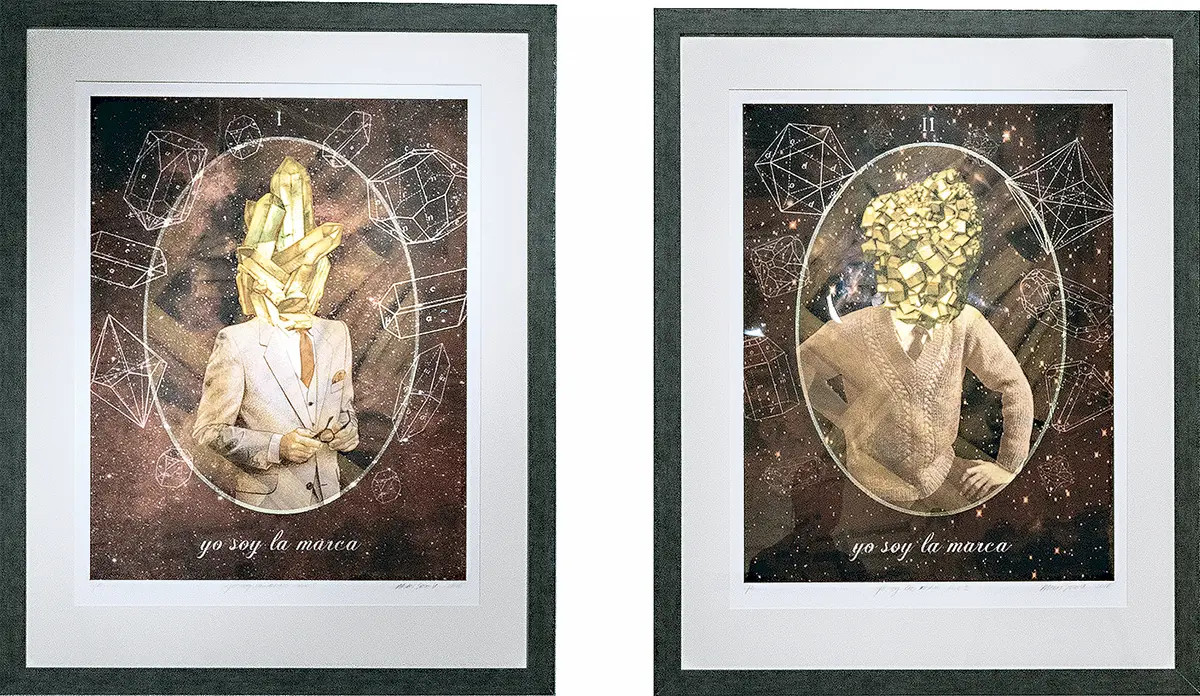
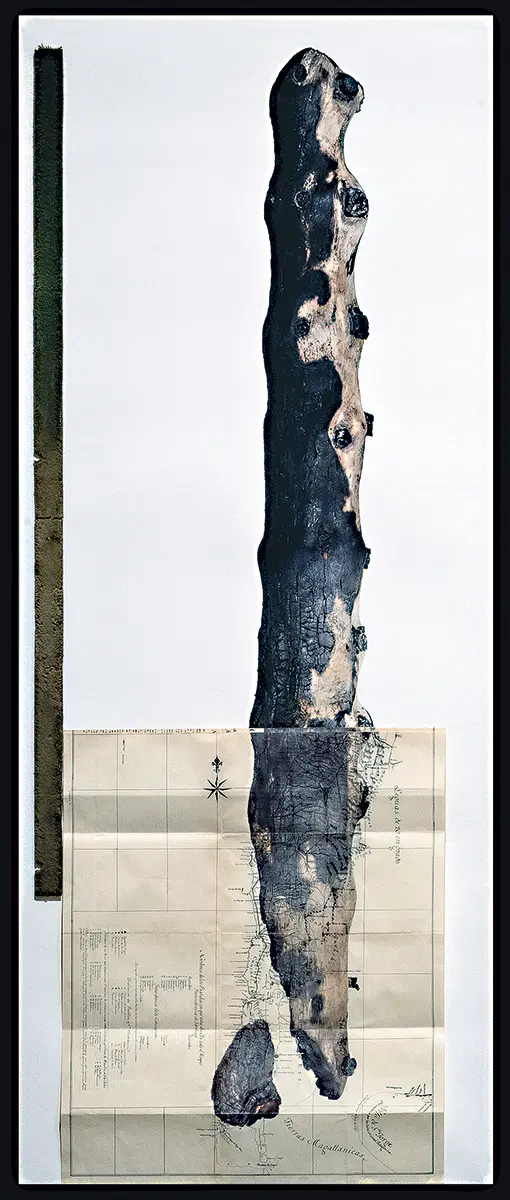
White in color, the first gallery titled “Diagramas” (Diagrams), focuses on the point of inflection provided by several artists who bridged the earlier Escena de Avanzada and the Vitalist Revolt of the 1980s. This group is represented by Mario Soro and Arturo Duclos, both members of Eduardo Vilches’ printmaking workshop at Universidad Católica, where they were encouraged to move towards new kinds of supports. In both cases, the works exhibited are critical of traditional languages and media. The exhibition features some contemporary collages by Soro, along with a series of drawings made during a trip to Germany in 1992.2 Duclos, in turn, presents an installation with found objects allusive both to his personal history and to the Latin American imagery that has always been present in his work. Alicia Villarreal, also featured in this gallery, exhibits photographs of land devastated by fires and pieces of charred wood in a collage with old maps of Chile, all part of a broader investigation on territory and memory.
Titled “Posmodernidad Vintage” (Vintage Postmodernity), the second gallery—in an apricot-orange hue that was in fashion in the 1980s—presents the work of first-wave artists from the MAVI collection in dialog with the new production of their second-wave counterparts: Carlos Maturana (Bororo), Samy Benmayor, Pablo Domínguez, Omar Gatica, Gonzalo Díaz, Jorge Tacla, and Francisco Smythe, in the first instance; Bruna Truffa, Coco González, and Rodrigo Cabezas, in the second.
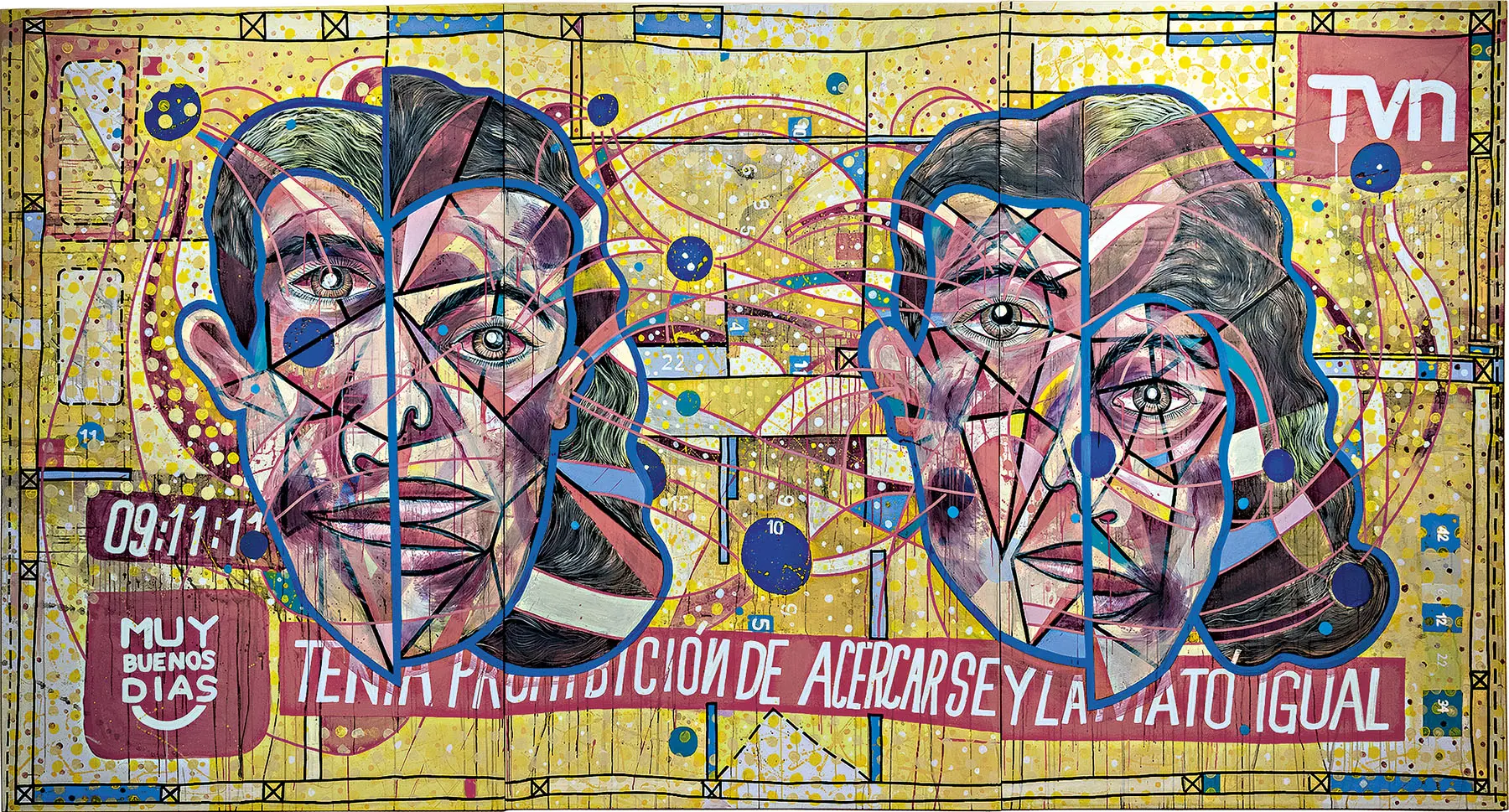
In general, the artists of the second wave had a more critical way of looking at things and engaged painting in a radical mode, bursting it open based on its own points of reference. This is the case of Rodrigo Cabezas’ diptych Yo la quería (I Loved Her, 2019), a large-format painting dominated by the neon colors that are typical of the 1980s. The title alludes to a song by Los Electrodomésticos, an iconic band from the period (the lyrics are about a crime of passion), while at the same criticizing the model of today’s television programming, which contributes to the contemporary world’s feast of violence.
Bruna Truffa3 presents a colorful triptych of migratory birds that speaks of today’s human refugee and migrant crisis. She also introduces one of her female characters, the wind-up woman, who moves from the wall to the painting and ultimately materializes in two kitsch-style ceramic sculptures. Jorge “Coco” González Lohse exhibits a series of twelve small canvases encased in dioramas; his works deconstruct Chile’s landscape using references to and quotations from the history of the country’s painting and pop-culture figures, all the while commenting ironically on a historical past filled with violence. At floor level, González Lohse unfurls a walkway with 365 mountain and volcano shapes that reference Chile’s landscape.
The third gallery, Arqueología en blanco (Archeology in White), transports us to the cultural and emotional context of the 1980s via the loop projection of a work by Luis Navarro. To reconstruct a decade, Navarro’s video clip-like visual collage uses images gleaned from TV ads and news broadcasts, documentaries, early Japanese animations, photographs, and videogames, combined with the sound of the New Wave, punk, and rock bands that emerged from the period’s countercultural effervescence, such as Los Pinochet Boys, Los Fiskales Ad-hoc, and Los Electrodomésticos.
Painting-Based Experiments
The filiations put in play by these artists must be seen as the result of an adverse context, both in political and economic terms. Deprived of state support for obvious reasons, the Vitalistas learned that self-management was their only tool. They formed duets and collectives like Contingencia psicodélica (Psychedelic Contingency), which included Mauro Jofré and Carlos Araya among its members; they published journals, fanzines, and books, and held many group exhibitions. The path leads to the fifth gallery, “Gabinete de ediciones” (Editions Cabinet), which features original copies of comics from the period, music album covers, posters, documentary photographs, catalogs, and books, along with the Vitalista group’s graphics production.4
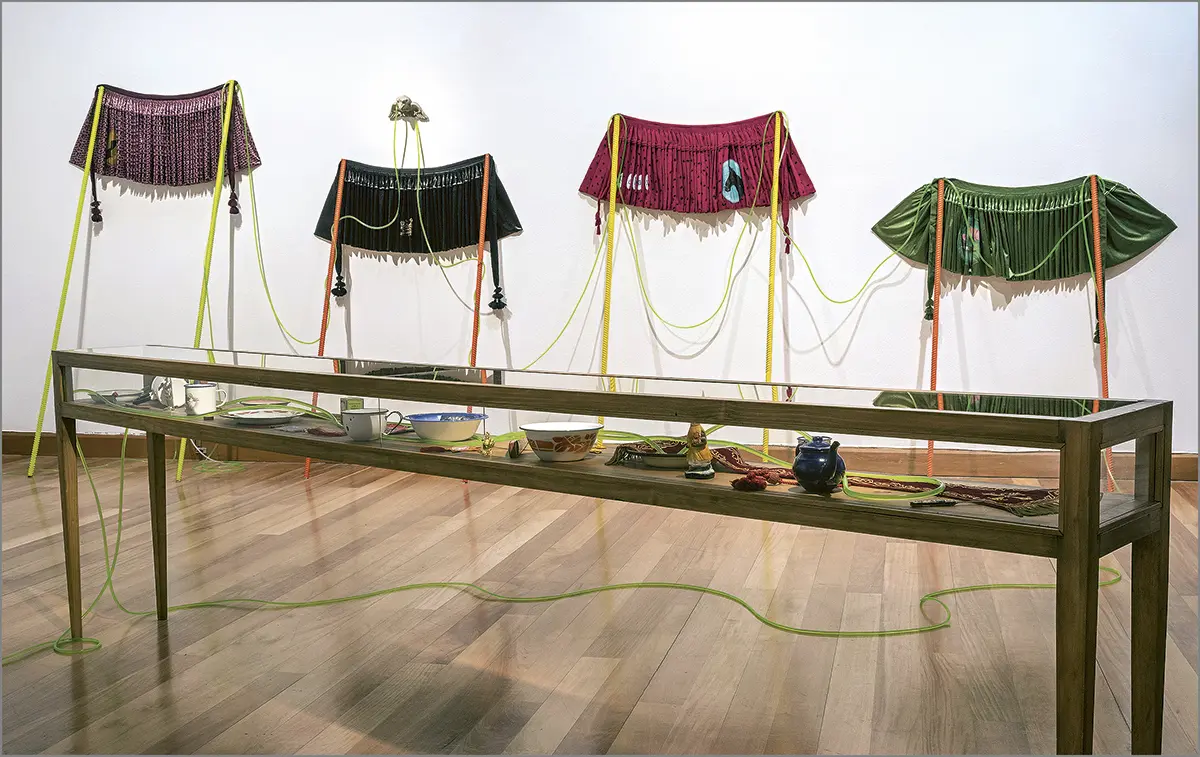
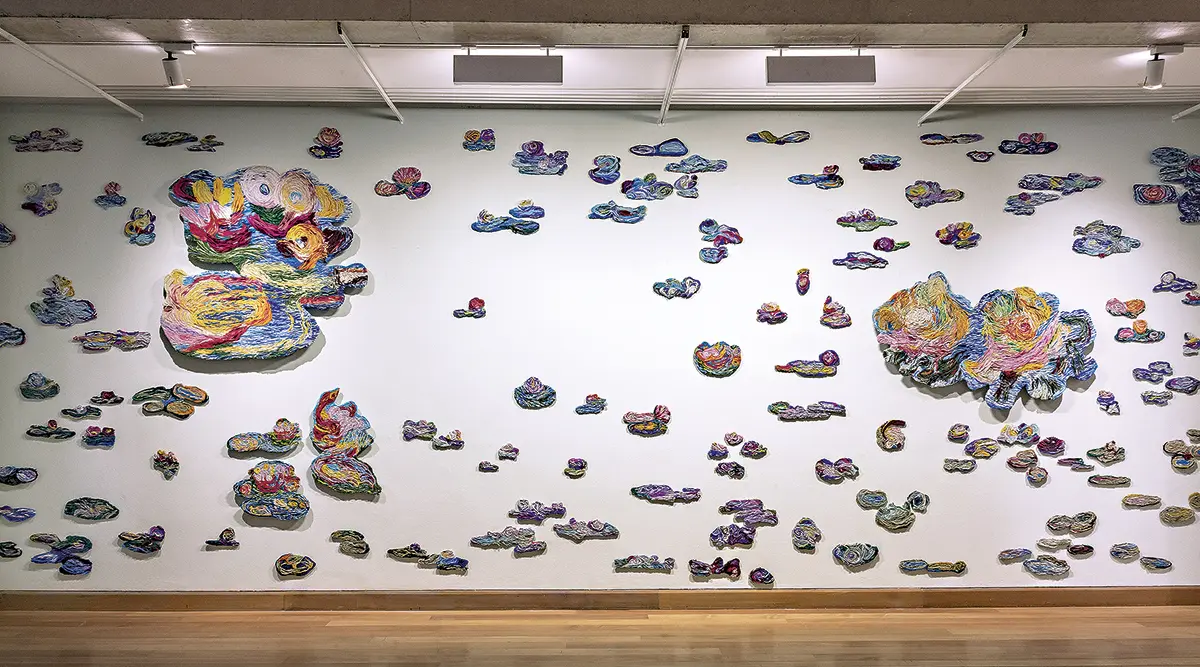
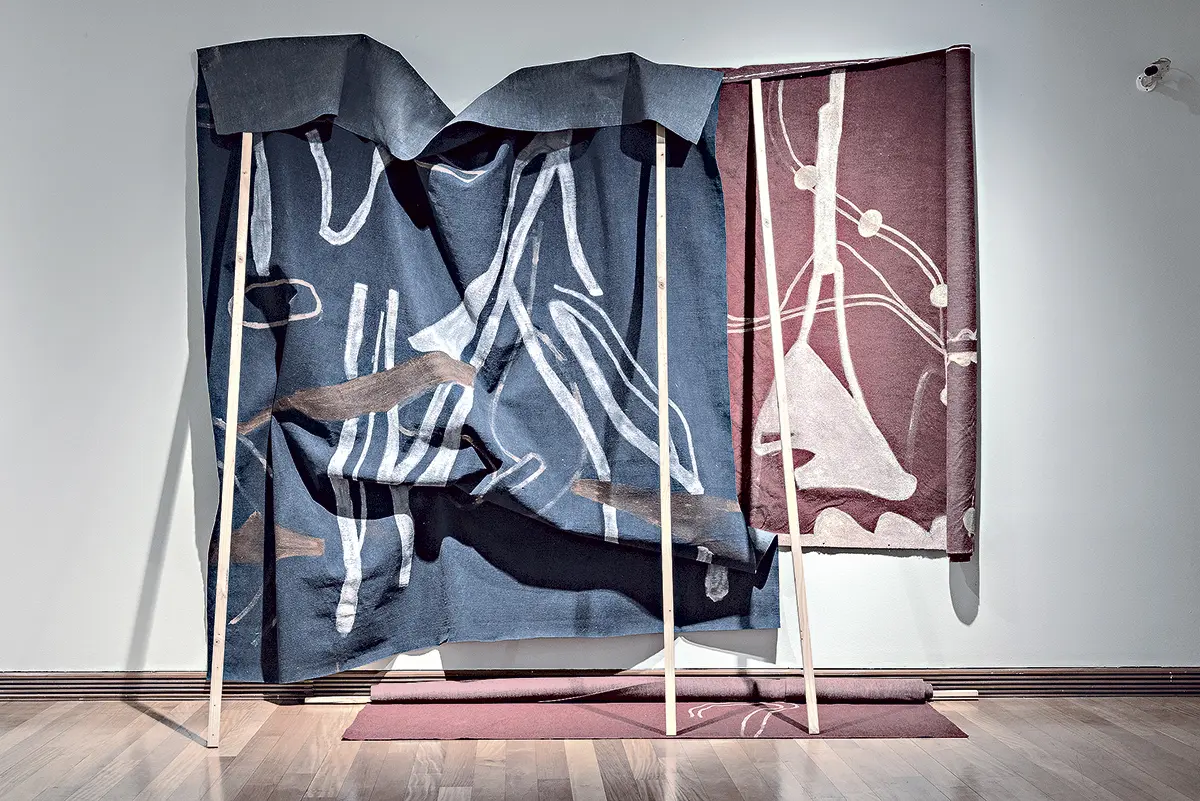
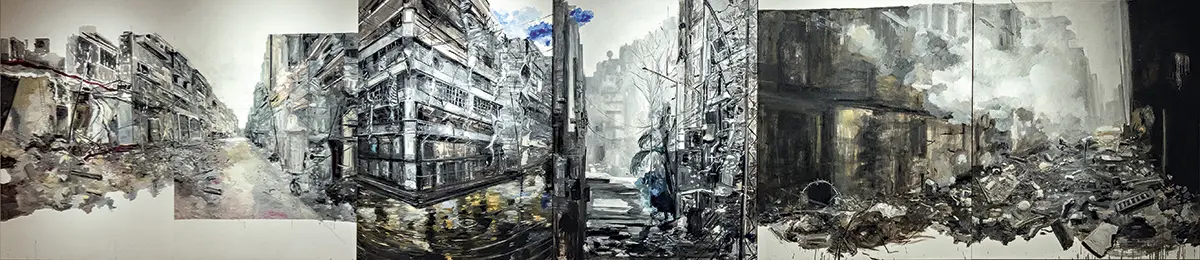
The fourth gallery, painted emerald-green, brings together artists who moved beyond the boundaries of stretcher-and-frame painting and invaded the surrounding space. “Arquitectura de la abstracción” (Architecture of Abstraction) is the title given to the works by artists such as Ciro Beltrán, who uses rugs—leaning on the museum walls with the help of wood beams—as supports for a move from painting to installation and performance, all in a single work of art. In turn, Paula Zegers presents an exercise of textures and materialities based on the color black, using ceramics and fabric. Meanwhile, Malú Stewart unfurls onto the walls one hundred figures cut in cholguán—a type of wood-fiber plate common in Chile —, embroidered with colorful pipe cleaners and arranged to resemble water lilies on a pond. The central space is dominated by Víctor Hugo Bravo’s work, a camouflage-painted piano sprouting eight giant spider legs (a reference to Louise Bourgeois), while a polyptych by Carlos Araya (Carlanga) titled Alepo (Aleppo) —a reference to the Syrian city—presented as a frieze in height, deconstructs pictorially urban destruction in contemporary wars.
In the space titled ¿Quién le teme a Virginia Woolf? (Who Is Afraid of Virginia Wolf?), curator Dermis León explores the idea of an undercurrent of feminism in the Chilean context, unexpressed perhaps due to the fear many felt to announce their political and gender identities openly. At any rate, the women featured in this central gallery in the MAVI building explored art based on their personal experiences, through humor and irony-filled emotional narratives.
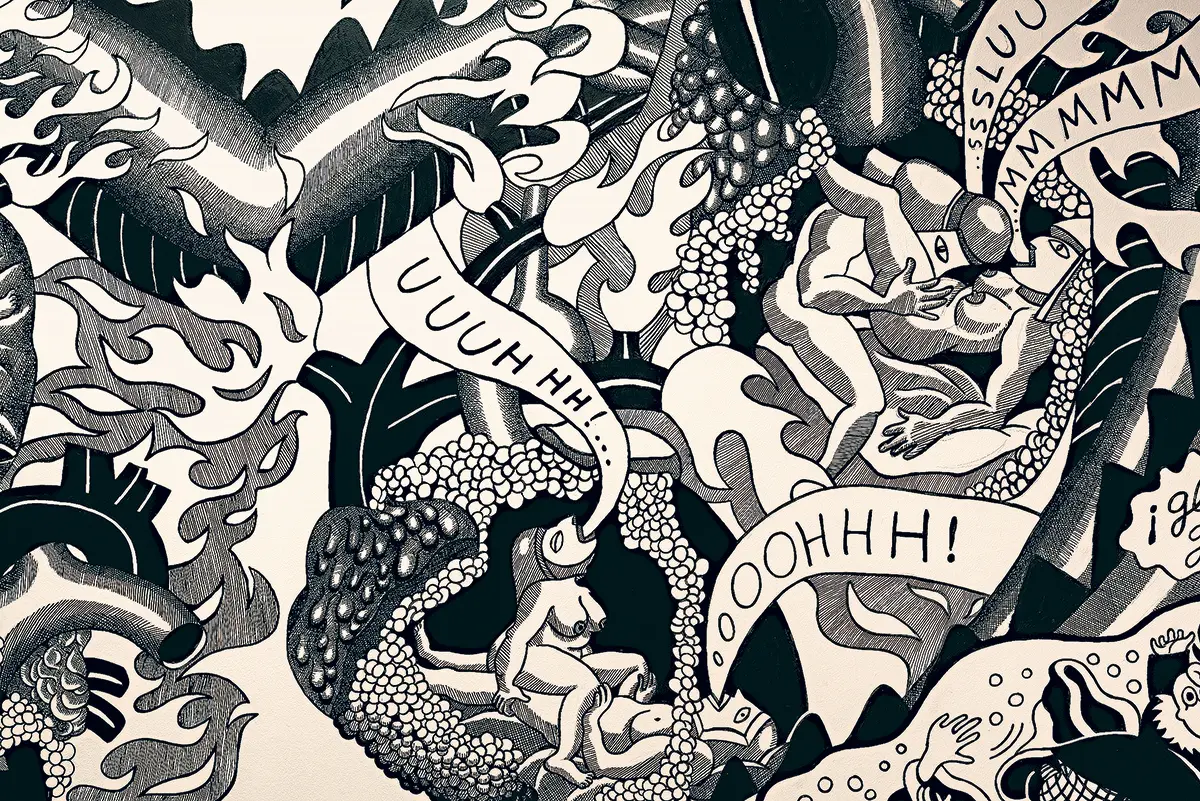
Marcela Trujillo,5 an artist working on comics, exhibits original vignettes and was invited for the first time to expand her imagery on a large-scale, black-and-white wall intervention. She shares the space with Claudia Peña and her portraits of women, rather traditional in style yet, at times, leaning on folk visuals. A similar vein of folk culture appropriation is present in Los vigías (The Lookouts, 1994), a sculpture group by Francisca Núñez from the MAVI collection. Emblematic for her work as a sculptor, Núñez assembles wood, paper, and fabric, to create two characters with Pop-Art inflections, in terms of their color, and informal-expressionist overtones, in their combination of materialities.
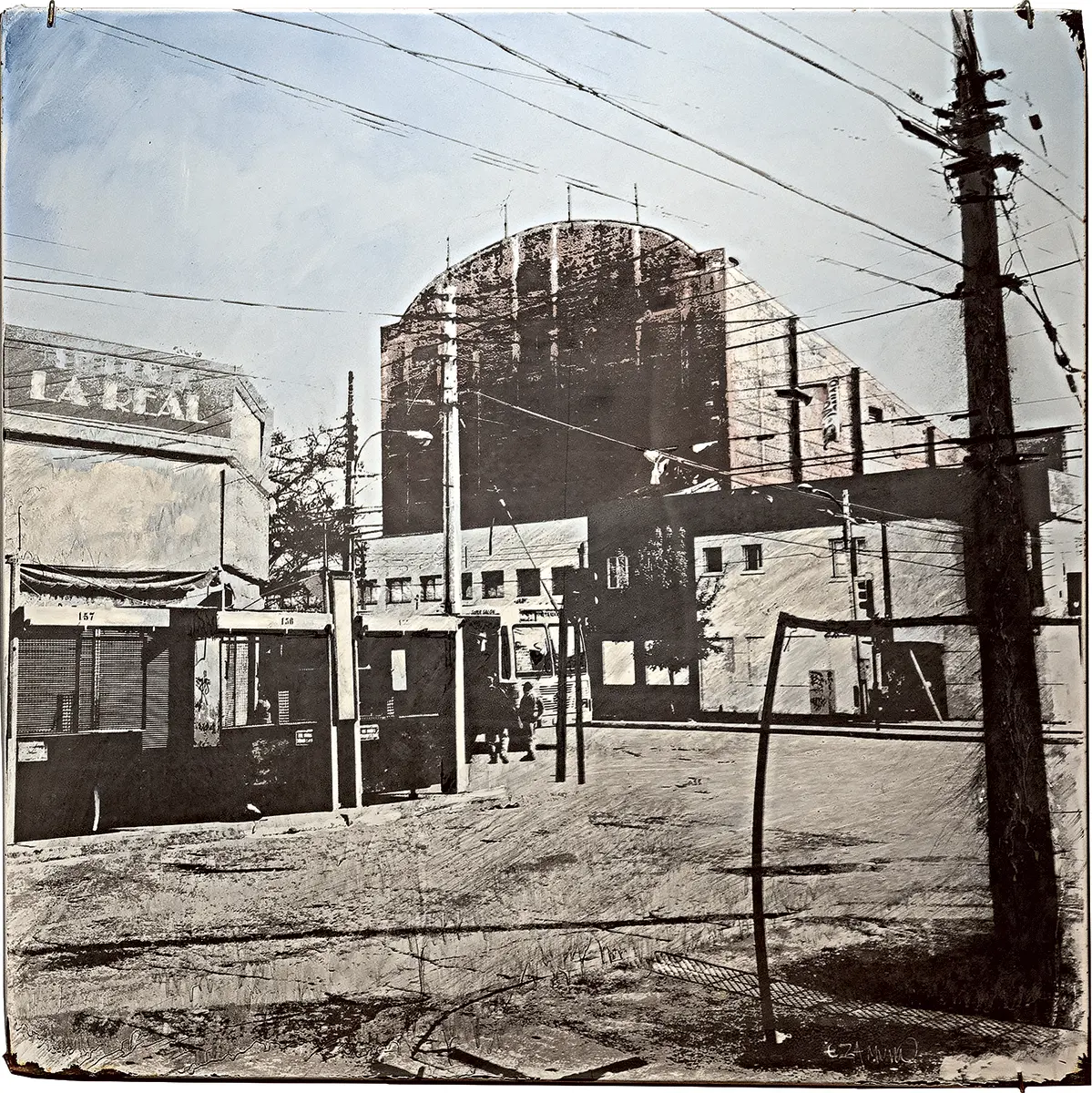
“Voces y Susurros” (Voices and Whispers), at the end of the exhibition’s journey, refers to the use of technical media such as photography and video, which, in their experimental analog forms, function as antecessors to the digital era. Klaudia Kemper’s installation intervenes a nine-meter wall with 286 painted acetate plaques, sequences from M, a 1990 video animation6 about the problems faced by a character stalked relentlessly by a beast. Meanwhile, a spontaneous dialog takes place between Sebastián Leyton’s paintings of landscapes from the urban periphery, like Torre de agua (Water Tower, 2017), and Enrique Zamudio’s photo-emulsion screen prints on metal, that record abandoned sites in the city, as well as details of Chilean wild flora as if they were images taken from a 19th century book.
After more than thirty years since the origin of the Vitalist Revolt, it is difficult to try to reconstruct history eloquently and linearly among artists who have taken such heterogeneous paths. Several of them lived abroad, and after the return of democracy in Chile, they exhibited the absorption of foreign influences that are reflected in their current work, conforming with their completely independent universes. Dermis León, nevertheless, manages to find a common spirit that holds this group together, setting up, with this exhibition, a first approach that deserves to be deepened even more. With this gesture, it is possible to claim, in the first instance, the contribution made by these creators, by putting together an effervescent original artistic scene, in which the vital impulse is the great winner.
NOTES
1. Critic Nelly Richard coined the term Escena de Avanzada to describe those artists who, moving away from painting in the direction of immediacy and experimentalism, broke with the academic tradition. Among them were Grupo CADA and individuals like Eugenio Dittborn and Carlos Leppe. Richards explored the subject in her book Márgenes e instituciones, published in 1983.
2. He had traveled to Germany to participate in Cirugía plástica (Plastic Surgery), an exhibition featuring many of the Vitalistas now included in Los dominios perdidos.
3. In the early 1980s, Bruna Truffa, Rodrigo Cabezas, and Sebastián Leyton launched a creative collective; it dissolved in 2003 and reunited in 2016 as the duet Truffa+Cabezas.
4. In 2014, many of the artists featured in this exhibition established SXC Cooperativa de Artistas, a platform for the research, creation, promotion, and sale of artworks.
5. Trujillo began to explore the world of underground comics in the late 1980s, creating Maliki, her alter ego, and producing the autobiographical works for which she is known today.
6. M won a Video Festival award and is now part of MoMA’s collection.
DENISSE ESPINOZA A.