A few years ago, as I was writing an essay for the catalog of the exhibition Loló un mundo imaginario (Loló an Imaginary World), I reflected on a phenomenon that Dr. Eusebio Leal intelligently defined as the “misfortune of gender.” He used the expression to describe the prejudice historically suffered by women in many domains of life, who, just because they were women, could not enjoy the same opportunities and benefits as their male counterparts. Leal was referring specifically to Mirta Cerra, one of the great representatives of modern art in Cuba.
I confess that the observation made me rethink the history of Cuban art from that point of view, and the analysis drove me through a path filled with omissions. I quickly compiled a long list of names that were yet to receive their dues, such as Mimí Bacardí, María Pepa Lamarque, Zilia Sánchez, Carmen Herrera, or Dolores Soldevilla (Loló). For the later, I sketched at the time an “unfinished laudation,” arguing for a need to continue researching her life and work, towards a rediscovery that will allow us to establish the true dimensions of her creative praxis.
More than ten years have passed since then, and the efforts of many art historians, critics, and curators in this process of historical salvage must now be acknowledged, among them Rafael Díaz Casas, Ernesto Menéndez Conde, Osbel Suárez, and Abigail McEwen. To their work we owe the fact that Loló Soldevilla’s name has begun to emerge from anonymity, all in the context of a newfound recognition for an entire period in the history of Cuban art until very recently deprived of visibility. Other associated factors are the ongoing boom of geometric abstraction in the international scene, which undoubtedly conditions the attention of researchers and collectors and drives the market, as well as the increasingly growing view towards Latin American art in general and the presence of a higher number of women artists in collective exhibitions worldwide.
In the midst of what is known today as the Carmen Herrera “phenomenon”—whose works reach very high prices and are included in the catalogs of different international exhibitions—the name of her fellow Cuban Loló Soldevilla has also shown up in the roster of several important exhibitions in recent years. For example, América fría, held in 2011 at the Fundación Juan March, in Madrid, explored Latin America’s geometric abstraction between 1934 and 1973. To the Argentinean grid, Venezuela’s kinetic art, and the Concrete adventure in Brazil, it added an unexpected Cuban presence, particularly Soldevilla’s and its unique stance. In 2015, El Museo del Barrio in New York City, in collaboration with the Museo de Arte Contemporáneo de Buenos Aires (MACBA), organized The Illusive Eye, revisiting geometric, optic, and kinetic art from a mostly Latin American standpoint. Alongside the most widely renowned figures of the movement, like Julio Le Parc, Victor Vasarely, Carlos Cruz-Diez, and Jesús Rafael Soto, women were amply represented, and Soldevilla appeared next to Lygia Clark, Matilde Pérez, Gego, Martha Boto, Lygia Pape, as well as Carmen Herrera and Zilia Sánchez.
Loló Soldevilla’s work was also displayed alongside Zilia Sánchez’s and Amelia Peláez’s in an exhibition organized by New York’s Galerie Lelong. The show told, in the manner of constructivist dialogs, the story of more than fifty years of geometric art in Cuba, and acknowledged the role played by Soldevilla as a key figure in the formation and promotion of the Concrete movement in her country.
In 2017, the art of Cuba was once again in the news with Adiós Utopía. Dreams and Deceptions in Cuban Art Since 19502, an exhibition in which geometric art occupied an important space and once again Soldevilla’s work gained singular prominence. Recently, Madrid’s Museo Nacional Centro de Arte Reina Sofía (MNCARS) selected some of her works for the suggestive exhibition París pese a todo: Artistas extranjeros 1944-1968 (Paris in Spite of Everything: Foreign Artists 1944-1968), which reconstructed the complex art scene that emerged in the French capital at the end of World War II.
With a frenzied attitude that zig-zagged between “somnambulism” and a “state of madness,” Loló Soldevilla represents in Cuban art a high dose of enthusiasm and fervor. Her constant drive to experimentation summarizes the desire of someone who has just discovered art and wants to exploit it by itself. In Cuba’s cultural context, Soldevilla’s work was particularly unique and new. She was among very few women who broke into the artistic horizon in the 1950s and deserved to be held in an elevated position.
Dolores Soldevilla Nieto was born in 1901 in Cuba’s westernmost province, Pinar del Río. She was a multifaceted woman who worked as a teacher and a journalist, practiced music and literature, and was also a representative in Congress and a cultural ataché in Paris. She began painting in 1948 motivated, according to family lore, by her close friendship with Wilfredo Lam. In a letter Lam wrote her after seeing her paintings for the first time, the great Cuban artist acknowledged Loló’s courage and described her work as a real example of passion and honesty, anchored on unbridled creative freedom.
After visiting several museums in the United States under the sponsorship of the American Federation of Arts—a tour that brought abstract and surrealist art to her attention for the first time—Loló settled in Paris in mid-1949. She remained in the French capital for more than five years, fulfilling her diplomatic responsibilities as Cuba’s cultural ambassador. Post-war Paris, marked by a bustling cultural climate and the confluence of artists from around the world, provided a favorable environment for the development of her artistic interests.
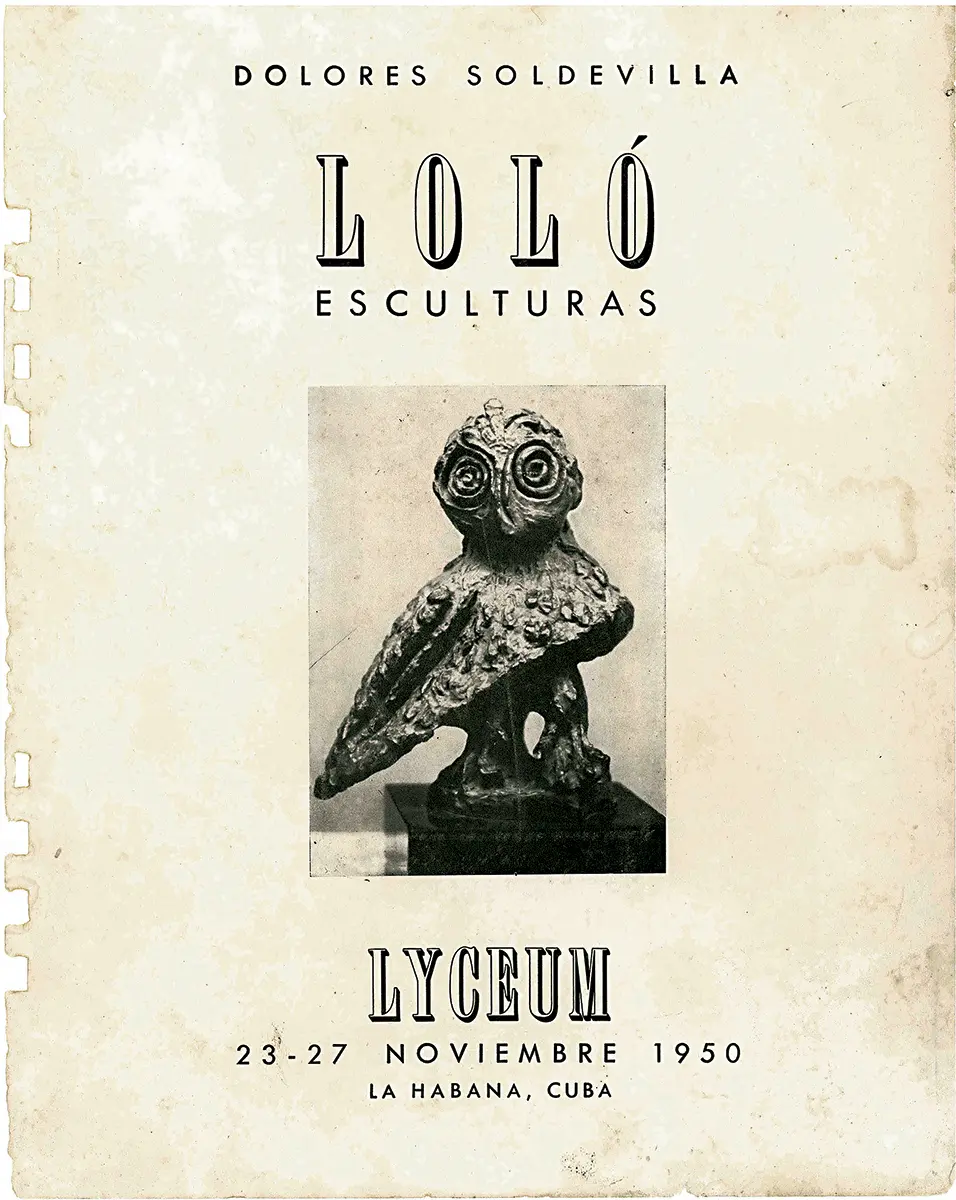
During her Parisian sojourn, Soldevilla made frequent trips back to Cuba to exhibit her work. She had her first solo show at the Lyceum in November 1950, presenting a series of sculptures in various materials, including stone, bronze, terracotta, and plaster, all resulting from her experiences at the La Grande Chaumière Academy and the Léopold Kretz and Ossip Zadkine workshops. These small-format sculptures revealed an interest in the representation of human figures based on the deformed and the grotesque, which anticipated by a decade the aesthetic approach developed by Cuban sculptor Orfilio Urquiola.
A few months later, Loló organized her second solo exhibition in Havana, now revealing herself as a painter. Twenty oil works representing individuals of her immediate milieu or her family were on display at the Law Students Union at the University of Havana. These were naïf inspired figurative portraits that carried under a pregnant silence, as she defined it, “meters of smoke, of pain, with hate in their pupils.” 3 The two exhibitions were Loló’s introduction to the Cuban public, and she would repeatedly return to the country to present her explorations in the arts.
One of the great achievements in Loló’s diplomatic career was the Art Cubain Contemporain (Cuban Contemporary Art) exhibition, featuring a selection of works by the most relevant Cuban artists of the period. It opened in February of 1951 at the Musée National d’Art Moderne in Paris, to great media resonance, and can be compared in its ambition to the 1944 Modern Cuban painting show at the Museum of Modern Art (MoMA), in New York City.
Abstraction soon made its appearance in Soldevilla’s work, not in response to a whim or as an exciting move but stemming from her need for continuous formal experimentation. Her exchanges with representatives of the Paris School—such as Victor Vasarely and Jean Arp—and her classes in the Jean Dewasne and Edgar Pillet workshops defined, to a large extent, a new meaning for her work and significant shifts in her creative process. Abstract art gained considerable impetus in the second half of the 1940s. In terms of the art field, the post-war period in Europe was crowned by the development of geometric styles. Galerie Denise René, which opened in 1944, and the Salon des Réalités Nouvelles, established two years later by Fredo-Sides, were two key pieces in the international validation of abstract art. The Van Doesburg group found followers among figures like Max Bill and Jean Arp, whose ideas coincided in the need to explore a purely rational expression, facilitated by the exactitude of precise instruments and the use of pure components.
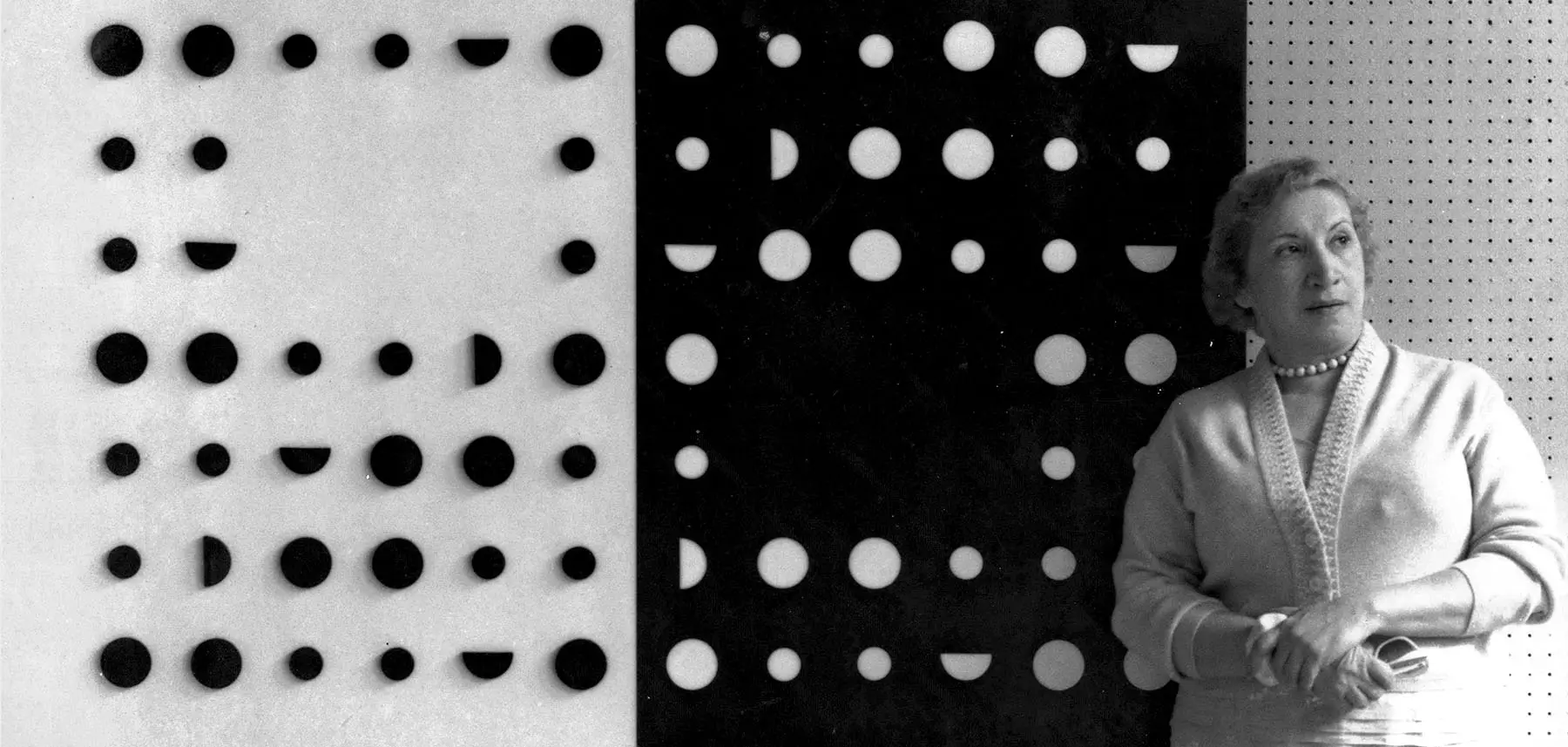
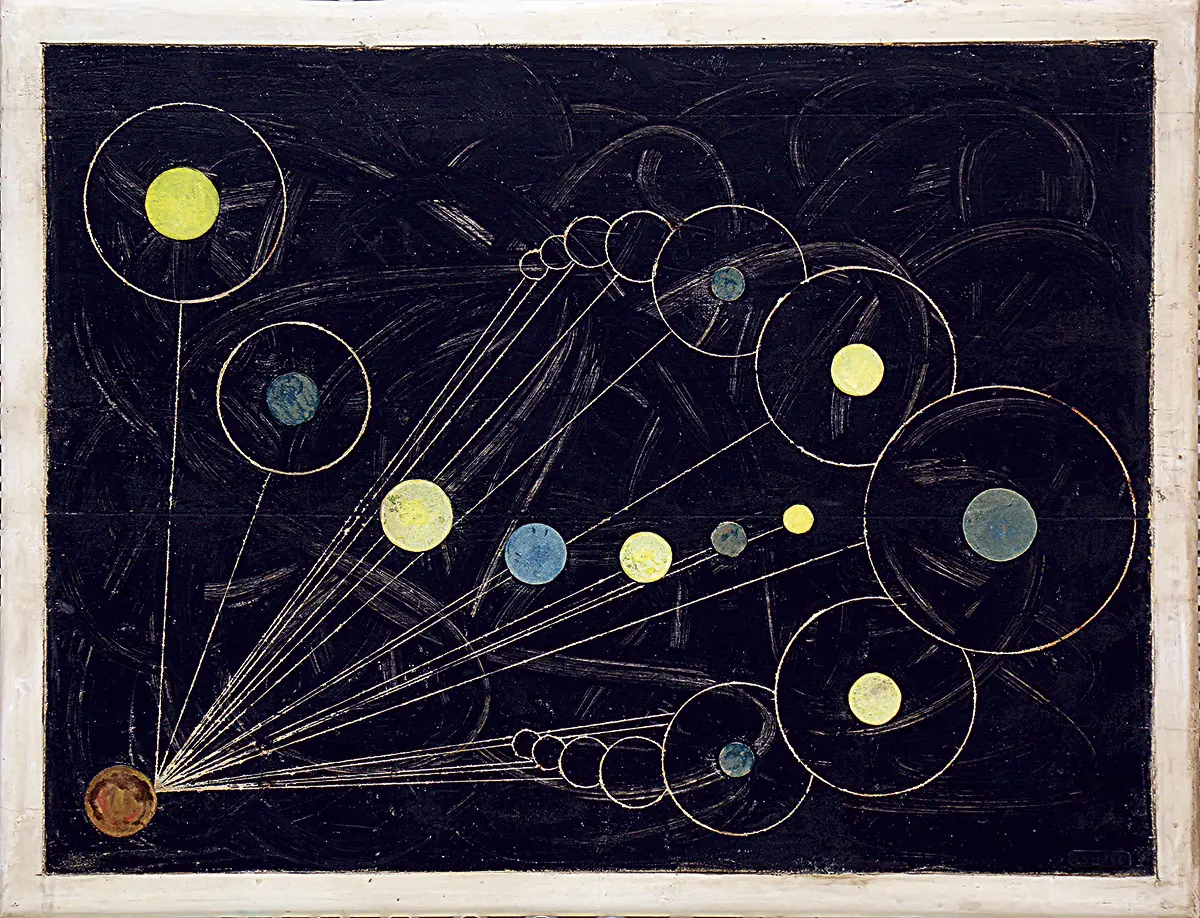
Loló joined the Parisian avant-garde and exhibited alongside its members. Her works partook of the concept, promoted by abstract art, of the creation of new pictorial realities based on the transformation of the painting into an object in itself. Loló’s deft astral compositions, which she dubbed her celestial charts, are the product of a grand imagination, distinguished by the organic character of its elements and the centrality of color. “Loló’s abstraction, the essential images of which are the circle, the square, and light, expresses the symbolic values of an essential mythology of space brought to its most scientific conclusions by a geometry as poetic, sober, and luminous as the celestial, star-filled spaces where she seems to find her inspiration.”4
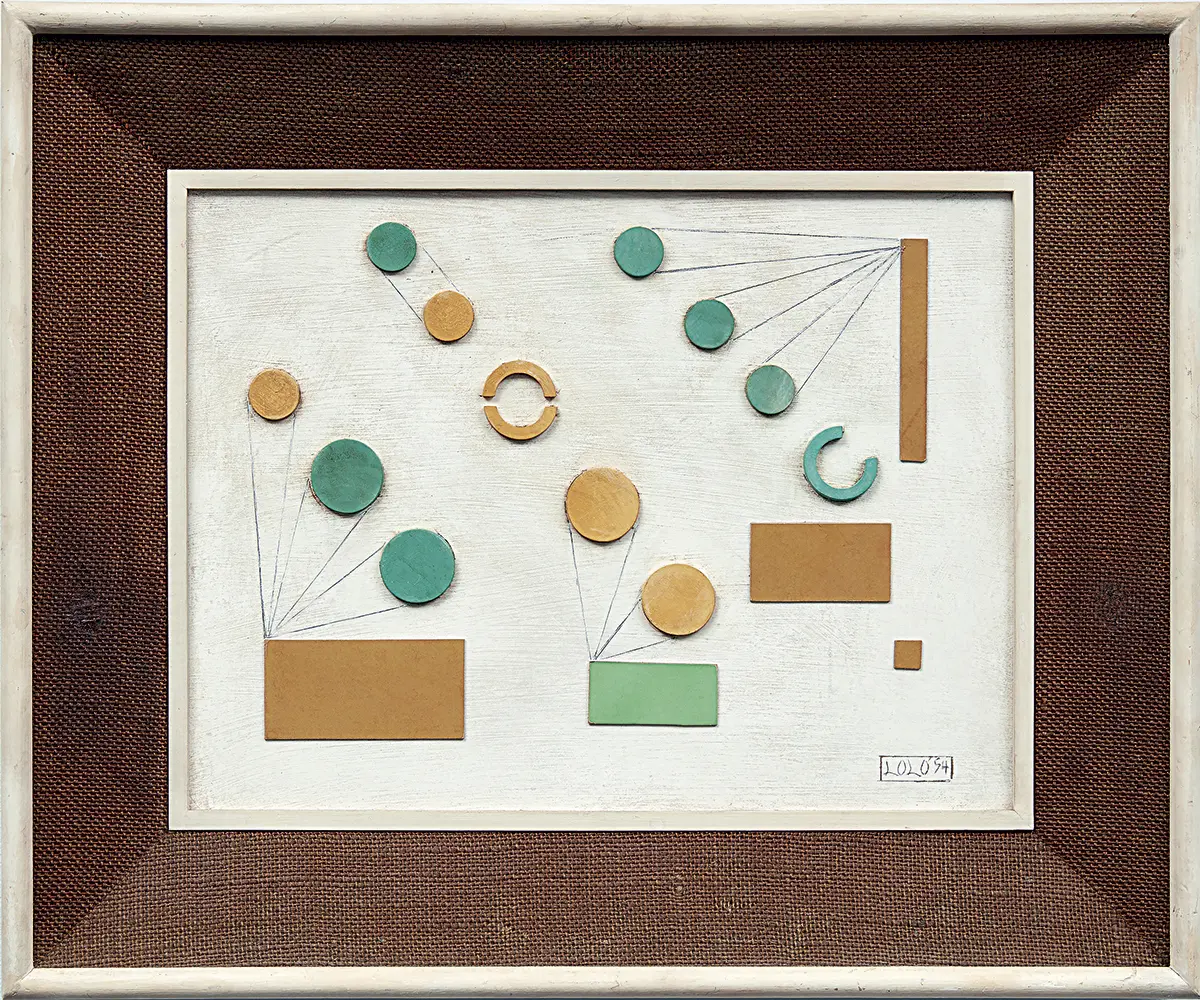
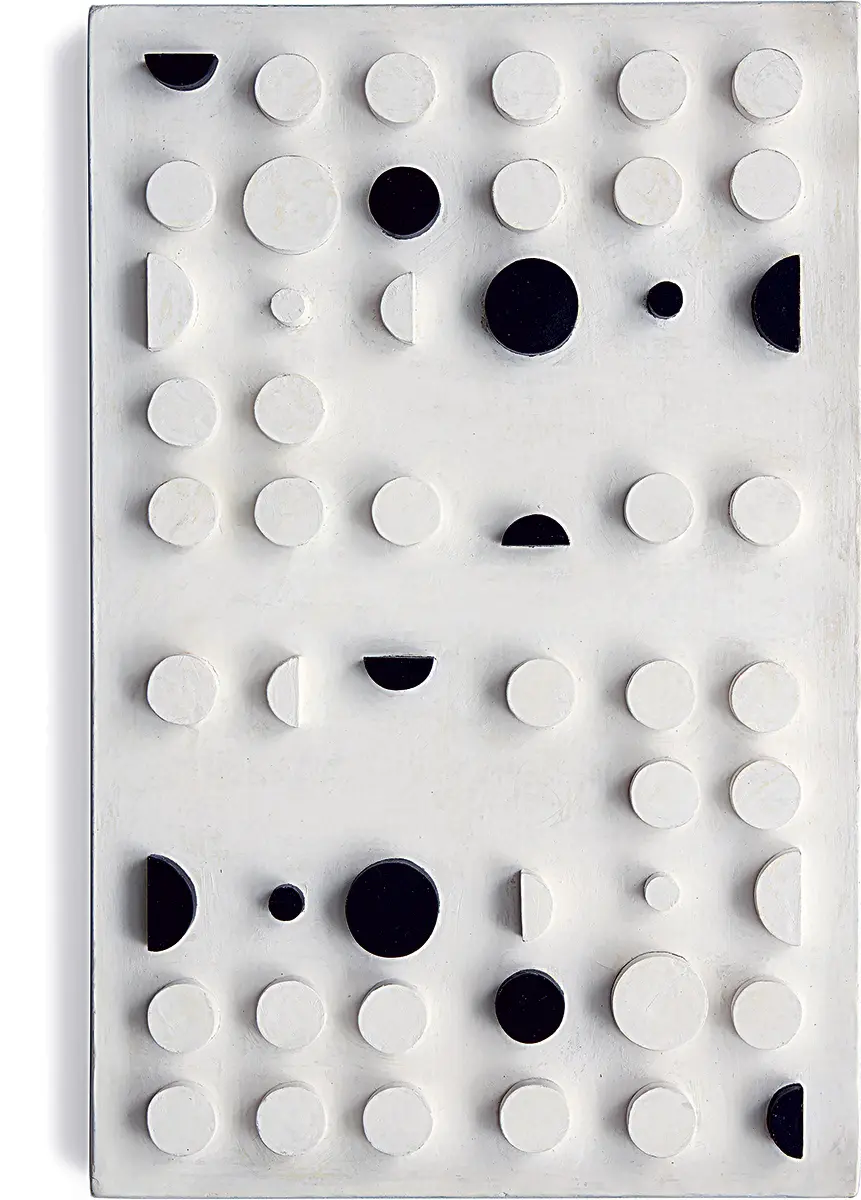
Modern life and its accelerating automatization offered a handle for the search for new ways to express the characteristics of the world around us, always from the artist’s spiritual perspective. Loló’s “constructions” or “boards,” as they are known, appear to have a strong point of reference in Sophie Taeuber-Arp’s tableaux reliefs, a true and refreshing liberation of space developed by the Swiss artist in the 1930s. Loló’s use of new materials and different supports during this period signifies the emergence of an artistic universe capable of being unendingly recreated. The chromatic cadence, obtained from a succession of blacks and whites, and the never-repeated arrangement of elements in the composition are some of the recurring features.
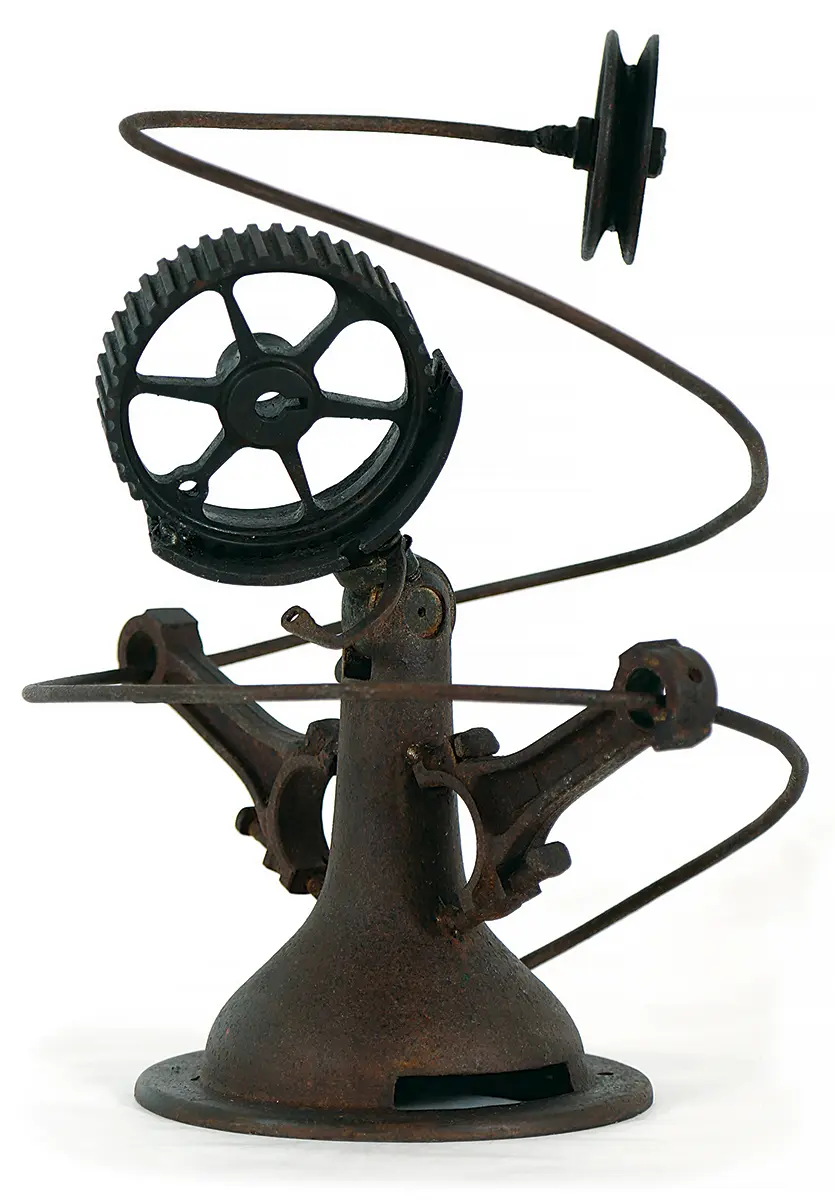
In 1955, after several editions in which she also participated, Soldevilla exhibited in Réalités Nouvelles her light reliefs, clearly connected to her ceaseless drive to experiment. The execution of these plastic objects, to which she incorporated artificial light, was in large part a result of Loló’s professional relationship with the Spanish kinetic artist Eusebio Sempere. Soldevilla and Sempere had already exhibited together at the Círculo at the University of Valencia (Spain), in 1954. Loló’s fulgent paintings are, from a historiographical point of view, anticipations of Sandú Darié’s Cosmorama of the 1960s. 5
Loló was an unusually masterful practitioner of collage techniques, which became one of the most authentic registers in her entire oeuvre. Also, in 1955, the Parisian gallery La Roue was happy to present her small cut-paper spheres, arranged wisely and with exquisite taste as a genuine attempt at music; critics described them, indeed, as a kind of musical phrasing where harmony and simplicity exist hand in hand. With these collages, Loló demonstrated that she was able to “multiply rhythms and organize colors in compositions that never repeat.” 6
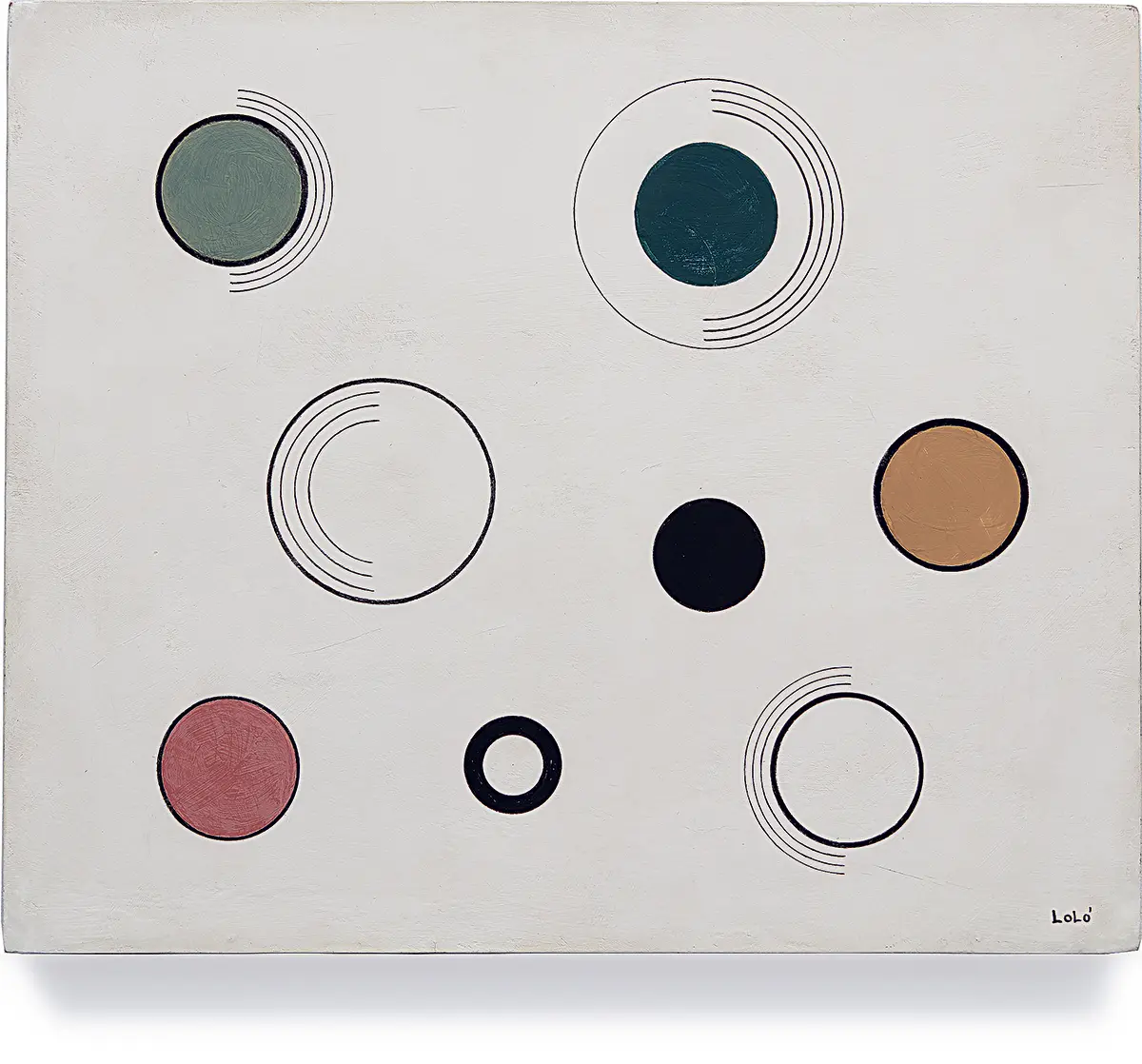
Dolores Soldevilla returned definitively to Cuba in 1956, bringing with her “a considerable cargo of original works, reproductions, and documents by artists or groups of artists subscribing to geometric abstraction, Op Art, and kinetic art. It was a legacy accumulated for more than five years, the result of a patient and passionate assimilation of those aesthetic approaches, and a successful relationship with the media in which they came to be expressed.”7
Those were the origins of the important exhibition titled Pintura de hoy. Vanguardia de la Escuela de París (Painting Today. Vanguard of the School of Paris), organized at the Palacio de Bellas Artes in Havana. This anthological show, dominated by European geometric abstraction, had a powerful impact on the local art scene with its novelty and prodded young creators to adopt the new styles.
During the 1950s, in Cuba, “a revolution developed, and, with time, became a hard-transgressional zone and shook the foundations of an aesthetic formed by neologisms that lasted more than a century. The development of non-figurative art in its two veins, abstract expressionism (or informalism) and geometric abstraction (or concrete art) became the debate node in Cuban art of the period.” 8 Loló was an essential part of this new generation of artists committed to directing Cuban painting towards harmony with universal visual arts, also exercising a powerful influence over all her colleagues.
After a solo exhibition at the Palacio de Bellas Artes in Havana, which brought together oils, collages, and light reliefs produced between 1953 and 1956, Loló traveled to Venezuela, invited by the journal Integral.
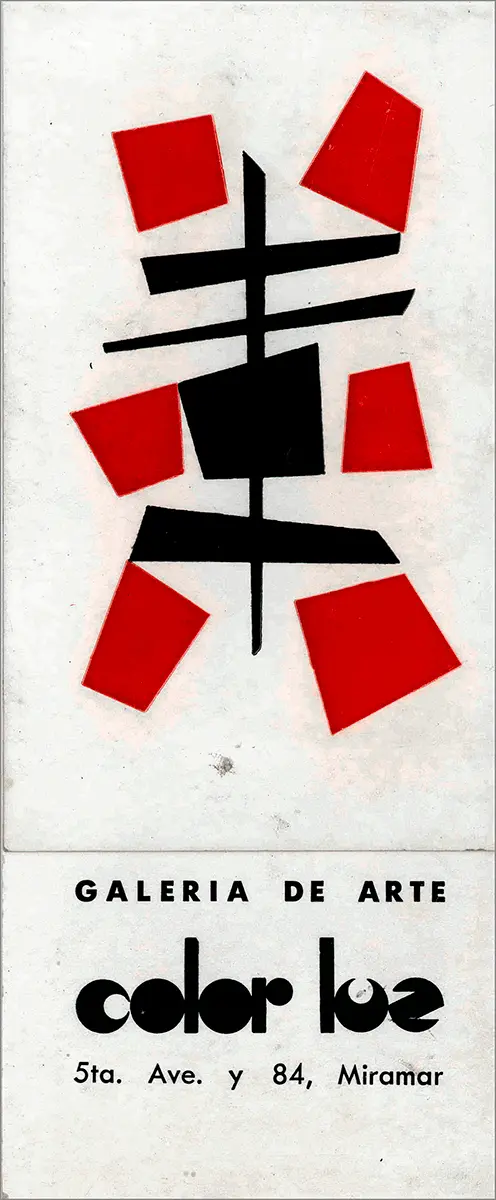
Her connection with this Latin American country goes back to the relations she established with some of the members of Los Disidentes, whom she met during her time in Paris, and with many of whom, she developed great friendships. Her visit to Venezuela included a show at the Sala del Centro Profesional del Este, in Villa Flor (Caracas), which was well received by the local press. Back in Havana, motivated by her exchanges with Caracas’ Sardio gallery, Loló established, together with Pedro de Oraá, Color Luz gallery, in October 1957. Located in the wealthy neighborhood of Miramar, the gallery opened with a group show of Cuban artists. On opening day, renowned writer José Lezama Lima gave the welcoming remarks. The new space fostered the gathering of artists who shared criteria and interests regarding the new modes of artistic expression. From her declaration, in a collective manifesto to which she ascribed herself in Paris in 1955, Loló warned about the extraordinary importance of both elements–color and light–for the artistic creation. Color Luz gallery, a real entrepreneurial effort, closed in 1961.
With her magnetic personality, Loló was able to gather around herself many artists, some of whom had already established careers in Cuban art. Motivated by the desire of promoting a new and unique mode of expression in the late 1950s, they decided to organize the group 10 Pintores Concretos (10 Concrete Painters). Loló and Oraá were joined by Sandú Darié, Luis Martínez Pedro, Salvador Corratgé, Wilfredo Arcay, Alberto Menocal, José Mijares, Pedro Álvarez, and Rafael Soriano. José Rosabal, the youngest member, came on board shortly afterward. The lifespan of the group was rather short: it was officially established in November of 1959, with an exhibition at Color Luz, and disbanded in 1961, with another show, this one on the occasion of the First Congress of Cuban Writers and Artists.
Together with the group Los Once, concrete painters played a significant role in the rupture with the remnant academicism and the exclusive predominance of figurative art, introduced new concepts of the artistic expression, and asserted their version of the abstract-geometric current, this time in synchronic action with the centers of the artistic avant-garde.
After the triumph of the Revolution, in 1959, Loló alternated her creative efforts with other equally prominent assignments, among them teaching at the University of Havana’s architecture school, joining the editorial team for the newspaper Granma, and working as a toy designer at the National Tourism Institute (INIT). In 1965, Loló launched the Espacio group, and, in 1966, Galería Havana exhibited a solo show titled Op art, Pop art, la luna y yo (Op Art, Pop Art, The Moon and I), featuring more than forty works grouped in sections: Celestial Charts; Black and White Gallery; Humorites and Structures. She dabbled in literature and became a notable art critic. Among her books are Ir, venir, volver a ir. Crónicas de su estancia parisina (Go, Come, Go Back. Chronicles of Her Parisian Stay); El farol (The Lantern), and Bombardeo (Bombing). In terms of exhibitions, her contributions to two important collective events bear special notice: in a mural for the May Salon, which in 1967 moved for the first time from Europe to Havana, and the now-legendary Salon 70, which presented a diversity of expressive discourses acting upon one another in an interesting time of intergenerational confrontation.
After her death in 1971, a retrospective of her work was held in the exhibition gallery of the Ministerio de Salud Pública, featuring abstract and figurative paintings, prints, and drawings, as well as several sculptures and constructions.
Since then, only a few exhibitions have included Loló’s work: Creadoras cubanas (Cuban Female Artists) presented at the Museo Nacional de Bellas Artes, in 1988; Maestros de la pintura cubana (Masters of Cuban Painting) organized at the Centro Provincial de Artes Plásticas y Diseño, in 1991; and La razón de la poesía: Diez pintores concretos cubanos (The Reason for Poetry: Ten Cuban Concrete Painters), also at the Museo Nacional, in 2002. A year later, the Museo de la Marcha del Pueblo Combatiente organized a solo show titled Color Luz (Color Light), and in 2006 the Museo Nacional presented Loló: un mundo imaginario (Loló: An Imaginary World), a show intended to resituate Soldevilla’s oeuvre in the continuum of Cuban art.
In little more than twenty years of tireless effort, Loló was able to engrave her name in the history of both the postwar European avant-garde and Cuban abstract art, where she extended her drive, her skills, and her unique personality. Lauded by foreign critics, her work motivated commentary by renowned experts, including Jean Arp, R. V. Gindertael, G. Boudaille, and Michel Seuphor. Indeed, the latter included Soldevilla in his Dictionnaire de la Peinture Abstraite, along with other Latin American artists like Carmelo Arden Quin, Luis Guevara, and Gyula Kosice.
Audacity and joy, intellect and imagination, perseverance and dedication, galactic and earth-bound: these are some of the words defining Loló Soldevilla’s personality. The man takes refuge easily in molds established by him for centuries, always resting in easy and traditional ways. Loló dared to change and set out to create on a different plane and with greater possibility, bringing light and a renewed breeze for Cuban art. Her ability to continually experiment, break canons, and transgress times, explains Loló’s transcendence. “To interpret new laws, balance in color, shape, and composition, ought to be the task of an artist who marches forward with the times […] the spiritual integration of a work of art that represents for the viewer a legitimate inner truth.”9
Expectant figures, unfathomable harmonies, and an infinite of spatial forms comprise this splendid universe, moving at once serenely and hauntingly, possessing the wild lyricism of a teeming imagination. “The new art into which this painter has brought the mysterious algebra of light and time, delves deep […] in the unwritten space that contains the key to the absolute.”10 Through the well-deserved reassessment her work is experiencing these days, we know that “[…] her stone did not fall on a wasteland, but on water, which flows eternal.”11
NOTES
1. Wassily Kandinsky, quoted by Loló Soldevilla. In Loló: óleos, collages, relieves luminosos 1953-1956. Instituto Nacional de Cultura. Ministerio de Educación. Palacio de Bellas Artes, Havana, January 1957. Catalog.
2. An exhibition organized by the Cisneros Fontanals Art Foundation (CIFO), in collaboration with the Houston Museum of Fine Arts and the Walker Art Center of Minneapolis. These institutions presented the show in March and November of 2017, respectively.
3. Cartas a Baal. Autobiografía testimonial. Havana, August 8, 1949. CIFO Veigas archive, Havana.
4. “El arte nos enseña a pintar con una gramática organizada.” El Universal (Caracas), April 1957. Archive of the Collections and Curatorship Department, Museo Nacional de Bellas Artes, Havana.
5. There were few practitioners of kinetic art in Cuba. Besides Loló Soldevilla—with her mobiles and lightboxes—and the pioneering work of Sandú Darié—whose transformable structures anticipated a vastly diverse oeuvre where art and science came into true communion—we can mention the essential figure of Osneldo García, starting in the 1960s, and the Grupo Cubano de Arte Óptico, in the late 1970s. The latter was formed by Jorge Fornés, Helena Serrano, Armando Morales, and Ernesto Briel.
6. R. V. Gindertael, “Libertés et rigueurs du collage.” Cimaise, March 1955, Paris.
7. Pedro de Oraá, “Una experiencia plástica. Los Diez Pintores Concretos”. La Gaceta de Cuba Year 34, No 6, p. 51. Havana, November/December 1996.
8. Lázara Castellanos, “Centro y periferia. Breve estudio de las vanguardias cubanas de las décadas de los años 50 y 60”. Palabra Nueva. Revista de la Arquidiócesis de La Habana. Year 7, p. 42. February 2000.
9. A statement by the artist for the catalog of the exhibition Loló. Óleos, Collages, Relieves luminosos 19531956. Instituto Nacional de Cultura. Palacio de Bellas Artes, Havana, January 1957.
10. Severo Sarduy, Loló: 1953-1957. An exhibition organized and sponsored by the journal Integral. Centro Profesional del Este (Caracas, Venezuela). May 1957. Catalog.
11. Words by Cuban poet Nancy Morejón during the opening of Loló: un mundo imaginario. Museo Nacional de Bellas Artes, Havana, October 2006.
* © Martha Flora Carranza Barba, universal heir of the work of Loló Soldevilla
ELSA VEGA DOPICO
Independent curator.