Curated by researcher Andrés Matute Echeverri, the exhibition Acts in Silence establishes a dialog between works by two Colombian artists Karen Lamassonne (New York, 1954) and Liliana Vélez (Bogota, 1980). Part of a program of exhibitions aimed at connecting proposals by artists from different generations, the show sharply and appropriately proposes a curatorship that appeals to our critical sense and critical thinking in the context of feminist art in Colombia. The exhibition is also framed by a necessary historic perspective firmly anchored in the present.
Facilitating a situation that seems like a dialog between two artists developing their own works concurrently, despite actually being apart by several decades—and the fact that such interaction closely resembles a phone conversation between two people working in the same period—offers viewers an intense experience. One in which they witness connections between two human beings with similar sensibilities who share the comings and goings associated with being a woman in the contemporary world. I remember the assertion insistently repeated by an older curator (closer to Lamassonne’s generation): female artists must ask themselves what the condition of women in the world is and speak about it from their own experience. Otherwise, their work is meaningless. Well, Lamassonne and Vélez could be the panacea for such a premise. Their proposals make it clear that self-references are an excellent raw material for addressing issues that, I dare say, affect all women, from North to South and from East to West. Themes pertaining to the body, intimacy, everyday life, patriarchy, love, and sexual relationships, family interaction (or the complete lack thereof) are the order of the day in the female cultural repertoire.
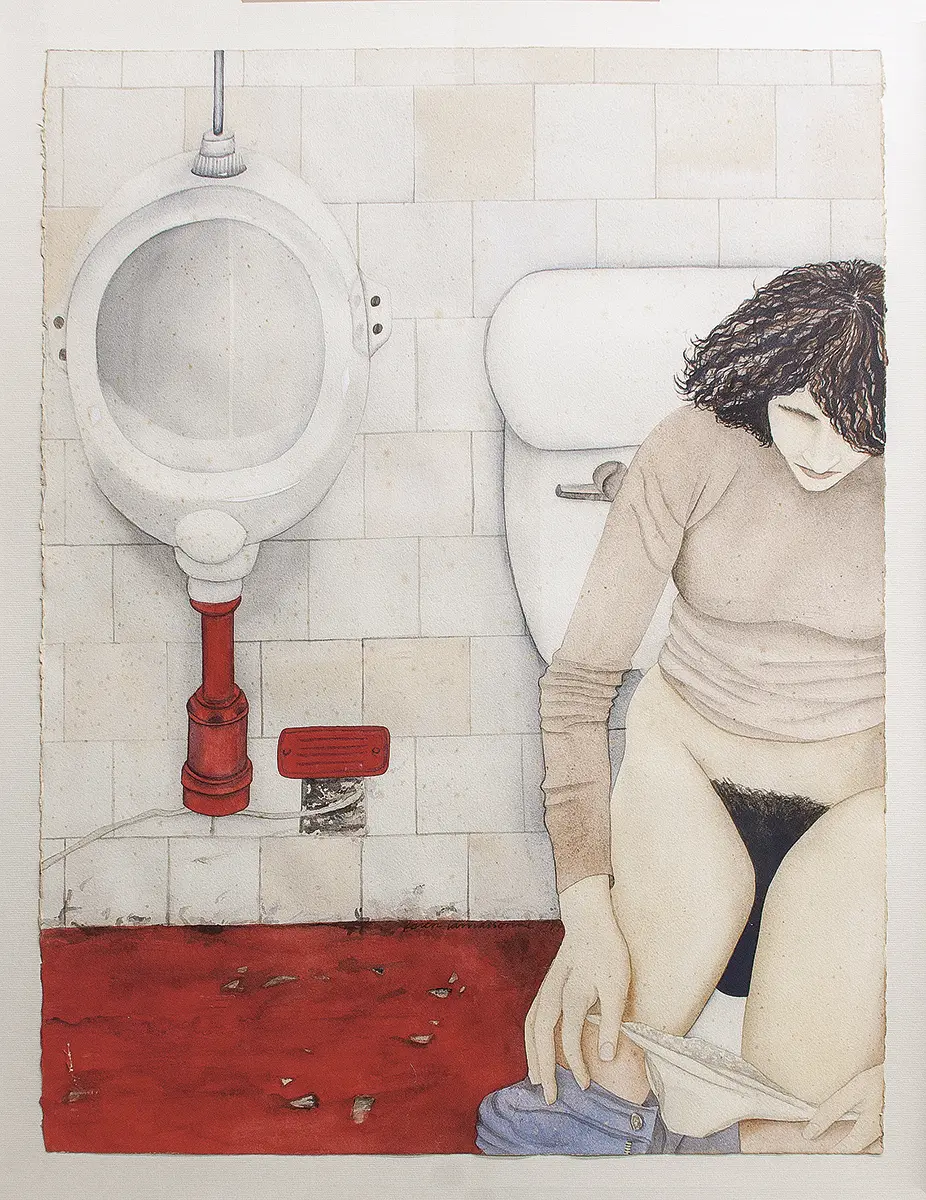
Bearing in mind the title of the show, two types of silences appear as one walks through the exhibition space: one intimate and another loud. We also encounter two different gazes converging in the viewer, one voyeuristic (on the outside looking in) and another exhibitionistic (on the inside looking out). Lamassonne’s work gives access to situations that would otherwise be intimate, a silent intimacy. Her watercolors offer viewers a look through the peephole of public and private bathrooms. She depicts women performing actions like, for instance, sitting on the toilet pulling their clothes up or down, lying naked on the floor next to the scale that tells their (dammed?) weight, or in the nude sitting on the floor and leaning against the wall, absently gazing into space and time. Sometimes we see their faces and, in other instances, only their fragmented bodies. Titled “Bathrooms,” this historical series was exhibited in 1979 at the Galería Club de Ejecutivos (as stated in the curatorial text by Matute, who has thoroughly researched Lamassonne’s work). The series reveals an intense and undefinable discomfort generated by elements like the women’s postures and the spaces, marked by altered perspectives and the notion that something is always hidden from us: as it happens to be frustrated prying people, we are deprived of seeing what is actually going on.
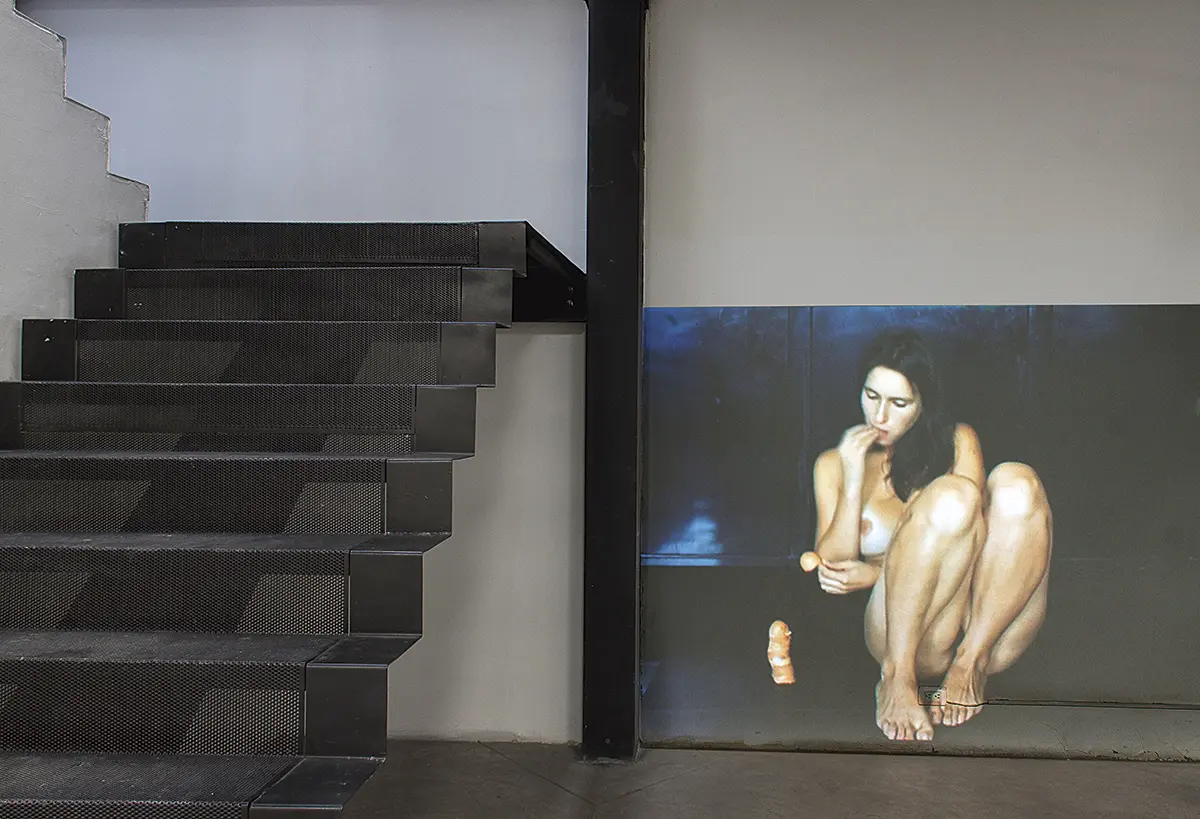
There is a certain dreamlike quality to Lamassonne’s works that allows us to immerse and lose ourselves in them. This is the case with the 1982 video titled Secretos delicados (Delicate Secrets). It consists of a succession of delirious images, scenes, and characters edited in such manner that we could very well be witnessing the artist’s subconscious. In terms of “noise” inhabiting silence, this is the piece by Lamassonne that screams without actually verbalizing it.
Noise is always present in the performance videos by artist Liliana Vélez. Her candid admission that her work represents a way of dealing with the conservative nature of her roots is remarkable. In this manner, kicking and screaming, she talks to us through solemn, silent, performances that get under our skin and get emotional responses from us. They confront viewers with a type of exhibitionism that is masochistic, sexual, and, at times, abject. A case in point is the work Ensalada de frutas (Fruit Salad), a video that shows in rather straightforward fashion a transformation of the image of love from an iconic heart made of fruits to vomit that results from its consumption.
Discomfort goes from being something rationally analyzable and perceptible, in the way we identify with the women observed in Lamassonne’s work, to something that, in Vélez’s work, hits us directly in the stomach—like when witnessing the ingestion of a large number of eggshells. Their texture and the likely sensation they produce in the mouth stay with us during the entire walk through the exhibition.
Lastly, a nearly two-meter long strand of hair going through a drain grate hangs from the gallery stairs. What an unpleasant chore is to pick up hair from the shower! And yet, how necessary for the proper functioning of our hygienic routine! This group of works ends on a high note the walk through the creative world of two artists, from two different generations, able to approach with precision two feminine worlds connected through different physical and emotional textures.
CARIDAD BOTELLA