With this third personal exhibition in a few months in France, the Brazilian artist Julio Villani (Marilia, São Paulo, 1956)–represented in São Paulo by Raquel Arnaud Gallery–corroborates the solid foothold for the circulation of his work in two continents. Soon he will present, in the beautiful Cistercian abbey of Thoronet (in the south of France), a large installation of 250 square meters produced by the Palais de Tokyo.
Villani’s second exhibition in the Parisian gallery RX provides a new opportunity to find his characteristic style, at once playful and constructive. Villani has transformed that seeming contradiction into a strength, making it the intellectual and formal core of his work. The joyfulness that pervades in his art also contributes to shaping a permanent accomplice duality, fueled by his undeniable inventiveness, for more than thirty years.
The exhibition, which occupies two floors, includes mostly recent works (2018), but also some from 2012, 2014 and 2016 (paintings, drawings, collages, objects, and sculptures). In the first room, five large-format canvases, vertical triptychs, whose separations are almost imperceptible, express–as the artist explains–a continuity that his life between Brazil and France could have fragmented.
These recent paintings also reveal his complicity with the sensitive and almost “musical” geometry of Alfredo Volpi, a Paulista like himself. Villani shares with Volpi the same freedom of creation, the delicate and transparent approach to color, and perhaps a more emotional than an intellectual construction. The reflective and perfectly orchestrated fusion between opposites or oppositions that we can observe in the center of all of Villani’s creations–whether they are paintings, objects or collages–between tension and loosening, rupture and continuity, movement and stability, humor and nostalgia, self-portrait and portrait of the world. The title of the work, Deambulo por una calle que atraviesa varios países (I Wander down a Street That Crosses Several Countries), is the common thread of all this existential and sensitive plot. It ties those multiple roots, that permanent wander, and that stasis that allow us to weave the bond of Villani with the geographies and cultures in which his life, for many years, on both banks of the Atlantic. Exile is not for him a rupture but rather an inexhaustible vein, a quality of life that continually inspires him, a matrix where he unceasingly combines the two faces, front, and back of his life, whose regenerative duality feeds each one of the creative gestures of the artist, in a vital work in constant renovation.
The second exhibition hall gathers objects and paintings, as well as an embroidered fabric composed of parts that are joined with stitches, a technique he has been using since 2004. The embroidery, which was originally made in Brazil, is now made in France by professional embroiderers. They are followed by series of strange and funny objects, utensils of daily life, from which “portraits” are constructed, such as Sourire (“Smile,” metal plate and red wire, 2014). Finally, three drawings and collages (2018) on the pages of a Bible dating from 1665 bear unusual titles such as those that Villani usually invents: Instrument poetique (Poetic Instrument), Ver de lune (Lunar Worm), and L’infini turbulent (The Turbulent Infinite).
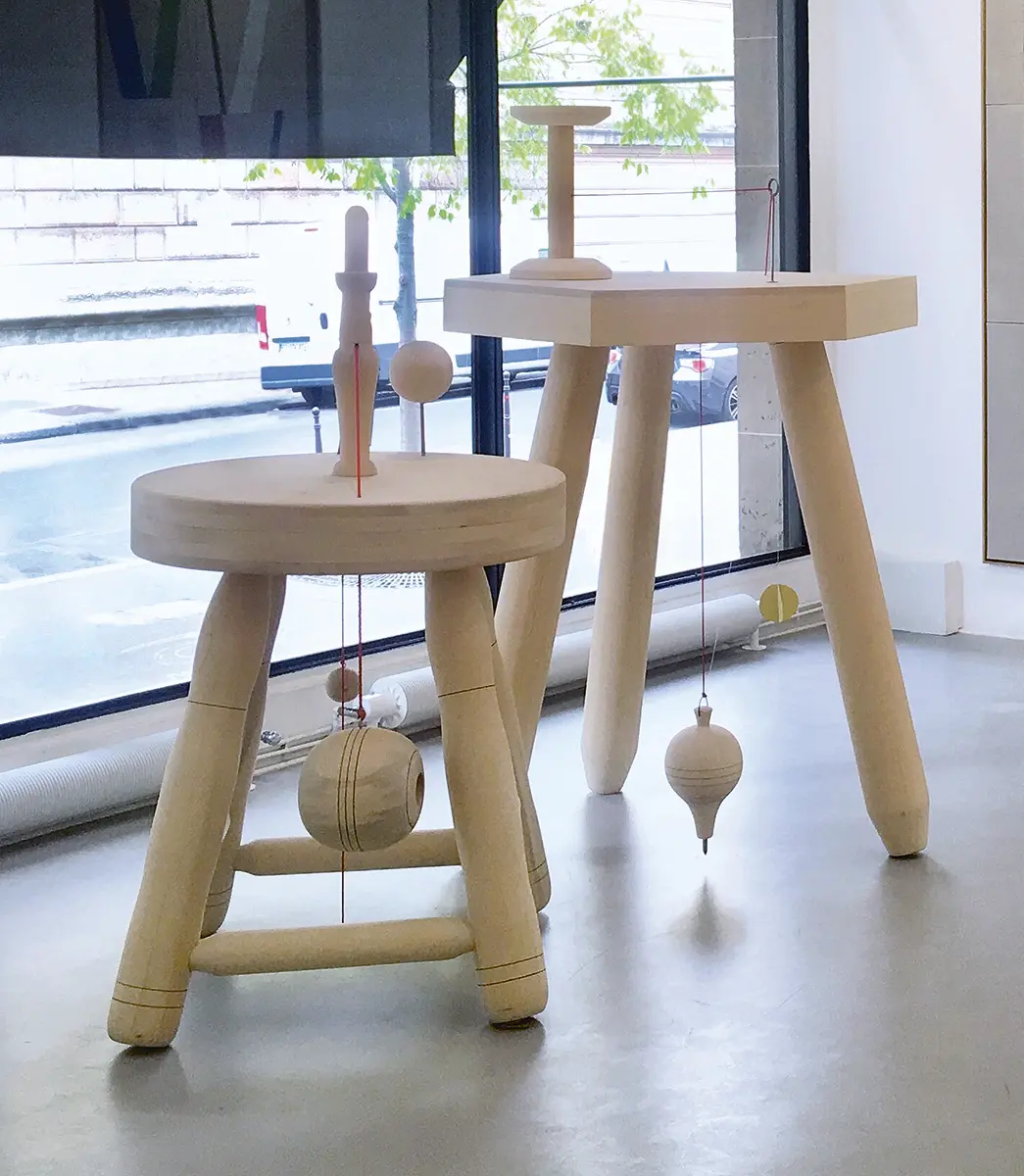
Seemingly eclectic, this selection of works concentrates a good portion of Villani’s conceptual, artistic, and technical knowledge, as well as his emotional and aesthetic memory. Complementing it on one of the walls is a selection of objects, paintings, embroideries, eccentric assemblages, and drawings (in other words, something like a cabinet de curiosités or “secret study”). It brings to mind André Breton’s wall now at the Musée National d’Art Moderne at the Centre Pompidou collection, gifted in 2003.
We could quote–and perhaps attribute to Villani’s work–the description made by Didier Ottinger (conservator of the MNAM) of this wall: “The whole, shaped by a strange caprice, with a paradoxical order that weaves personal and the respect that is due to the hidden powers, to the laws of magnetism, to the surprises of chance. The ‘wall’ of André Breton, as a challenge to the Museum of Modern Art, as the core, still hot, of a reactor of enormous power.”
CHRISTINE FRÉROT