Trazar el umbral (Drawing the Threshold), a project by Juan Guillermo Tamayo curated by Olga Eusse, was featured in the C Program at Museo de Arte La Tertulia, in Cali. Launched in 2016, the museum’s C Program focuses on providing support and visibility to the city’s new art projects. It is based on the general goal of making it possible for artists to work on a given project over an extended period, in consultation with a curator.
At first sight, Trazar el umbral seemed focused on architecture, consisting of a series of projections of possible buildings. However, closer inspection of the project’s different components revealed a need for further levels of analysis. Indeed, the project had at its base a revision of secondary stylistic features, specifically the shapes of old metal gates found throughout Cali. Whether one sees these “ornaments”—the name given in Colombia to such metalsmithing elements added to buildings—as architecture or as something else will depend on one’s point of view, as has been historically the case with the notions of art and craft. Is the frame part of the painting? Looking at altarpieces in baroque churches, it’s difficult to claim that it isn’t.
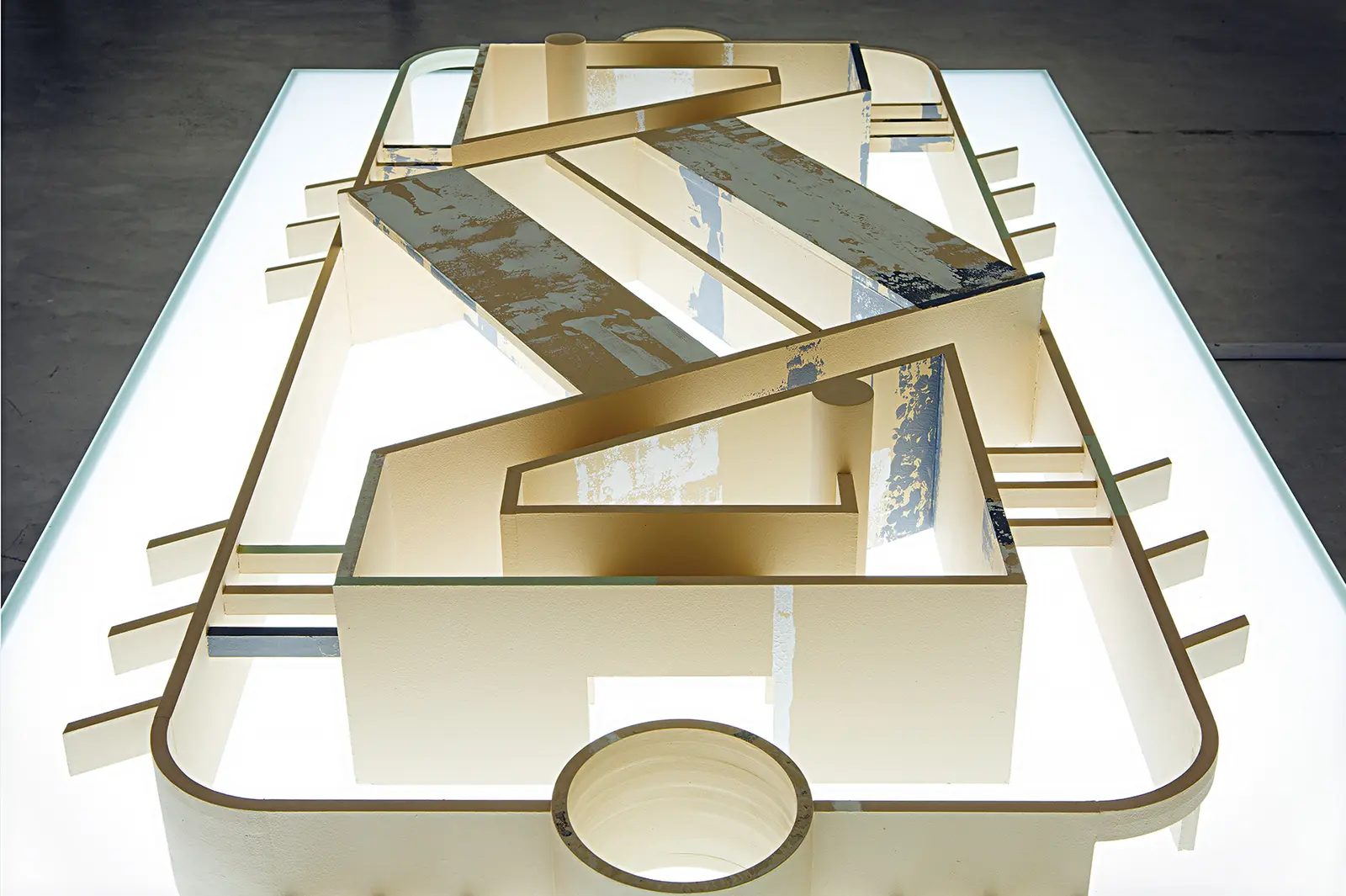
Indeed, the hypothetical models that comprise the project seem like challenges to our understanding of architectural space, contravening as viewers’ expectations. When we see something, we are always under the impression of being the originators of the perspectival coordinates that define our gaze. With the works in Trazar el umbral, however, viewers would be forgiven for thinking that they are seeing those objects according to someone else’s perspectival coordinates. This would be comparable to looking at an everyday object from an unexpected angle that renders it unrecognizable, producing a radically different way of seeing.
In other words, these works could be the result of looking at an object as familiar as the gate to our own home from a new angle and finding that it prefigures a hypothetical architectural space, or that one can be imagined existing within it. For most people, a metal gate is a secondary architectural feature, but when reading between the lines, it reveals a parallel universe where front surfaces are deep and habitable volumes lack materiality.
Juan Guillermo Tamayo explores the surface of the city like a dark well, where its true depth resides.
JAIME CERÓN