Several significant leaps that occurred during the 19th century regarding the vast field of study of the human body should be taken into consideration when reviewing the exhibition titled Extinct by Javier Vanegas at the Galería El Museo, in Bogota. There are two key examples: Madame Tussaud and Cesare Lombroso. The first one was for perfecting the art of waxwork modeling that imitated human features, a skill that was in high demand after the French Revolution, when she was asked to reproduce the heads of Marie Antoinette and Louis XVI and to exhibit them in several regions of France. The message had to be clear: the power of the monarchy had been guillotined. The second one is an Italian criminologist and doctor, who designed a complex system of human features to be used to identify at a glance potential criminals, their attitudes, and the amoral or condemnable tendencies that they could have.
Nowadays, after medicine, photography, and human behavior studies have advanced and allow us to see this time with the distance that only time can give us, we can see this period of history as something rugged and even humoristic. On the other hand, these examples help us understand that the 19th century saw the classification of the world’s species and the beginning of a grotesque circus that exposed every abnormality (sometimes in formaldehyde, other times using wax, or even by showing living beings) in the bodies of animals and human beings. It was also a period when all types of devices were created to “enter” the bodies, scrutinize them to their very last millimeter, and preserve them for years. The classification, within its pyramidal form, placed the human being at the highest part of an animal kingdom full of dangers and chains of predation. In this way, we classify ourselves as the absolute owners and masters of the face of the earth. Everything remained at the infinite service of the human being.
All these significant classifications come to light, and hence the importance of understanding the world as a container of “wonders” that should be studied and shown to an interested public, to spread the greatness of the human being. The steps are similar to those you start to spread when discussing what is artistic or what is democratic. Several animal species are gathered, classified within a pre-established order that must be the same all over the world, dissected to study them, stored in different urns, and shown to the public in a museum. The museum gives us information about species that inhabit the face of the earth, and in many cases, it shows us species in danger of extinction, signaling the urgency of preserving them. A curious way to tell the public that the animal you see stuffed in an urn is an endangered species.
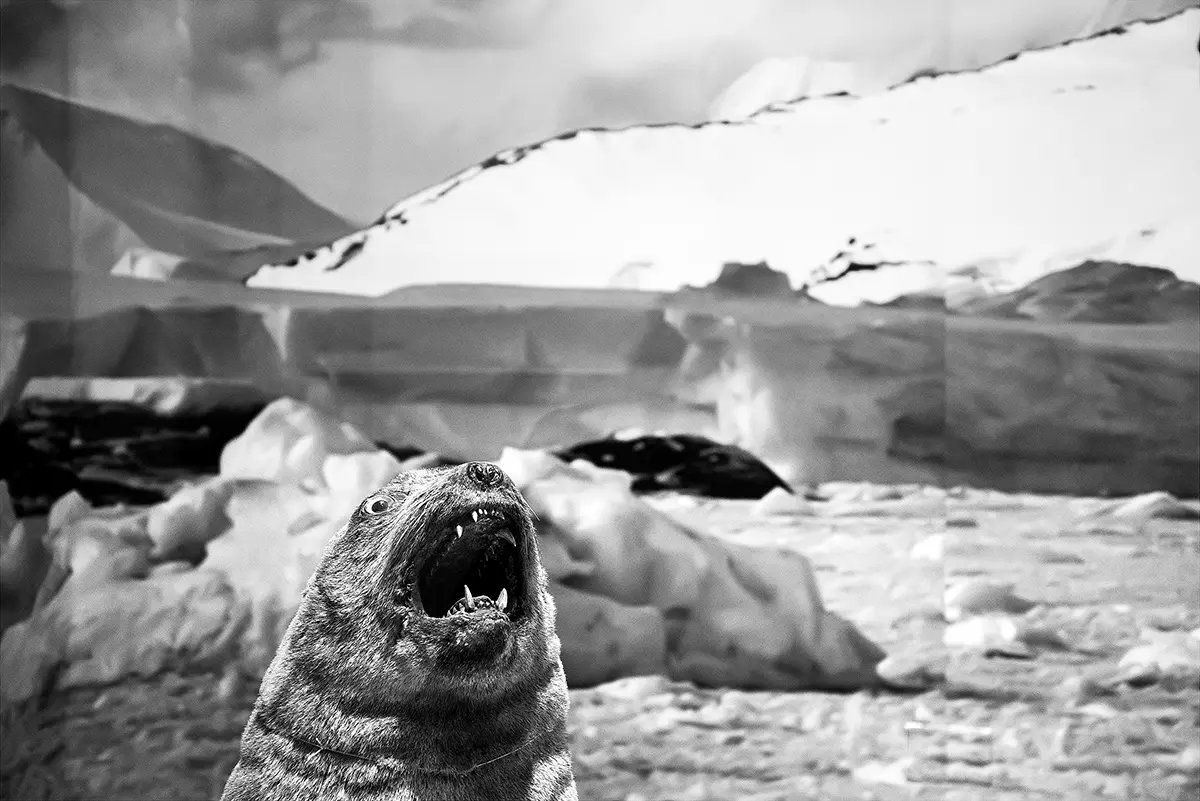
Javier Vanegas’s photography exhibition is a cruel, ironic, and crude look at reality that is mentioned as an anteroom in this text. In his introduction, the artist questions respect. Respect that for more than a century, we decided to ignore, based on the supremacy of the human being overall species. He questions the use of the museum. Some containers of dissected pieces that nobody studies, that nobody looks at, but that maybe, just for the pleasure of having a museum, are kept in a limbo that borders on the absurd. When seeing his images, we must necessarily return in time, and, with the same distance that we review what happened in the nineteenth century, we must observe what we are doing. We experience the same degree of positivist superiority, the same arrogance over mother nature, then apply the same type of classifications by race, by purchasing power, and by the colonization of powers. All this with an additional ingredient that makes this show a monument to human idiocy: disrespect.
Vanegas points it out and elucidates it in his images. The obsolescence of these museums, of what is no longer studied, of their disused architectures, of their neon lights, of polar bears, seals, and crocodiles that are useless, of their lack of care, or instead of their mistreatment, and above all, how they keep kicking to show what they never were: a place to respect what surrounds us. These museums are winning the race to reach the absurd, rugged, and grotesque that we saw in Madame Tussaud’s or Cesare Lombroso’s endeavors. If we review these types of museums, we will find one of the many things that Javier Vanegas points out to us with this exhibition: human greatness was too big for the human being.
ANDRÉS GAITÁN T.