Helen Escobedo was a visionary artist. According to critic Rita Eder, Escobedo saw herself as a “problem solver.” Moving swiftly throughout her career between her art and cultural management (she was the director of MUCA, between 1961 and 1978, and the director of the Museo de Arte Moderno, from 1982 to 1984), she helped lay the ground for a then-emerging new scene in Mexico, which ran in parallel to its international counterpart. Escobedo laid down, like bridgeheads, the connecting threads that supported a space of tension, debate, fascination, and amazement. In this process of intervention on the environment/landscape, which used various materials to develop a formal portability that spoke to and acted on the world (without being able to draw a true separation between these two actions). She lived exceptional times with a natural disposition for the extraordinary. Nine years after her death, the relevance of her work fascinates us as a continuity, as a process that remains open, which rises like a building that tends or emulates or pours ( as many verbs as metaphors of seeing and doing) in its horizon line (and its possible narratives): both the millenary tree and the sidereal ships.
And even in her farewell, she said that the only thing she regretted was not having achieved his projects.
Helen Escobedo has been relaunched with a unique retrospective exhibition of Proyectos Monclova, a show including 79 pieces—between drawings, collages, models and paintings made between the 60s and 80s—that lay a map of narratives and processes.
This initiative, along with other projects, arises from the effort that Andrea and Miguel Kirsebom—children of the artist—had in 2017, to bring the work out of storage after seven years and establish the Fondo Artístico Escobedo to put her oeuvre back in circulation in museums, fairs, and galleries. Curator Sandra Cerisola heads the Fondo, which is represented by Proyectos Monclova. As Polina Stroganova, the director of Proyectos Monclova, explains, they agreed to inventory the collection and decide on that basis which works would go to museums and which would be for sale. Final decisions will be made once the inventory of the works, and an assessment of their condition is complete. The collection is organized following Escobedo’s own criteria. Sandra Cerisola notes that, while some of the works will be available to the general public, the intention is to sell them to real collectors, so that in the future they can be loaned out to institutions rather than ending up in the secondary market. One of the Coatl maquettes was purchased by Luis Pérez Oramas, former curator at the Museum of Modern Art in New York, for the Peru-based Hochschild Collection of Latin American Art.
This retrospective exhibition (continuing with our use of verbs as metaphors) feeds from or lays out its territory on the paradox between the latent possibilities of execution at the base of Escobedo’s work, and the impossibility of it being executed by her. It features several scale representations of possible places both in time and space. Some of these actually occurred. Presiding over the exhibition is the model for Coatl, which in the narrow confines of the white cube refers to (or invokes or brings forth) the polychrome expanse of the guardian serpent that inhabits the UNAM’s Sculpture Space, a project on which Escobedo collaborated actively with Mathias Goeritz. Yet many of her projects for monumental sculptures exist only as drawings on paper or as models. The title of the exhibition is an accurate description. They presuppose, arm, or tend a work in progress to an indeterminate future.
The works exhibited were created between the 1960s and 1980s, following the artist’s investigations in architecture, sculpture, and public spaces during those years. In the words of Rita Eder: “Three significant characteristics appear in Helen’s career trajectory: thinking sculpture based on a new materiality; subjecting this new materiality to an idea of serialized sculpture and eschewing any notion of a recognizable personal style.”
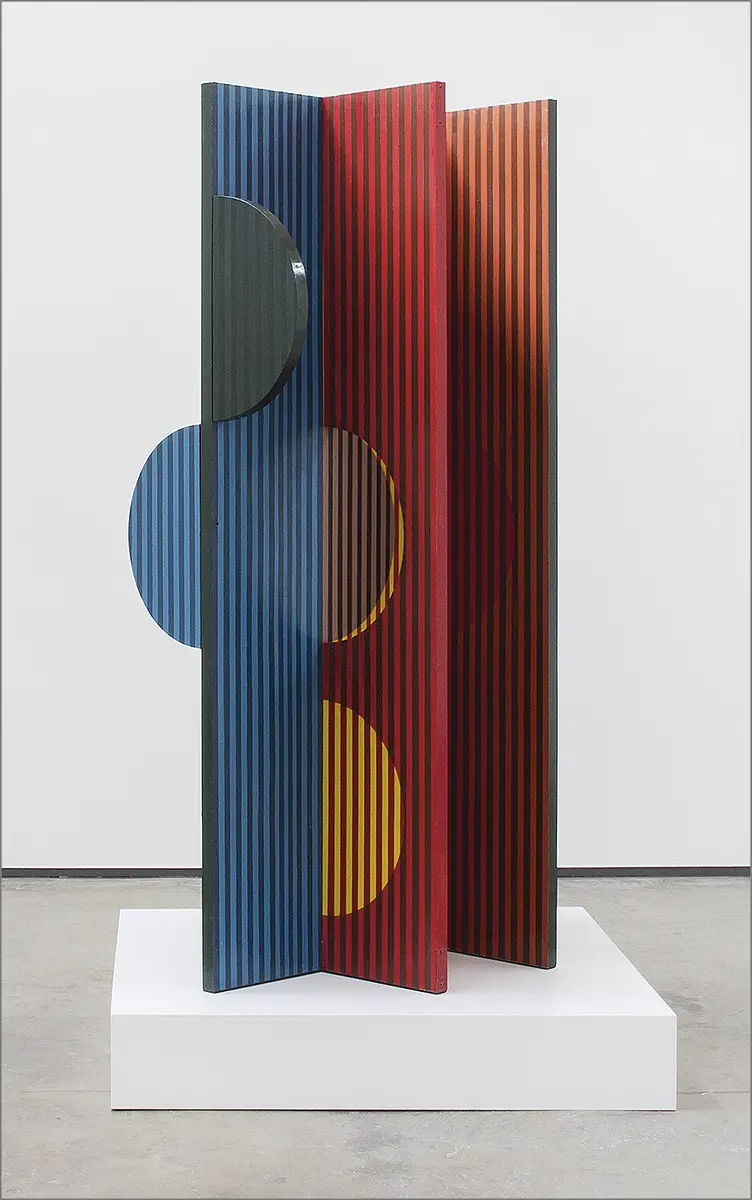
Along with the Coatl maquette and sketches, the exhibition includes, among other never-executed projects, drawings for Urbe and Eclipse (Escobedo’s final dynamic wall). It also features her photomontages with Paolo Gori, the maquettes for Doble barda caída (Double Fallen Fence) and Barda caída (Fallen Fence, which had to be restored), the maquette for the Homenaje al cigarro hemicycle (Homage to the Cigar). Another piece, worth mentioning, is the maquette for Homenaje a Octubre (Homage to October), in which the lines of tension in space become signs that articulate and break apart words. Also, on view are several of Escobedo’s small-format abstract paintings. The artist’s resistance to submit to the formal demands of geometric art is clearly displayed. Playing with the possibilities of the organic, with a common vocation towards abstraction, with both great humor and great meticulousness, she composed and built form and color gestures and imprints, imagining sites—this was her prerogative and her solace—for all of her potential sculptures.
RICARDO POHLENZ