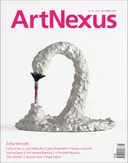
In his recent solo show at Becerra Guzmán Galería, Fran Camino has once again proved his mastery of iron, challenging the hardness of the material as he creates a sensation of weightlessness in his works. At the same time, he has engaged in effective ways with key aspects of sculpture in metal, such as the integration of space as a substantive element of the work and the creation of seemingly “moldable” figures, all with great technical excellence. And he continues to give meaning an important conceptual role, a move that has indeed become one of his distinguishing features.
The festive inclination of Camino’s sculpture, as seen in the Serpentinas (Streamers) and in shapes that allude to other games and entertainments, can be understood as a theme, but it also serves as a platform to reflect about his relationship with the abstract-geometric tradition from which he emerged. Camino’s process starts from that legacy. On the other hand, the experience acquired during his time in Carlos Cruz-Diez’s studio, as well as his practice as art restorer and conservator, have helped this artist explore his expressive medium in great depth, and to reach crucial understandings about the form-volume relationship, space, and color.
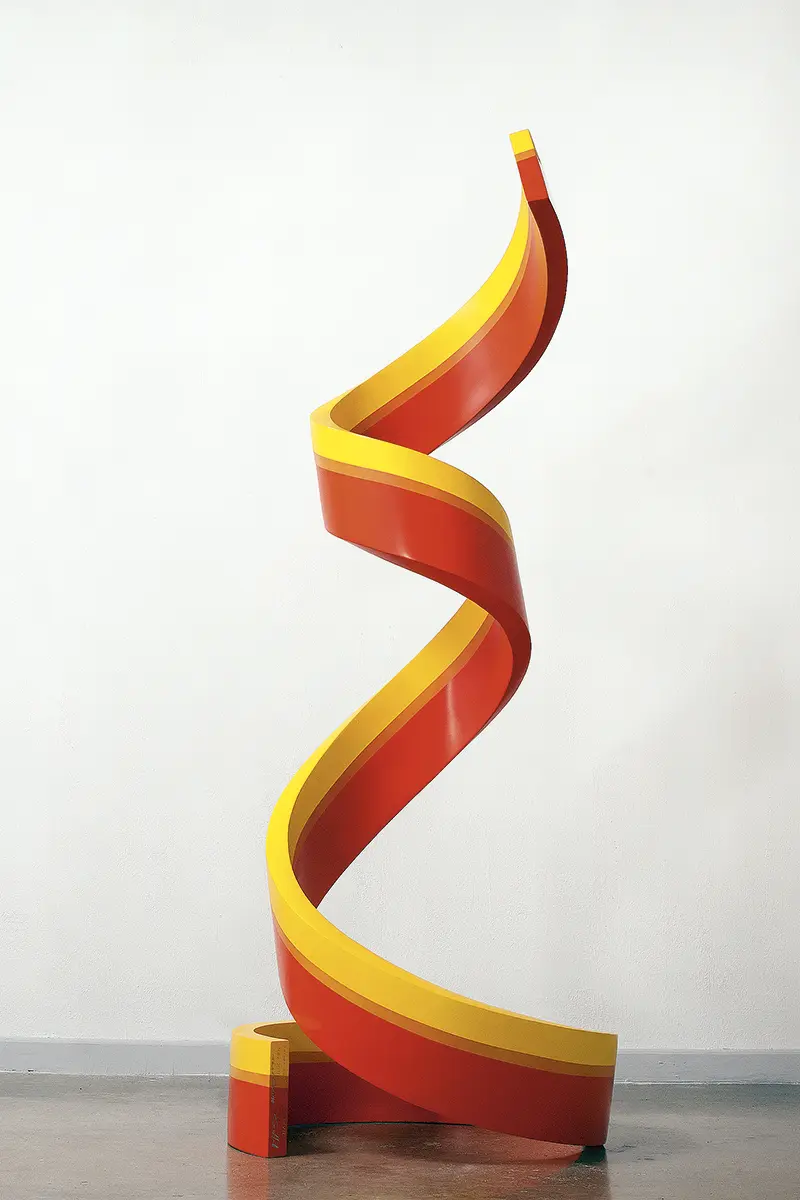
Given all this, it is possible to wonder whether Fran Camino’s sculpture can still be said to belong in the field of abstract art. Indeed, already with his Serpentinas, Camino sought to transcend the plane and the idea of a sculpture based on geometric shapes. This was a gradual process, based first on tubular shapes, then on spirals, and finally—both in the polychrome and the plated Serpentinas—on the line as a central element. In this formal synthesis (which nevertheless remains allusive to a popular utilitarian object, the paper streamer), space plays a dominant role as a constitutive element of the figure, as does the power of color. Without them, the lively and festive serpentine shape would not be established in such a forceful way.
On the other hand, providing the work with a semantic payload involves gaining a certain distance from the logic of abstraction; hence the streamers and other games. This certainly goes beyond the idea of a type of sculpture based only on the relationship between its formal elements. On the contrary, the work acquires meaning and begins to lean towards other contemporary references (for instance, in the way in which Camino magnifies the festive objects to which he refers, Pop Art.)
In this exhibition, the process of maturation and distillation of Camino’s creative proposal, which has involved interesting and radical shifts, reached a new level. If until recently his work found an anchor in color, now this aspect is entirely suppressed (albeit not the sense of playfulness it implied.) Before, color was the explicit carrier of meaning; shape has now taken on that role. But not any shape: the line in its most sharply defined, purest condition. Indeed, Camino has replaced pigment colors with plating, and he has set aside volume in favor of a two-dimensional line that in turn expands in space. Both facets coexisted in this exhibition, showcasing two aspects of sculpture around a single topic.
Fran Camino has suppressed volume and color to arrive at the purest formal austerity. His sculpture comes across now as drawing in space. His Slinky series retains the reference to play and to the streamer shape using a distilled line, bright in its own terms, free from color. One could be forgiven for thinking that in this process of distillation, Camino also frees himself of formerly weighty references, such as the chromatic legacy derived from his work with Cruz-Diez or the rigidity of the plane in connection with a specific geometry. He has gained an awareness of the fact that the meaning of his work, ultimately, is not lost: it stays, to the point that it can shed color entirely. And with this, the artist begins to set aside other elements as well. In her presentation essay, Anny Bello explains it as follows: “He goes from volume to the two-dimensional plane. He draws the front and side angles of the streamer, conquering the synthesis of the figure, where the relationship with the represented object is at times lost.” Indeed, and paradoxically, abstraction seems to regain its validity. The simplification of the line is such that in some works, all specific references seem to disappear, and we are left with pure shapes expressed in the delicate elusiveness of a calligraphic stroke.
SUSANA BENKO