Brazilian artist Erika Verzutti’s first large-scale exhibition in Europe (and her first appearance of any scope in France) was presented as part of the yearly multi-discipline event mutations/creations, now in its third edition. The exhibition designing the living explored the transformation of living in the age of biotechnology, in the fields of art, design, and architecture.
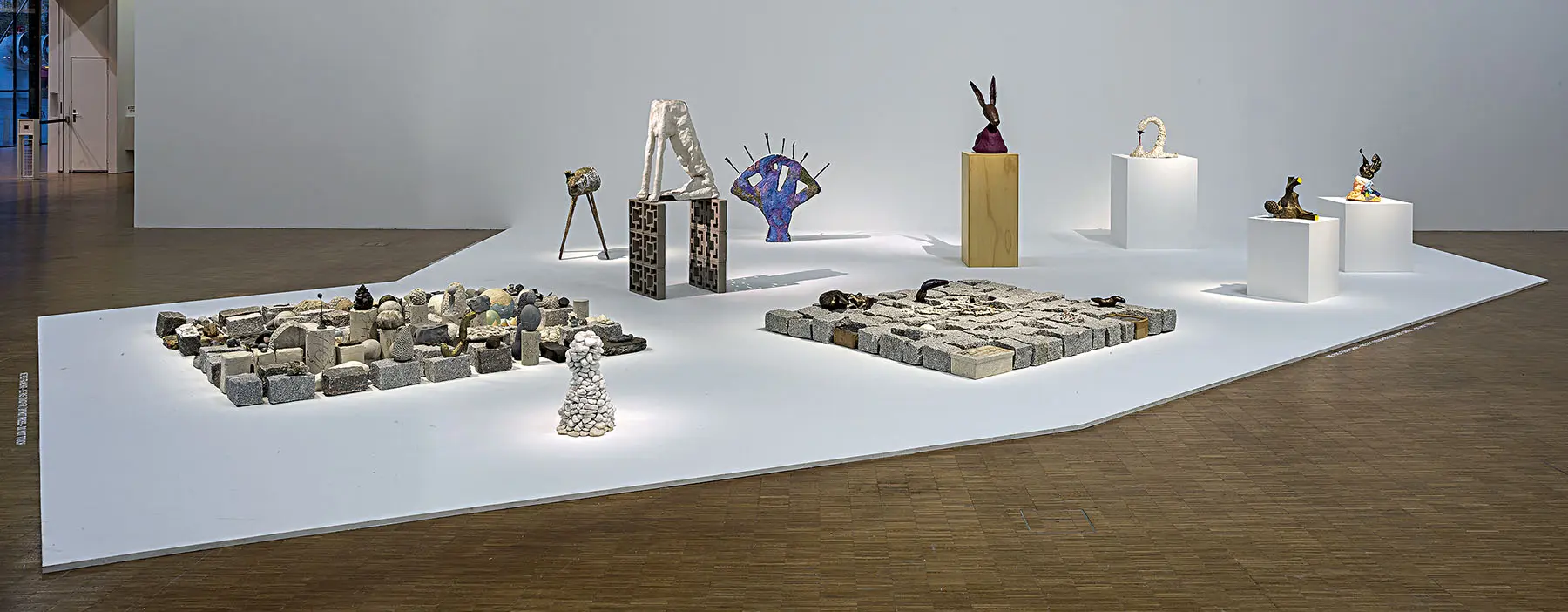
In collaboration with curator Christine Macel, Verzutti (1971) conceived the layout for her exhibition as a large archipelago-like installation, comprised of small islands of various shapes into which “families” of sculptures were grouped, regardless of their aesthetic or thematic connections. This open space, with the artworks mostly at floor level, allowed visitors to discover a multiform and unique oeuvre, sensual and tactile at once, carefree and enjoyable both for its materials and its lively colors, unbound by restrictive intellectual codes. It is a body of work rich in unexpected convergences, uniquely original even if some (distant) references can be occasionally found: Tony Cragg, Brancusi, Henry Moore, and Louise Bourgeois. Taboo-free imagery, conceptually and materially unbridled, inspired the duality of the real and the fictional, the natural and the artificial, at the farthest edge of the legacy of Brazil’s Antropofagia movement and constructivist art. The selection of 55 sculptures and bas-reliefs resulted in a convincing presentation of the artist’s proposal as it has evolved in her 18-year career, focusing on the living and inspired by the pleasure and passion of creativity.
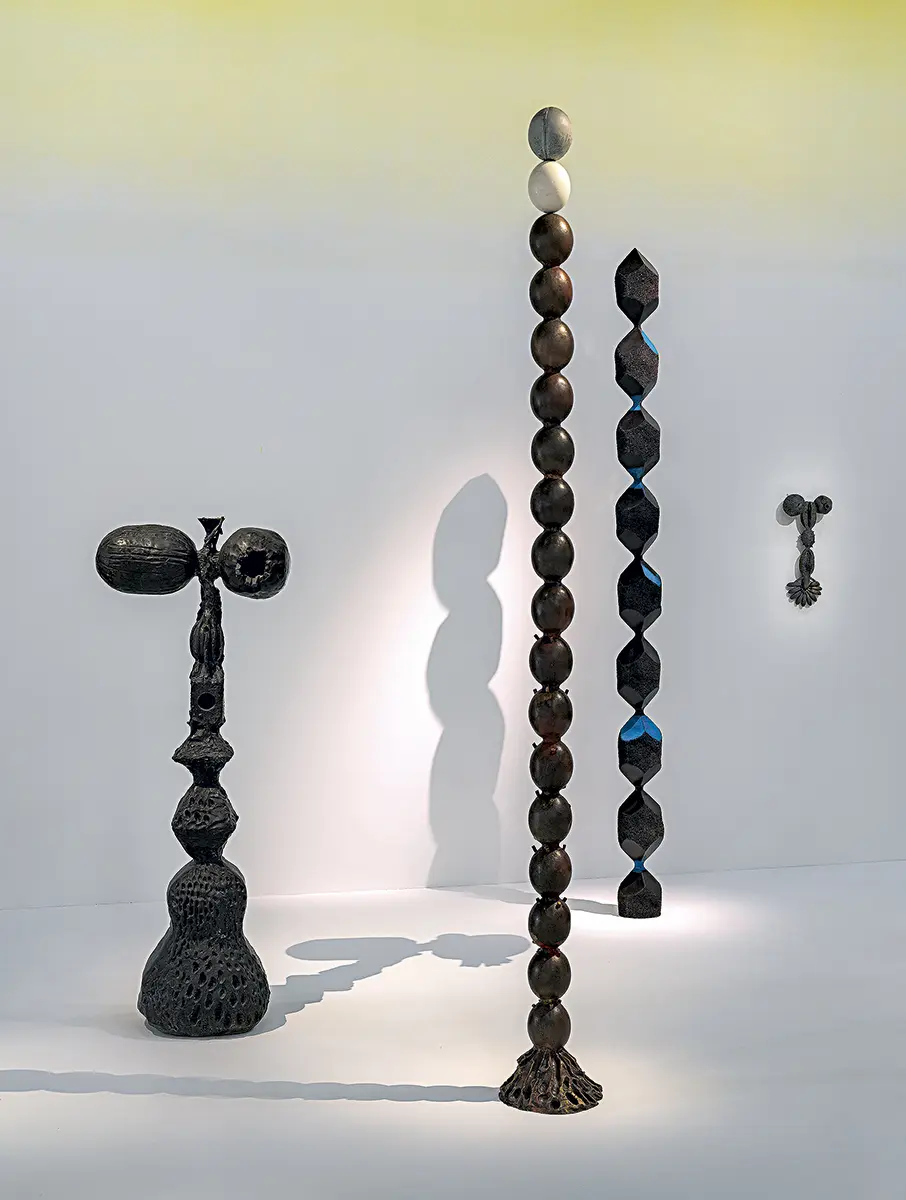
The natural and organic focus that dominates the exhibition is established from the start by Opening with rain (2018), a large ceramic and papier mâché work hanging from the wall at the entrance. Printed on the wall, a map of the exhibition shows the various islands, numbered and classified into six groups, and names the works. In this way, visitors circulate in the sequence chosen by the organizers and the artist. Group I connects different materials (papier mâché, stone, playdough, concrete, wood, ceramics, assorted objects.) With a straightforwardness that can be disconcerting, Verzutti explains that her floor installations, such as Cemetery with Fringe (2014) and Indigentes (Indigents) are “made with remains or rejected pieces.” With Group II, the transition is immediately apparent. This group is characterized by its verticality, and somewhat abstract character (albeit not entirely, as it includes allusions to animals and flowers). The affinities between the sculptures become more evident, and we find ourselves in a kind of “stone forest.” Group III confirms this desire for closeness with profound nature, more specifically, geology, with a group of small sculptures titled Mineral (2014). These are presented like stelae, or perhaps like effigies of some kind, evoking the layout of Easter Island’s iconic statues.
Between Groups II and III, the large Turtle (2017) fills the space with its white eggs strewn around the floor. Group IV is presented in an original way. Its island, in the shape of a white swan, was created specifically for the exhibition. Here the artist tells her own story, intertwined with the story of Brazil and dotted with tributes and remembrances. The sculptures are aligned on the swan base and include references to Tarsila do Amaral, to Brasilia, or to Saramandaia (a 1970s soap opera), as well as to such emblematic staples as the jackfruit—Brasilia Quitanda (Brasilia Greengrocer, 2010), Brasilia (2010), and Brasilia Cinema (2010)—and also, to a lesser degree, the papaya (Desenho, Design, 2011).
The identity of Group V revisits some of these visual elements and the references to emblematic fruits, like the banana.
The last section in the exhibition is a “cabinet with a more intimate atmosphere,” with 15 bronze or cement bas-reliefs, emphasized with often polychrome paints, on its walls. Some of these are on the abstract side, others more on the referential side and all are preceded by the bas-relief Homeopatia (Homeopathy, 2018), which alerts us from the start about the characteristics of this new space.
In this enticing and ironic selection of works, filled with inexhaustible creative freedom and a great sense of humor, Verzutti delights in disorienting and teasing visitors, provoking aesthetic sensations that are tinged with affection and knowing smiles, something decidedly different from the often icy and arid discourses of contemporary art and its supposed intellectualism. As the product of the hand that sees these forms emerge between its fingers, it reveals Erika Verzutti, in the noblest sense of the term, as a craftswoman of the matter-bound imagination.
CHRISTINE FRÉROT
Ph.D. in art history. Researcher, curator, and art critic. Member of AICA.