There is a type of metaphor by virtue of which small actions come to evoke broader concepts. It works as a suggestion, teasing out relationships between what is seen (or read) and issues that float in the viewer’s consciousness. Donna Conlon (Atlanta, 1966) and Jonathan Harker (Quito, 1975) present at Museo Rayo a series of short videos where concrete poetic gestures hint at complex, problematic matters.
For this exhibition, Miguel González curated a selection of environmental-themed works: Más me dan (More I get, 2005), Estación seca (Dry Season, 2006), Brisa de verano (Summer Breeze, 2007), El basurero (The Garbage Dump, 2009), Bajo la alfombra (Under the Rug, 2015), and Voz a la deriva (The Voice Adrift, 2017). These works also contain, between the lines, a meditation on scale and nothingness. The household scale of bottles, bags, or a rug suddenly broadens into a universal plane, touching on such subjects as the oceans, the mountains, or all the world’s garbage. This ability to bridge the gap between the particular and the general derives, in part, from the concreteness of the gestures and the length of the videos. These works are closed cycles where the chaotic nature of the flow of objects is always on display.
In More I get, for instance, two hands hold a plastic bag containing another bag, which in turn contains another bag, and so on. The bags are unwrapped one by one in what feels like an interminable sequence. In the end, nothing is found there except for the containers themselves, like the packaging detritus that remains outside the cycle of consumption and becomes an object only as a function of the objects inside it. That nothingness underscores its disposable and polluting nature. In the end, all that is left is a tragic, hollow support for advertising messages.
The issue of nothingness is similarly present in Dry Season and The Voice Adrift. In the former, an outsize accumulation of empty green glass bottles resembles a mountainous landscape, while someone throws more and more bottles to the pile at an increasing pace. The sound of breaking glass also reaches a peak, a summit like those of the mountains to which it alludes. Perhaps this is a crystalized sea on the verge of a complete breakdown. In The Voice Adrift, in turn, a bottle contains—if it can be said to contain anything—a secret: the voice of a man who whispers into it, then closes the lid and sets it adrift on water canals. In the end, the bottle a woman picks the bottle up, opens it, and brings it to her ear. It may be that in some of Harker and Conlon’s works, nothingness is made concrete, able to be perceived.
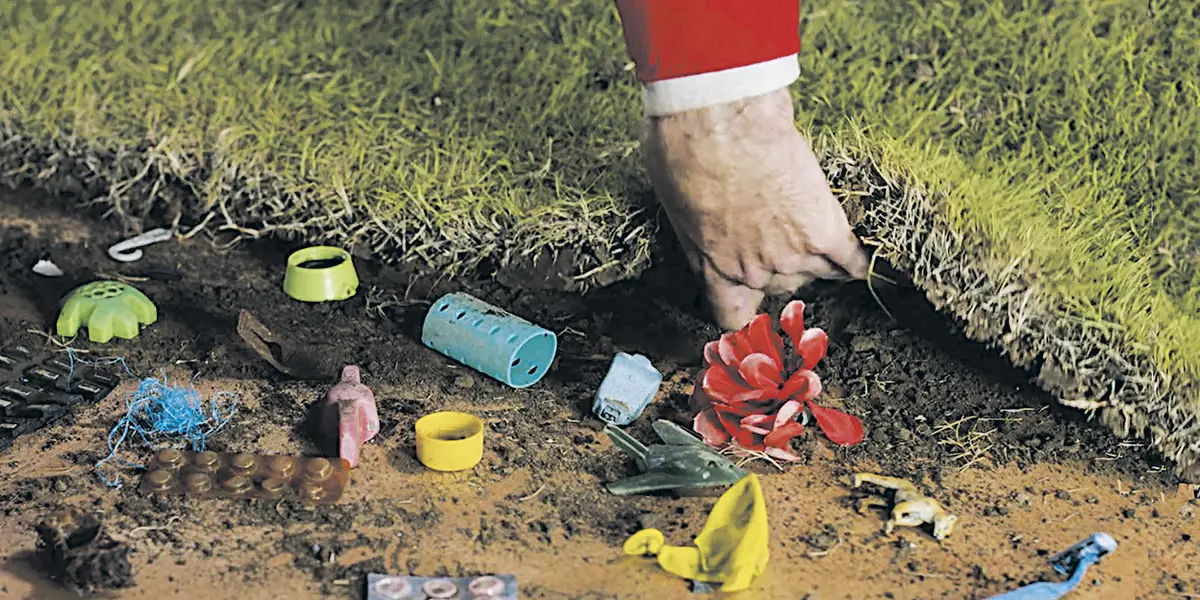
In Summer Breeze, plastic bags are pushed by the wind and get trapped on a metal grille, like on a sieve. The grille is progressively clogged until all we can see is a thick accumulation of garbage through which not even air can filter. Viewers connect this lack of see-through visibility with nothingness. There is an inversely proportional relationship between the lightness of a clean environment and the noisy materiality of pollution. In another video, two people sweep garbage under the rug, alluding to the archetypal “bad worker.” The rug, a large sheet of dirt and grass, is transformed by the accumulation of garbage into a mountain crowned by the Panamanian flag (Panama being the country where Conlon and Harker have produced most of their work.) Under the Rug has a staged look; it is less “spontaneous” than the rest of the videos. Somehow, the color and objects in that scene result in a very precise gesture: to saturate the undersoil of a small landscape.
We arrive, finally, to an image of dollar bills being carried by ants as they attempt to climb up a tree. Not following a fixed line, or even tracing a precise path (in The Garbage Dump), the ants backtrack, hesitate, fluctuate. Capital fluctuates, flowing like a liquid. Once again, the scale shifts: from what could be a home patio (or a tropical forest) to the free-flowing structure of the world economy. The denouement in this video is perhaps ironic and prophetic: the ants take the dollar bills to a garbage dump, where, Conlon tells us, some of their colony’s dead also lay.
BREYNER HUERTAS