“Everything can be used to build or to destroy, and so, in this sense, anything is worthy of attention.” Pablo D”Ors
The seductive and yet menacing title of the exhibition by Cynthia Gutiérrez, Not Forever on Earth, fulfills by far its unsettling promise. Its content is an extract from a poem by the figure known in Mesoamerican history as the “poet-king,” Netzahualcóyotl:
“Is it true one really lives on Earth?
Not forever on Earth,
only a little while here.
Though it be jade, it falls apart,
though it be gold, it wears away,
though it be quetzal plumage, it is torn asunder.
Not forever on Earth,
only a little while here.”
In the same manner that layers of meaning are inferred from the title, it is also possible to assume “terrestrial” layers in the work by Cynthia Gutiérrez. As terrestrial as a clay fragment or a piece of woven threads, they will perhaps endure a little less, or maybe just a little bit longer, than the life of the artist, the viewer, the gallery, and the market. But not art. Not art, the kind that possesses inner strength, the fire that compels it to consume itself, as described by Theodor W. Adorno in “Paralipomena,” the final chapter of his book Aesthetic Theory. Art like Gutiérrez’s that will definitely survive us.
In the all-white main exhibition room of the Proyecto Paralelo gallery, three angular columns of different dimensions discretely inhabit the space. It is not until closer inspection that it becomes possible to observe the geometric cavities in these white blocks. Of various shapes and sizes, the voids are filled with initially undefinable objects that are quickly identified as fragments of what were once pedestals. They are now broken into many pieces of different and almost indiscreet shapes; inert, useless fragments that lack any meaning. Entirely filling the hollow spaces in the neat colonnade, they nonetheless stay within the boundaries of the voids containing them. It is as if the heavy and inclement air of an extinct past keeps them pressed within the borders of that which is no longer there. The broken pedestals now form an imperfect line for the invisible boundaries. Old meanings disappear when bodies from the past are “ruined” just to allow for the presence and interpretation of new significant and symbolic strata (if any).
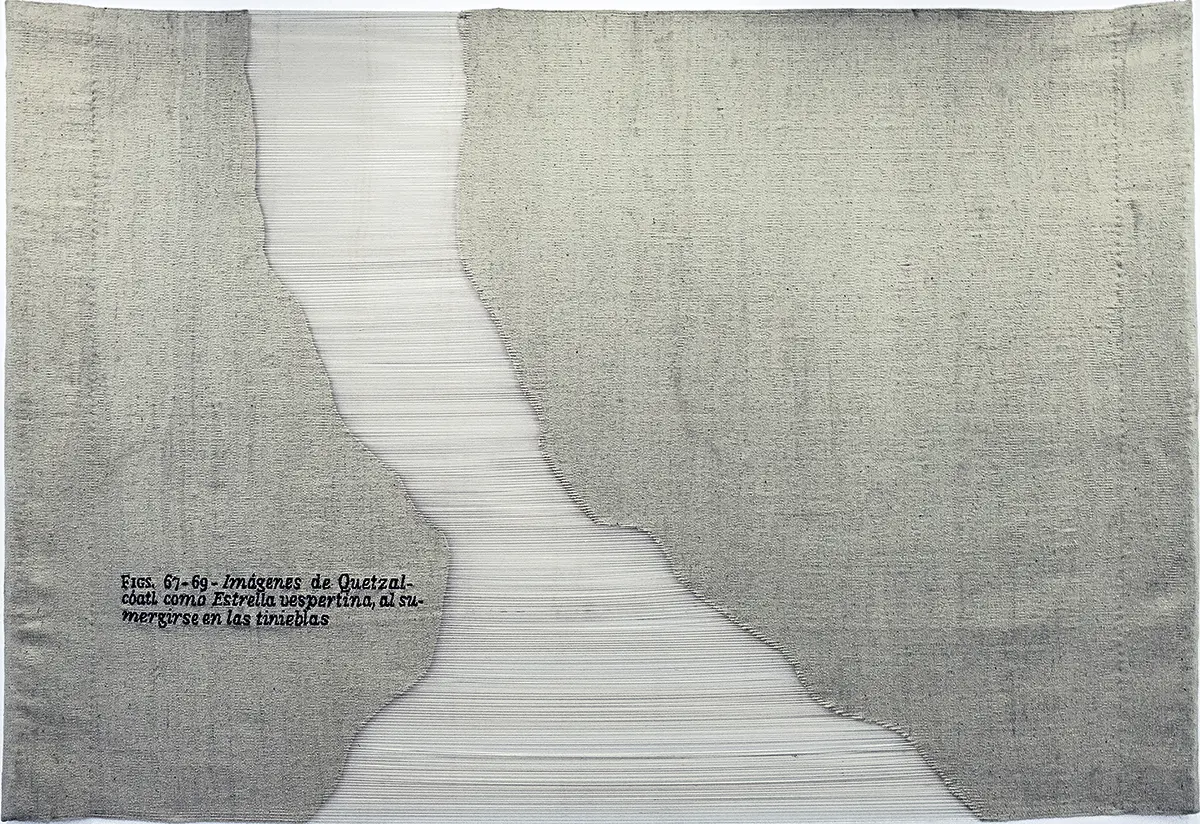
Powerfully subtle and captivating, another piece in the exhibition that clearly stands out is a large textile displayed on the longest wall of the space. A legend on the work, in a neutral tone like the fabric, reads: “Figs. 67.69. Imágenes de Quetzalcóatl como estrella vespertina, al sumergirse en las tinieblas” (Figs. 67.69. Images of Quetzalcóatl as an evening star, descending into darkness). And towards the left third of the canvas (seen from the front), there is what seems like a path. It also looks like the bed of a river that is almost dry, supported only by horizontal threads–those that carry the plot (literally and metaphorically), as in a written text or a pentagram. While this section exposes and separates, it also unites the totality of a textile whose dimensions and texture at times transform it into a rug. A mysterious and enchanting work (seemingly educational as a result of the legend it contains), it resembles a larger version of an ancient map with minimized clues and indications. The cartography, like the pedestals, can no longer “locate” anything or hold any power of recognition.
“Cynthia Gutiérrez practice and production processes develop around the bridge connecting the past to the present. The fine line that divides memory from oblivion—the lasting from the ephemeral—has become an essential element for understanding her work,” can be read in the introduction text of the exhibition written by Issa Benítez, curator and director of Proyecto Paralelo. In this manner, voids—of significance, currency, contemporaneity, and permanence—are inhabited in Gutiérrez’s work by remains, weakened sketches that (pace Jacques Derrida) tired or overwhelmed by something, still endure in their residual state nonetheless, maintaining their presence and handmade quality as the last reference to that “other” time in which they existed.
In this manner, the exhibition “Not Forever on Earth” by Cynthia Gutiérrez is constructed with two elements condemned to confront the threads and thresholds of their materials and boundaries, their transformed purpose and significance. The malleable nature of textiles is “forever” frozen, cast in bronze. Fragments from formerly celebrated pedestals contain stories in their fractured matter that will be “forever” subverted/disassembled. “Cultural sediments accumulated piece by piece, gradually render an incomplete landscape of what we are, of what we could have been.”
MARCELA QUIROZ