Inspired by Jacob Lawrence’s work, which refers to the mass mobilization of African Americans who migrated from the rural south to the urban north in the United States at the end of the First World War (1940-1941), Carola Bravo addresses issues such as migration, exile, and assimilation. Bravo, born in Venezuela and living in Miami, makes a conceptual work based on her own experience in which she refers to geographical displacement, voluntary or forced, which implies sacrifices and entails economic, political, social and psychological consequences.
The exhibition Inhabited Geometries: New Video Works presents five video installations explicitly made for Bernice Steinbaum’s gallery space.
The idea of the exhibition arises from the reading of Gaston Bachelard’s book The Poetics of Space and the interesting corners of the gallery’s space. As the artist explains, “Bachelard talks about the spaces that make us feel in a home and that are intimate and close such as corners, windows, drawers, closets, all the spaces where we store things, where we have part of our memory.” It further clarifies that “each installation has a small text related to what is being viewed.”1
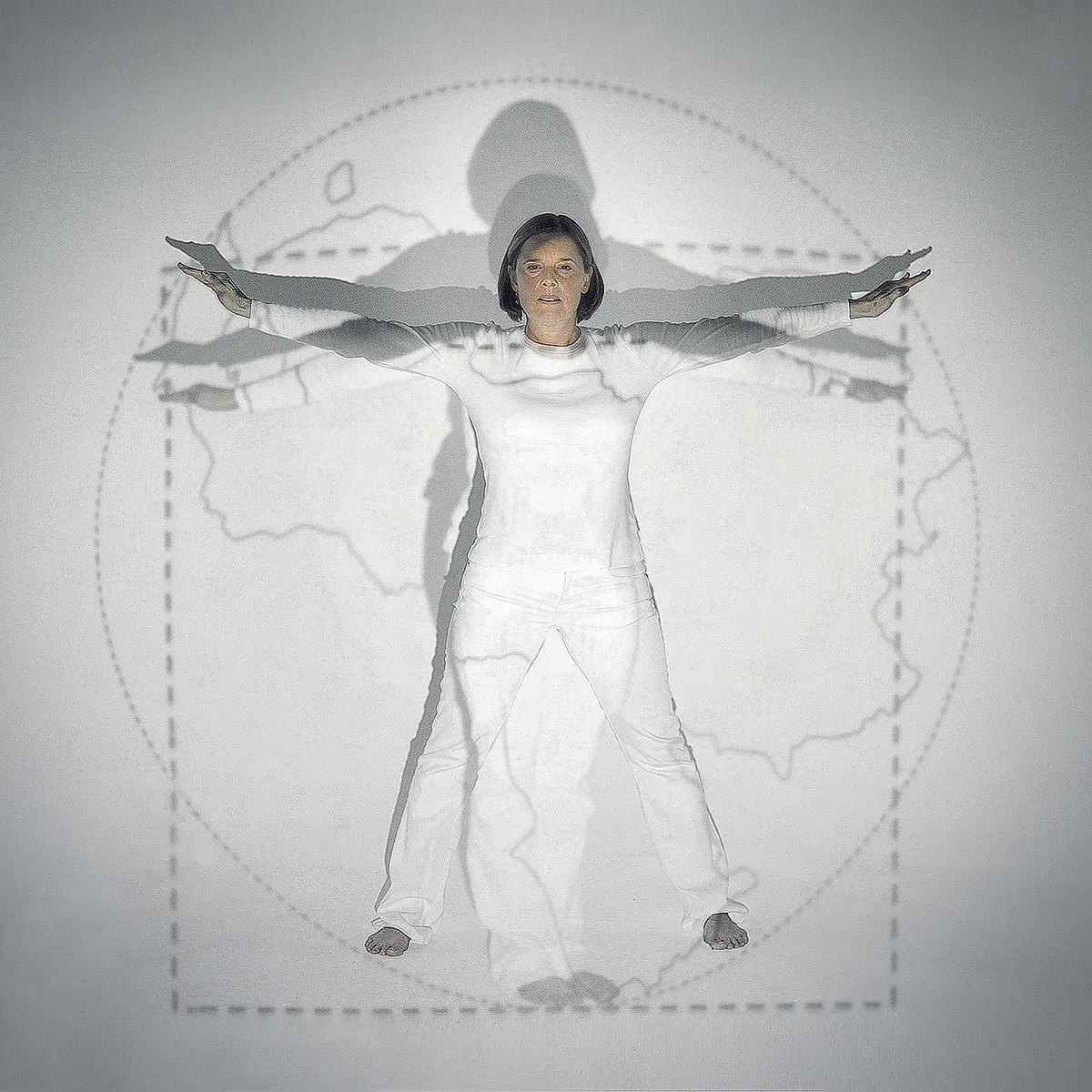
The exhibition begins with a video installation based on the work Identity Canon (2016). In a new version, Bravo draws the interior of a closet with a great sense of line and perspective. The two-dimensional drawing acquires new proportions through the presence of three objects—a sack, a Santa Claus’ head and a toy zebra—but above all, by the video projected on a screen that constitutes the central point of the work. In it, Bravo appears dressed in white observing an image of herself inspired by the famous drawing The Vitruvius Man by Leonardo Da Vinci (1942). The precision drawings’ lines, which hints at her training as an architect, and the rich superposition of plans and ideas in the same work, serve as a starting point for the pieces she presents in the adjoining room.
The installation titled Dreamer of Corners and Books (2018) presents a library drawn with black lines on the gallery’s white wall. On the side, a video-projection shows the artist entering the wall’s space. The play of planes becomes even more complex by reflecting this image in a mirror, generating a new virtual space. In addition to working with different levels such as space, movement, and sound, Bravo plays with multiple realities: she shows herself entering the space that symbolizes the library, drawing on the wall, and reflected in the mirror. All spaces, real and virtual, are handled with great success formally and conceptually.
In the next installation, Geometry of Echoes (2018), she uses similar elements more abstractly. Inspired by a quote by Bachelard, the piece refers to the home not only as an architectural construction but also as a symbol of memory and history. Bravo places a metal rod in the corner creating a solid line that serves as a vanishing point for the composition of real and virtual lines that come out of it. The real lines are drawn on the walls, and the virtual ones appear as the artist draws on the video projected on the wall.
According to the artist, “one of the most important signs of the human being, of our existence, is to define the space where we live, where we are. When you, as an immigrant, decide to leave, you are completely rooted out, you take the roots, and you have to decide what to take and what to leave because you cannot take everything. We bring the best of ourselves because the rest we have to leave. Everything that is not valuable, everything we are not, we leave behind. You bring your essence. In the new country, in order to belong again, we must integrate ourselves and connect. In a space like this, and with my work in general, I feel like a spider. Throwing lines to the corners and trying to hold on to them, so I do not fall. Those lines connect me with everything that surrounds me.”2
In the following installation, The House of Memory (2018), the objects are particularly significant. A bench, a suitcase, and two tablecloths symbolize physically and metaphorically what she has decided to take, not only in terms of the objects but also in terms of memories and even illusions. Finally, Bravo shows the video The Warm Nest (2018) accompanied by the poem by Jean Caubere that has the same title. In the poem, the author talks about the old home, which on the screen is represented by a large nest being painted by the artist’s hand. In the end, the artist is shown as a silhouette on one side of the scene, making it clear that each of the works presented in the exhibition is a testimony of her own history.
NOTES
1. Carola Bravo. Guided visit to the exhibition. Miami, January 2019.
2. Ibid.
FRANCINE BIRBRAGHER PHD