The poetic power of architecture and urbanism and its connection to political and philosophical matters characterize the work of Cuban artist Carlos Garaicoa. This is reflected in his most recent exhibition titled Landscapes of Labor at Luisa Strina gallery, in São Paulo. Sculptures, drawings, and installations, specially created for this solo show, focus on modernist architecture and the paradoxes between the beauty of utopian urban landscapes and the efforts and physical work involved in their construction.
Once again, Garaicoa emphasizes his esthetic obsession with spaces built as images and reflections of the political and social reality. He consistently relies on the appropriation of everyday objects to represent his themes. And this exhibition is no exception. It consists of four “work tables” with drawings, directly rendered on them, of enlarged designs by Oscar Niemeyer. The works are titled Poder (Power), Justicia (Justice), Danza (Dance), and Muerte (Death). Surrounding this group, Garaicoa installed drawings created with wire, connected with nails and old rulers directly on the wall. They also allude to modernist architecture and the ideals of the unfinished civilizing project, especially in Latin America.
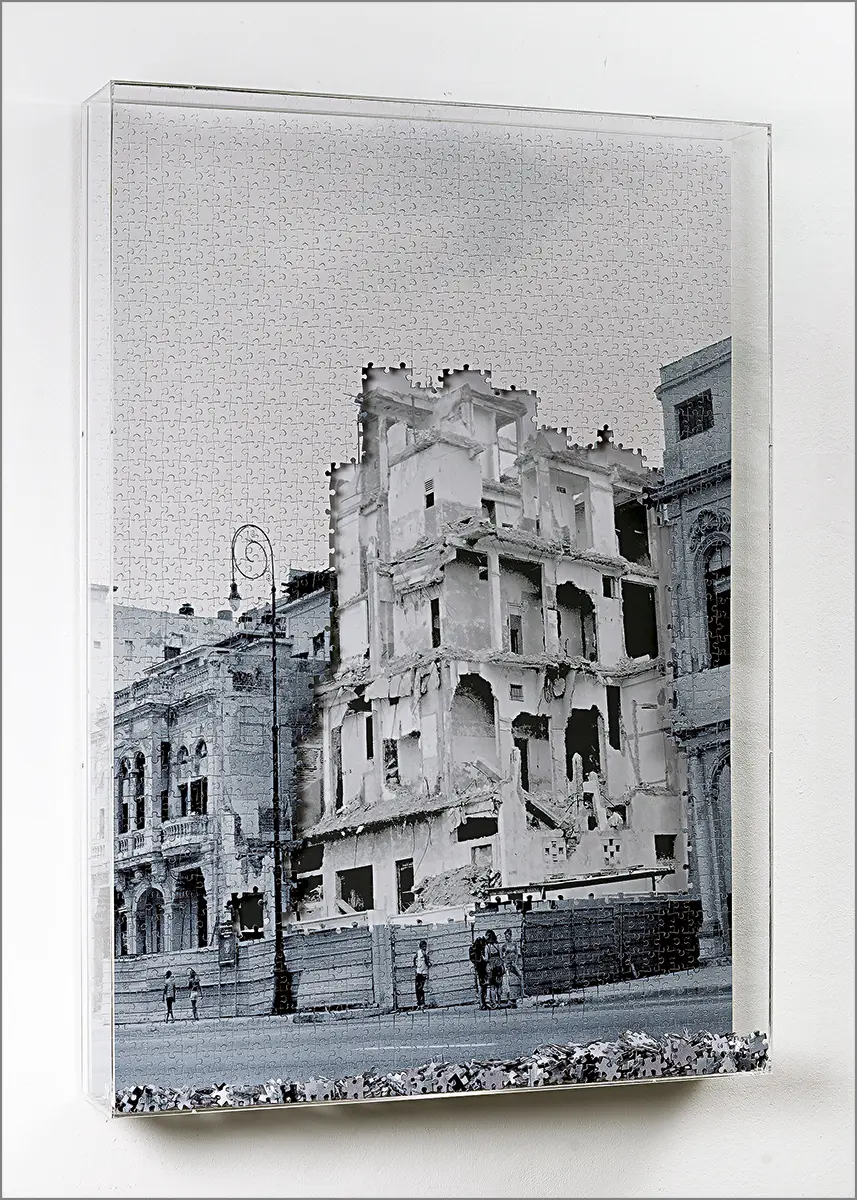
New pieces from the Puzzles series, which started in 2018, complete the show. This group consists of enlarged photographs in blue tones of Cuban urban landscapes printed on jigsaw puzzles. Covering certain areas of the image that reflect what still remains of the original urban landscape, the blue-toned jigsaw puzzle has been disassembled by Garaicoa in other sections where their absence reveals underlying black and white images of architectures in ruins.
This is the fourth exhibition by the internationally renowned artist at Luisa Strina gallery. A careful look at earlier exhibitions confirms the coherence of his work in the way it approaches conflicts of contemporary life through the use of urban and architectural images. In 2013, the solo show titled “Revolt, Battle, Change” featured a production of tapestries that reproduced floors of old department stores in Havana. In 2009, the show “How to Become a Millionaire through Junk Mail” consisted of drawings, junk mail, paper mockups, and glass installations. Regarded by Garaicoa as “my public obsessions” and “my private obsessions,” the latter made connections between concepts like self-flagellation and the city. In 2005, the exhibition “The Traveler’s Map,” an installation inspired by the writings of travelers, explorers, and scientists, featured a “nonexistent map” of architectural buildings barely represented by plastic push pins (thumbtacks used for fastening papers in bulletin boards).
Although Garaicoa’s work is centered on the Cuban reality, his approach encompasses a global context. The frustrations resulting from the downfall of the utopia of the twentieth century, the desire to rethink the urban space as necessary for human beings, the regard for imagination as an alternative to reality, and the fragmentation of memory in the realm of history, are some of the powerful questions raised by Garaicoa through representations of the urban landscape. His work is a great metaphor for the collapse of the contemporary world.
In the promotional material for the current exhibition, Garaicoa explains: “I rely on a multidisciplinary approach to issues of culture and politics—particularly those pertaining to Cuba—through the study of architecture, urbanism, and history. My main subjects and sources of inspiration have always been the architecture of the city of Havana and the Cuban way of life. But there are also parallels with many other cities that I visit and that inspire me.”
Garaicoa has participated in several international exhibitions and biennials, including the São Paulo Biennial, documenta in Kassel, and the Venice Biennale. A self-taught artist, his career began in the 1990s in Havana, his hometown. A recipient of several international awards, Garaicoa belongs to a generation of artists whose process-based works during the 1960s were interested in the criticism of architecture—like Gordon Matta-Clark (1943–1978) and Hélio Oiticica (1937–1980). In Garaicoa’s case, the decadent urban experience in Havana defined the configuration of his work.
The trademark of his work is a reaction to the evolution of a late or paralyzed modernity turned into ruins. The formal language in his work accurately expresses the symbolic significance of Brutalism, the allegorical role of ruins, the arrogance of rationalism, and the scourge of urban contemporaneity, among other issues permeating the subjectivity of inhabited spaces. Through architecture, Carlos Garaicoa compellingly criticizes the social processes that stem from the failure of capitalism. His work entered the realm of the great symbols of such decadence.
ALESSANDRA SIMÕES