Shown in La Vitrina, the display window of Lugar A Dudas, one of the first things conveyed in the installation La herramienta correcta (The Right Tool) by Carlos Bonil (Bogota, 1979) is an inversion of concepts: a human femur is held by a skeleton made of plastic spoons. In other words, the body (or its remains) is held by a utensil. Since when has the human body been transferring its structural strength to the objects it manufactures? The installation by Bonil depicts a bodiless prosthesis, an uninhabited world that at some point, activated all the instruments that have accelerated its demise. It must be considered, of course, that La Vitrina’s limited space is assumed as the entirety of this world and its display window as the fourth wall through which the catastrophic event can be observed.
As a result, the work could be proposed as a catastrophe. The installation consists of a sculpture, La herramienta correcta (2013), a flag, Sin perspectiva (Without Perspective, 2019), and an environment of lights and a pedestal that confers the disaster a theatrical tone, unavoidably alluding to the tragic relationship between technological development and reason—aspects also connected to the outcome of evolution.
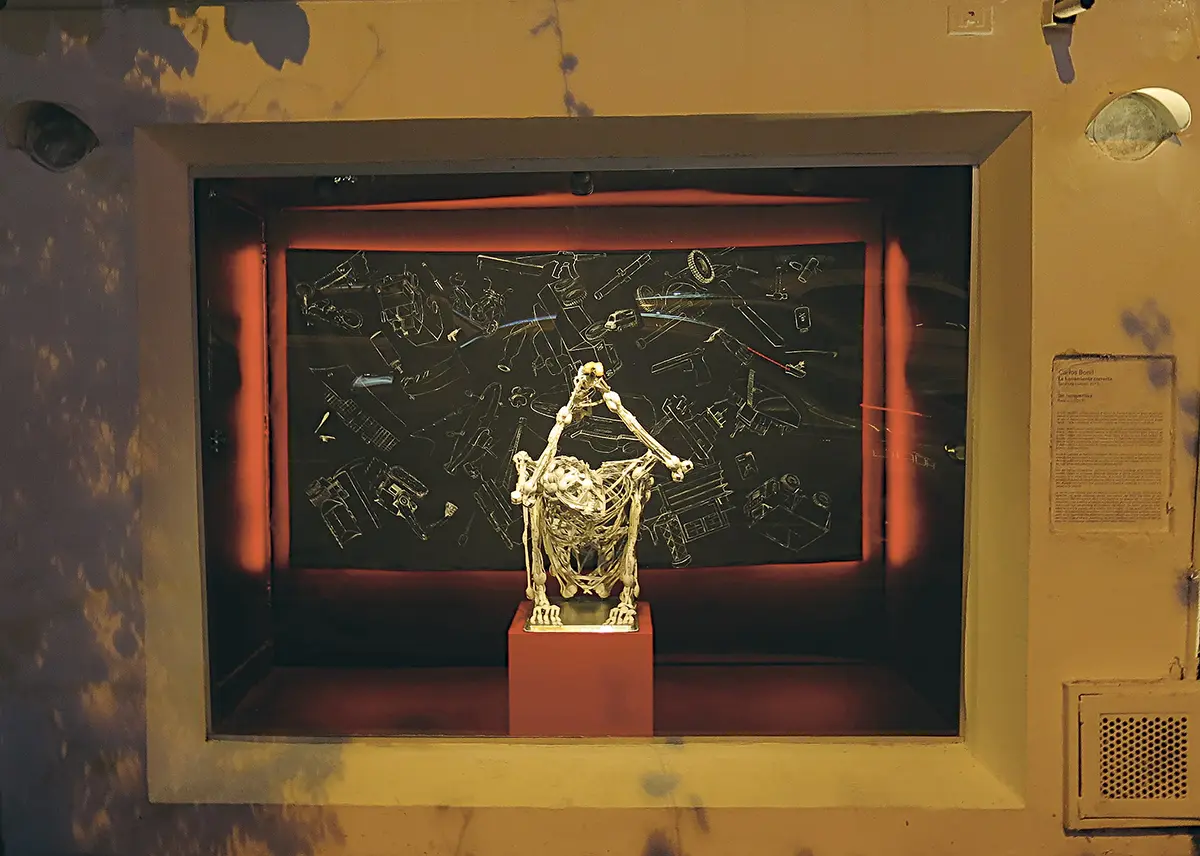
This skeleton fashioned with plastic spoons faithfully follows the structure of an actual human figure. To achieve this, Bonil created numerous scale models of mutated and monstrous animals and humans. La herramienta correcta is a fast-forward similar to the celebrated dawn of man sequence in Stanley Kubrick’s film 2001: A Space Odyssey (1968), which goes from a bone being turned into a weapon to a flying spaceship. A central part of this project, the time lapse here goes beyond the futurist line to a plastic-riddled present time where garbage outnumbers any space exploration projects.
He, who once stood upright—with the dignity that this implies to human beings— now crouches down once again. Such setback is perhaps the logical aftermath of centuries of rampant growth and progress. It is at this point where the tragedy contained in this work lies. The gaps between the assembled plastic spoons offer a glimpse into the contradictions between a remote past and the immediate future. In this sense, the object is a flashforward frozen in time. According to Bonil, the assembly of disposable cutlery is not an original practice invented by him. He uses bricolage to codify aspects of a collective memory that helps him trigger his own recollections.
The work by Carlos Bonil directly approaches issues related to the structure of bodies and objects, proposing a profound reflection on the materials used. In the last National Salon of Artists, in Pereira, Bonil presented what looked like a gift-wrapped limousine. And, in 2010, he created for ArtBo the life-size model (like the limousine and the skeleton) of a garbage truck made with used 1-gallon plastic jugs that alluded to wasted work. The accumulation of objects in most of his proposals generates an equivalent collection of concepts. As the sculptures are assembled, the very encoding of what is said (or listened to, in the case if his sound sculptures) is also being shaped. The starting point, the first spoon, hides underneath another assembly. Something else is already being communicated. The background of this scene is a black flag whose enormous size functions like a curtain. Machines and weapons are drawn on this dark backdrop to address the ideas contained in the sculpture. The flag (without perspective) was explicitly created for La Vitrina, a space that lends itself to scenographic interventions given its attributes as a cube open to the passersby. Trucks, ships, handguns, and machine guns float over its infinite darkness. The evolution of reason is in line with technological development—although it is not possible to establish with certainty if the inverse is also true.
Another interesting inversion occurs at this point: machines are no longer holding the flags, but rather the flag has swallowed technological development—floating like a bad dream over the head of a skeleton frozen in a scream and about to strike. Like its title suggests, this dark horizon removes any hope of survival. The prophecy that appears to inhabit the sculpture—which suggests the primitive nature of the skeleton’s posture as well as the possibility of hominids readopting it—is redundantly echoed in the background; the product of art’s desperate attempt to effectively point to the disasters to come.
BREYNER HUERTAS