Bosco Sodi is an installation artist, painter, and sculptor. He was born in Mexico and is deeply connected to his native land, yet he also enjoys wandering the world. This century, Bosco Sodi maintains studios in Mexico City and New York. He shows consistently in both cities and London. His raw material is the earth, which entails establishing the supremacy of its palette. Bosco Sodi’s works are best understood as minimalistic and telluric, as well as organic, without negating some geometric considerations. For those who have not seen his exhibition, the reference to “geometric considerations” must be expanded, since they are somewhat primitive, such as the creation of ceramic clay sculptures in the shape of square-cut columns (in other words, pillars). The technical proficiency in Sodi’s work is outstanding, even as it is unconcerned with making all edges rigorously straight. He has also created large “platforms” in the material mentioned above, to which other elements are added; in one of his installations, in a New York City park, he set up an interactive brick wall of broad social scope.
Having established the visual premises of Sodi’s work, let’s complete the idea by noting that the artist chooses and sets up the relationship with the material, with the help of Mexican locals in an effortful process of preparing the clay. This is done using animal traction—a donkey or a horse turning around a post—or manually when the amount of clay that is going to be prepared is lower. For those who know and treasure the resulting ceramics, it will be equally interesting to know that for his large-format pillars, Bosco Sodi sets up a special furnace instead of using the small and medium ones used by most ceramists.
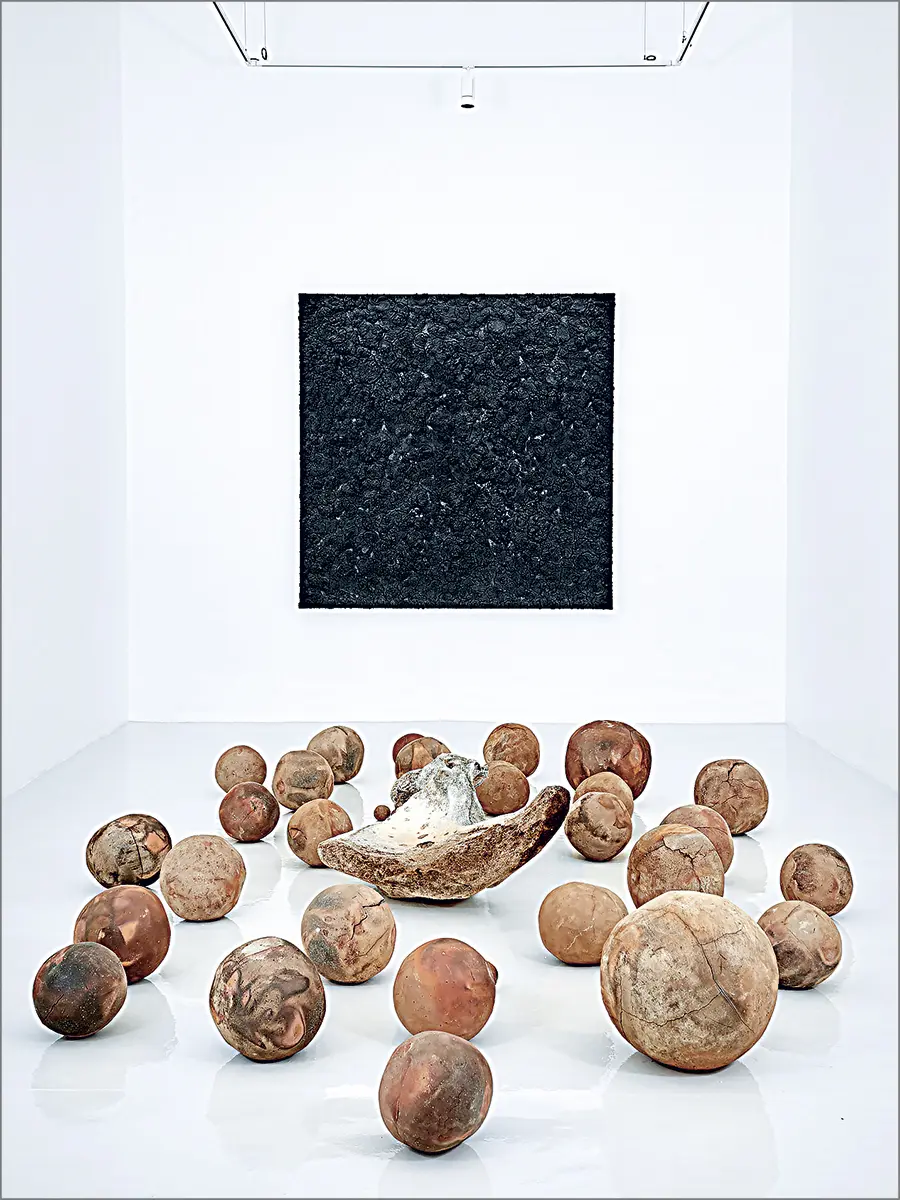
And it is a question of clay and fire, like a matter of life and death. The word that best describes Bosco Sodi’s work is intensity. The ancestral quality of clay and the tragedy of violence around the world coincide and are sublimated in the artist’s contemporary aesthetic.
The serenity of each one of Sodi’s work is indisputable, and it is disquieting. Wandering in front of the resulting ceramics can drive visitors from indifference to emotion, and from the perception of something simple to the consideration of enigmas. Making ceramic art is a way of life that Bosco Sodi shares with the painting of these monochrome or two-color dualities.
It is interesting to observe that the canons of beauty not only have changed but continue to evolve. People who understand the reality of our moment, those who accept that beauty and concept are permeable, perceive the indispensable ingredient that keeps creation alive. A profound refinement lives inside each one of Sodi’s spheres of cubes, or his parallelepipeds. Although it is not a material preciosity but an indecipherable essence. That is what the “observer” aspires to perceive and absorb wandering in the exhibition. There is, in the installations, a tension that is not only material, not only formal or coloristic but also spatial,
both in those that include some work on the wall and on the floor, as well as those that only inhabit the floor. It is left to the viewer to imagine whether the artist is inviting us to play with the distances between the parts or to assume that what is posited there is unchangeable. The question remains open for future dialogs with the artist.
“Las tinieblas sobre la faz de la tierra” (The Darkness on the Face of the Earth) is the title of the exhibition that is being reviewed. It deals with the dualities of existence, in its components of light and shadows, life and death, good and evil, spirit and matter. In a telephone interview as he was finishing the works, Bosco Sodi said: “I began to think insistently about life and death after the passing of my grandmother, Mima. I thought about the joy of being alive, and about the moments of sadness that accompany it. This exhibition is about that duality.” This also motivated a series of black and white paintings, composed of black carbon and titanium white.
GRACIELA KARTOFEL