The works featured in “Inflections” by Ben Abounassif display a particularly clean and refined take on geometric abstraction and op art, through the superimposition of planes, a limited chromatic range, and incisions and folds to alter the supports. Born in Caracas, in 1964, to Lebanese parents from Beirut—a city he visits often—Ben Abounassif blends the eastern visual experience of filigree with kinetic language, an influential tradition in Latin America.
Inflection, “curvature, deviation, or twist of a straight or flat thing,” is the conceptual basis with which Abounassif constructs a complex geometric language on two-dimensional supports that aspire to move or leave the plane. Craftsmanship and technology come together to alter paper, steel, and acrylic with a high degree of precision through digital cuts and handmade folds.
The selection of works reveals the progressive emancipation of figures, a transition that facilitates the organization of the proposals in three series: “Geometric Movements,” “Abstract Forms,” and “Fragments.” Sombras en movimiento (Moving Shadows) is one of the first pieces created in 2012. It consists of the superimposition of two papers, each of a different color—a red one in the background and a white one in the foreground—juxtaposed using cuts and folds. The same shape, created with a few incisions and folds, is repeated throughout the white surface. The shape’s slightly folded edges create interstices that expose the red paper underneath. These modifications give the once static form a new optical interpretation, outlining its edges through the visual combination of the colors in the two planes.
Then, in two pieces from 2014 belonging to the series “Geometric Movements,” smaller and less contrasting incisions reveal a slightly engraved and texturized surface that stimulates an optical effect. The geometric construction that remained somewhat static before now has been energized to create the perception of sinuous movement or motion across different depths. In a piece from 2016 created on paper and red acrylic, also part of the same series, the energy of color and the slightly oval forms emerging from the incisions generate a laminar effect. There, the luminosity that the material confers to the surface and to the notion of depth becomes notable.
In “Abstract Forms,” from 2017 and 2018, Abounassif relies on a combination of supports like paper, zinc, and acrylic. The separation between the planes is emphasized. Isolated from one another by a certain distance, the circular figures are perforated repeatedly to form a square reticle. Then, the second support is cut and folded. In this manner, a dynamic relationship between both planes is established. The circles obtained from the perforations are enriched by the effect achieved through the incisions and folds originated underneath, optically drawing different forms, rhythmic readings, and unexpected lights and shadows. A monochromatic range is a distinctive aspect of these pieces, as only blue, red, or white materials are used.
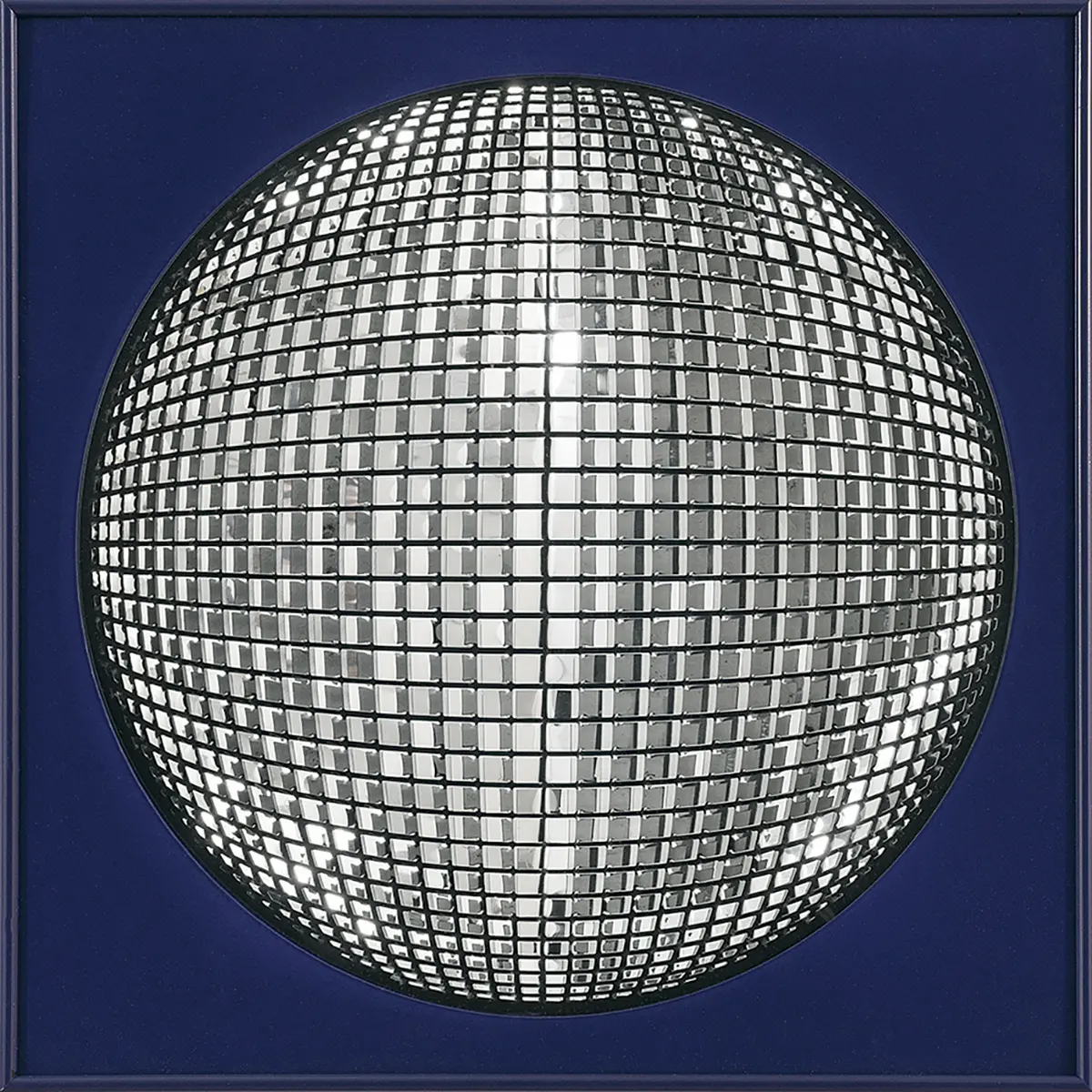
“Fragments” is characterized by the predominance of stainless steel and acrylic. Used to create unique forms—circles or squares—stainless steel is placed on acrylic sheets of neutral colors that either complement or contrast the color of the metal. The internal structure of the circles consists of small squares whose size decreases or increases to simulate the idea of perspective. This, and the shiny metal that stands out against the matte acrylic sheets, reinforce the illusion of three-dimensional support that is actually flat. In this manner, the generated effect of volume takes the form of a sphere. The opposite occurs with the square works, where the metal is contrasted with bright colored acrylic sheets. While two-dimensionality has been preserved in this instance, the perceived motion of the tiny cut out pieces has increased. Light causes outlines to be blurred into luminous black and whites. Because of the refractive nature of steel, the work transforms as the viewer moves and through the effect of light and of the surrounding environment. As mentioned by Susana Benko in the exhibition text, a particularly distinct moiré pattern can be observed in the undefined forms and the apparent visual combinations. As a result, the image is fragmented.
The calculated compositional arrangements, the study of the qualities of materials, and the possibilities that they offer to the work; the explorations of the third dimension and virtual volumes, and the mastery of elements of visual expression are harmoniously combined in a proposal that exemplifies the endless stylistic facets of geometric abstraction and op art.
ANNY BELLO