In From the Silence, Aureliano Parra proposes a reflection on the image, the word, and the large pendulum that oscillates between the two. Parra began this work after exploring personal situations in which self-discovery, the private space of his home, reading, and his work led him to delve into the relationship between images and words and to dissect their power as signs for representational content.
The exhibition is structured around several central themes that seek to revise the preeminence of visuality and words to draw attention to the primal state of silence. To assemble this discourse in the exhibition space, curator María Luz Cárdenas established a dialog between Parra’s work and publications intervened by him.
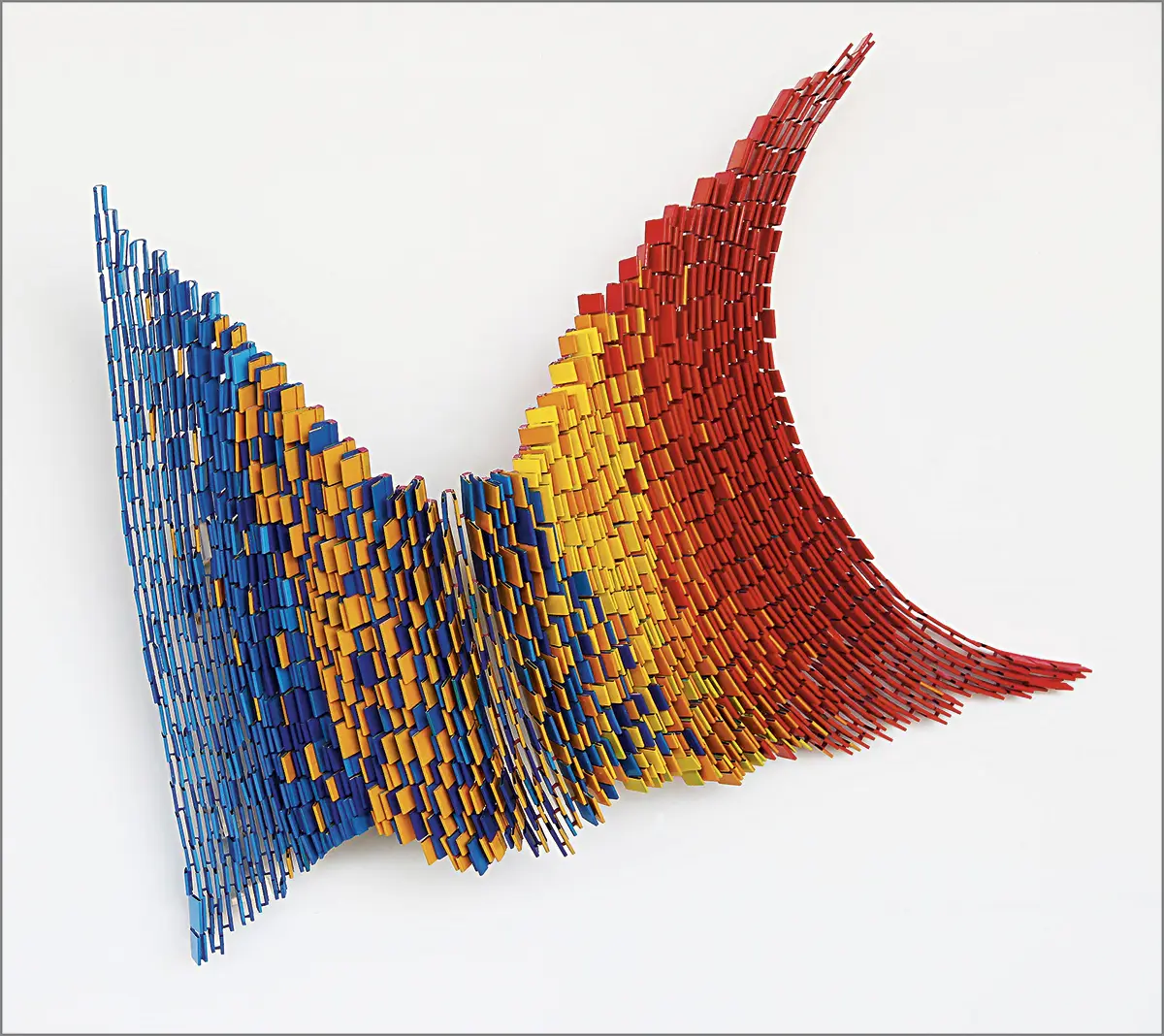
Parra based his proposal in chaotic urban environments, which he then rearranged visually. He resorted to several aerial views of a city whose compositions, shapes, and colors he fragmented. Through the skillful weaving and assembling of small painted pieces made of different materials, he created webs of organic forms. In Infinitos contrastes (Infinite Contrasts), Reflexiones sobre Mark Rothko (Reflections on Mark Rothko), Sección áurea (Golden Section), Resplandor indigo II ([Indigo Glow II), and Luminiscencia (Luminescence), all from 2018, the chromatic combination of multiple parts formed rich tonal ranges of yellows, blues, reds, and purples.
The painstakingly rendered weaves that characterize Parra’s pieces were combined with the laborious task of devastating the publications that confronted his work, cutting out and carefully selecting the texts from the books he decided to use. While diverse, the themes led him to establish connections with aesthetic, cultural, and social situations that are of interest to him. The dialog began with a book on which theories Parra himself bases his work: Tratado sobre el color (Treatise on Color), displayed at the center of the exhibition room. He extracted the writing, leaving only the images. Isolated, these were successfully disassociated from their original meaning to form a book-object. In this manner, Parra tears down his own formal bases to build a contemporary conceptual proposal that deconstructs the original meaning of the publication. Based on the book Reurbanización El Silencio (El Silencio Redevelopment) by Ricardo de Sola, he developed the piece Reconstrucción de la imagen (Image Reconstruction, 2018). He dissected its pages, performed the same type of cut outs already mentioned, and created a collage organized into a panoramic view of that redevelopment. Other reproduced pages from Tratado sobre el color were framed with plexiglass and hung on the wall. Examples or this are Curvatura del silencio I (Curvature of Silence I), Curvatura del silencio II (Curvature of Silence II), Ruta the ascenso (Ascent Route), Esplendor indigo I (Indigo Glow I), Geometría de lo humano (Geometry of the Human), Ocultamiento (Concealment), Posiciones divergentes (Diverging Positions), Cuerpos en continuidad (Bodies in Continuity), Dos capas de códigos pictóricos (Two Layers of Pictorial Codes), Signos I (Signs I) and Signos II (Signs II), all from 2018, and Vestigio y testimonio (Vestige and Testimony), from 2019. The selected pages that refer to the history of art, to the study of images, were altered to underscore a visual-formal meaning drawn from its internal structure. Once decontextualized, and no longer subject to a precise interpretation, they remained inevitably connected to the meaning that Parra intended to erase.
Parra designed the installation Catarsis (Catharsis, 2019) based on No hay silencio que no termine (There Is No Silence that Does Not End), written by Ingrid Betancourt. Using all the pages from the book, he created six curtains that hung from the ceiling. The autobiographical text, in which Betancourt relates her experiences, is subjected to an inverted process that reveals, through the written word and artistic action, the sublimation of certain emotional situations. María Luz Cárdenas sees this process of undoing to create new narratives as “a ritual, a form of prolonged meditation, a sort of actional prayer.”
In these works, visuality predominates over words. However, despite having eliminated the words from the paper, their absence confers them a latent and powerful symbolic presence. The altered pages acquire meanings that are different from the original quality of communication, a function that is nonetheless reaffirmed in the end. Paradoxically, the erased word demands its presence in the structured thinking required for the rational understanding of existence.
The exhibition mediates between aesthetic and concept, disrupting the auric treatment of the work and contrasting it with other visual resources. The word eliminated in a ceremonial act removes any written meaning to return to the void. These unexpected relationships generate unknown realities and place viewers on a thin and disconcerting line between the primitive and the need to once again find in words the possibility of explaining who we are and our surroundings.
ANNY BELLO