The game of distance doubles when there is enough separation for contact to be impossible, but enough closeness to listen to the whispers of a corresponding voice seeking a shared horizon. This condition is present in the exhibition titled Double Distance by artists Ana Bidart (Uruguay, 1985) and Armando Rosales (Venezuela, 1987) shown at the ESPAC, Espacio de Arte Contemporáneo in Mexico City, under the curatorship of Esteban King. Through works of painstaking spatial sensitivity and a rigorous reading of the context, both artists show the result of inquiries that have been accompanying their production for the last five years.
That the body is the medium for the perception of space and that movement is fragmentary, are still precepts that can be taken advantage of. Bidart and Rosales demonstrate it through gestures that recall the mutability and fleeting nature of instants. They explore ways of understanding the exhibition space, not to radically subvert its logic but to show us the phenomenology that inhabits it and that can be used in the visual fields.
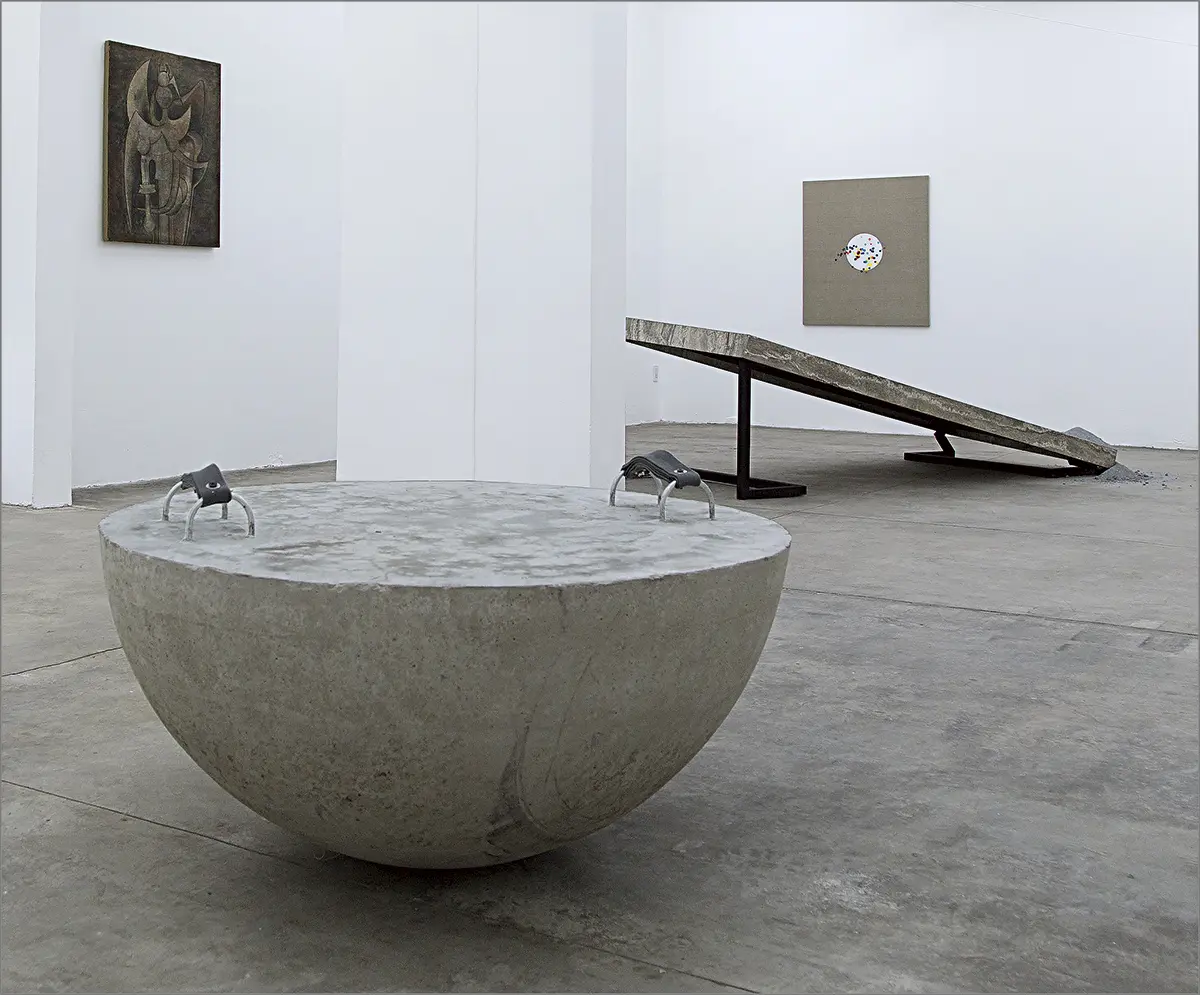
Upon being opened, a door lifts a small bag with blue pigment that falls back to the same spot when the door is closed, creating a drawing in the middle of the floor. The opening in the ceiling that covers the patio of the gallery offers precise instructions that must be executed by those working there every time an alarm goes off in their cellphones. Semidarkness takes over the exhibition from time to time to reveal the dim flood of light streaming from a window created for the show in one of the walls. Or the sheet of paper incessantly moved by the wind on the edge of one of the indoor façades that opens onto the patio of the gallery. All of these situations are subtle gestures that establish the context for those participating in this “time suspended between two voids” as they walk through the exhibition.
The work by Ana Bidart has intelligently oscillated between the subtlety of the immaterial and full awareness of the phenomena that intersects life at its multiple intervals. Some of the actions that are a constant in Bidart’s work are: revealing the flow of sunlight on architecture through drawing, measuring the wind and taking advantage of its effect to create situations in indoor spaces, assuming drawing as a way of interpreting sounds and distances, and perceiving time in order to externalize it through coordinates and minimal gestures. Her processes usually explore possible systems of rules that are then transgressed in favor of random operations, of understanding and reaffirming the continuous presence of drawing in the space. Trained as an industrial designer, Bidart has focused on revealing the image of that which is imperceptible: a suggestive translation of codes. Her participation in this exhibition shows the maturity of several ideas that emerged during her residency at Flora ars+natura (in 2018) and gave way to pieces like Hoja de sala (Exhibition Room Sheet, 2019) and Peso total (Total Weight, 2018).
Armando Rosales, for his part, has developed solid work. His inquiries invoke the body and the way it inhabits the exhibition space (with the resulting exercises of power that are hidden there), the use and flow of materials in specific places and their appropriations and circulation, the poetic of his assemblies, and the tension between extreme situations in social and political contexts transferred into the affective realm. Other aspects equally important in the development of his work are his closeness to the editorial field, music, and the management of autonomous spaces. A graphic designer by trade, he usually conceives his interventions as visual compositions on the architecture, often revealing relationships and mechanisms of power. In this manner, his clear inclination towards sculptural work allows his work to easily change in scale, suddenly going from object-based productions to brilliant transitions into architectural interventions. Sometimes self-referential, his process exhibits traces of the fragility of the body that eventually succumbs to exertion and bursts, wears out, deteriorates. It is the sculpture-based reading of an impending collapse.
These two artists share a background in design, both attended the SOMA educational program, come from South American countries, and have a common interest in the imperceptible experiences that occur in the space. The two measure, alter, and channel concrete or intangible elements, and understand the circumstances of the places in which they execute their works to reveal hidden elements or to challenge viewers. From the beginning, the curatorial proposal involved Bidart and Rosales working on open dialogue with some of the works from the ESPAC collection also on display. Another curatorial element included the publication of three accompanying booklets: a small catalog, and two other publications containing independent proposals by each of the artists as extensions of the exhibition. Distance appears to split in the presence of two artists questioning multiple temporalities, with two stages conceived for the exhibition of works that briefly converge on the same line of inquiry before splitting in two again. Therefore, in this instance, it could be said that distance is also an essay on synthesis. It separates and brings together again. It allows the condensation of processes to generate new tangents for anticipating a probable future.
JORGE LOPERA