According to Canadian scholar Astrida Neimanis, water is a metaphor and the object of flowing epistemologies; ever-changing knowledge opposed to the binary rigidity of colonial thinking. This theory or, in other words, this way of thinking and being in the world through the allegory and materiality of water, is at the center of the exhibition entitled Malpaso, a collaboration between artists Alejandro Almanza-Pereda (Mexico City, 1977), Birgit Rathsmann (Erlangen, 1975), and investigative journalist Rick Karr (Chicago, 1965). The show opened from March 9 to April 13 at the Abrazo Interno Gallery of The Clemente Soto Veléz Cultural and Educational Center in the Lower East Side, New York. In fact, it is the first time that Almanza-Pereda, Rathsmann, and Karr collaborate in a project despite sharing the same fascination for water.
Their joint research led to the creation of a small imaginary museum inhabited by a collection of fictions. Rendered through different media, including painting, video, installation, and the use of neon lights, these Borgean fictions “document” the reality of a place: Malpaso. A historically relevant valley located in western Chiapas (Mexico), Malpaso has been submerged since the 1960s. In essence, the show alludes to the relationship between history, culture, mechanisms of domination, and water. As stated in the press release, “The exhibition is organized around the metaphor of a small museum that documents the artists’ subjective experience of the landscape surrounding the Malpaso Reservoir in western Chiapas. The show investigates the historical layers of violence foisted onto this landscape as a consequence of colonialism, religion, and ‘progress.’” Indeed, since the “discovery” of America in the 15th century, the ideas pushed by progress, colonialism, and Catholicism have dominated global hegemonic knowledge. And while in this seemingly all-revealing “landscape” water serves as a channel for goods, all the things that are hidden in it function as a discontinued, submerged, or simply erased past. The Grijalva and La Venta valleys near Malpaso, for instance, were home to Olmec culture, a civilization that had to be historically, culturally and epistemologically buried because it preceded the so-called “New World.” The creators of Malpaso rely on a metaphor to make visible what is underwater, under the liquid, and the symbolic layers of Western history. In this manner, water serves not only as a metaphor for what it submerges but also for a model of thought that challenges Western binarism. To paraphrase Neimanis, “Thinking with water opens up a different sort of imaginative space, interrupting concepts and beliefs in the dominant Western systems inherited by many.”
The journey to Malpaso, Chiapas, and the joint research by the artists focused on the place, inspired by photographs of the Temple of Quechula (aka Temple of Santiago) taken during the drought of 2015. In that year, the Catholic church, founded by disciples of Bartolomé de las Casas—the famous benevolent Dominican friar and defender of “the Indians”—revealed its five hundred-year-old structure. In 1966, Mexico’s state-owned electric utility company (CFE) tore the hills surrounding Malpaso to build a dam that flooded the place along with other pre and post-Columbian landscapes. By recovering the landscape, the artists uncovered not only the hierarchical relationship between the dominant colonial Catholic model and the other but also the ongoing global struggle between humanity and nature. The creators of the project tell us, for instance, that nature and culture are not opposites and that, by extension, water dissolves the very idea of a binary hierarchical world.
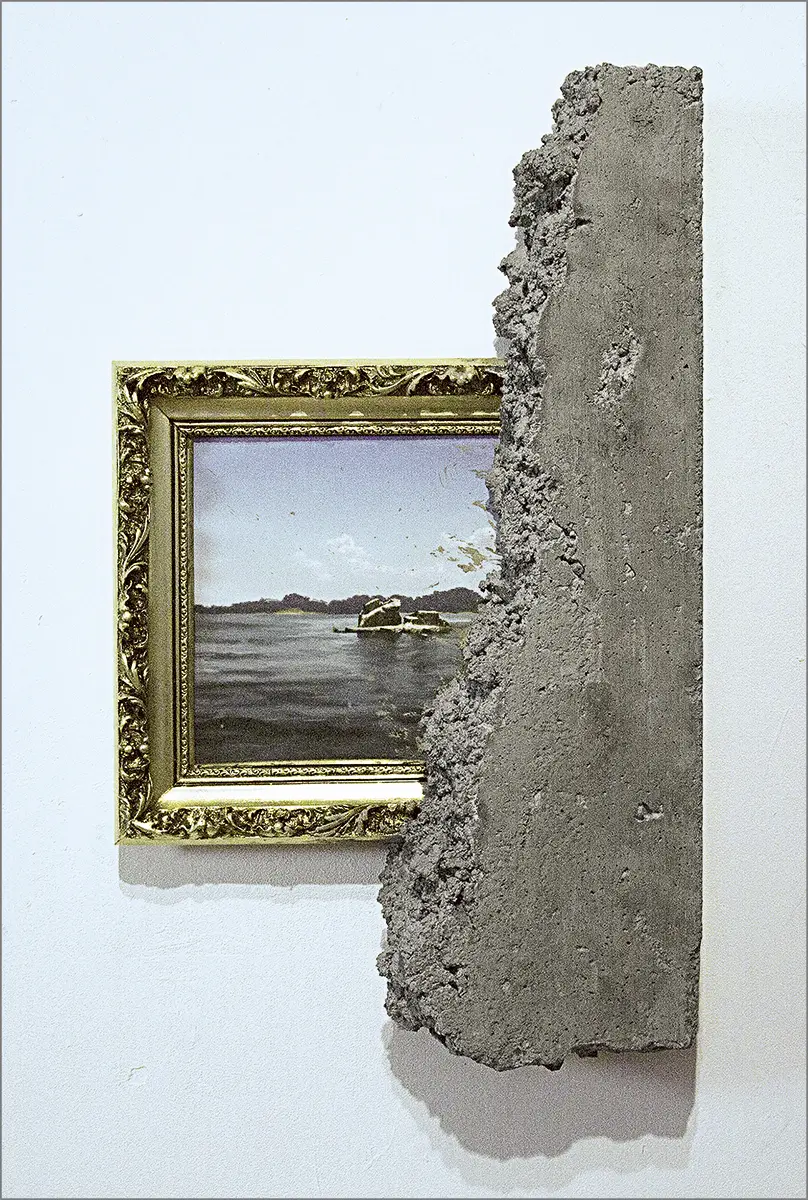
The piece titled Horror Vacui (Malpaso Scene) by Almanza-Pereda, for instance—consisting of a gold-painted wooden frame and a piece of concrete—is based on the Temple of Quechula: its representation, its sinking. By shedding light on the issue of humankind trying to dominate and encapsulate nature, and nature resisting such destruction, Almanza-Pereda, who since 2010 has been creating pieces for the “Horror Vacui” series, counterpoises the golden frame and a portion of the wall. The wall reveals its interior: the concrete that has not been transformed into a wall. Behind that wall, a painting with a golden frame shows the halfway sunken temple at the center of the composition. Even so, Almanza tells us ironic and critically, still sunk and resisting, this image is for many a beautiful landscape that, as such, should be framed, dressed in gold and placed in the home. Almanza then opposes the public space to the private one, exposing at the same time the domestication of nature. As the artist explained in an interview about the installation of some works from the “Horror Vacui” series presented at the 15th Istanbul Biennial: “Horror Vacui reveals not only how we see nature, but also how we see it in a fragmented way.” The Malpaso exhibition at The Clemente Soto Veléz Cultural and Educational Center shows us such fragments, inviting us to become aware of a shared and transregional struggle that questions the uses and abuses of the natural resources, in this instance, under and above water.
FLORENCIA SAN MARTIN