Sergipe artist Zé Carlos Garcia presents an exhibition titled Torto (Crooked) at Cassia Bomny gallery in Rio de Janeiro. Curated by Paula Borghi, the show features a selection of new works, all dated 2018. Torto illustrates the artist’s recent investigations, which attempt to establish a dialogue with the history and anthropology of Brazil. It comprises twenty-six sculptures made of wood, leather, and feathers, arranged in thirteen pairs. At the opening event, on November 21, a book documenting the artist’s creative process, with texts by Paula Borghi and photographs by Mario Grisoli, was also launched.
Although Zé Garcia’s journey during this period is connected to the relationship between anthropology and history in Brazil, he eschews the stereotypes of ethnography and historicity, embracing instead the new perceptions emanating from original contemporary studies, moving towards the meeting of emotion and critique in the visual arts. “These works reflect about concepts referred to the relationship between nature and culture in the field of anthropological subjectivity and poetic power,” says curator Borghi, and under that light, emotion gains great preeminence in the works.
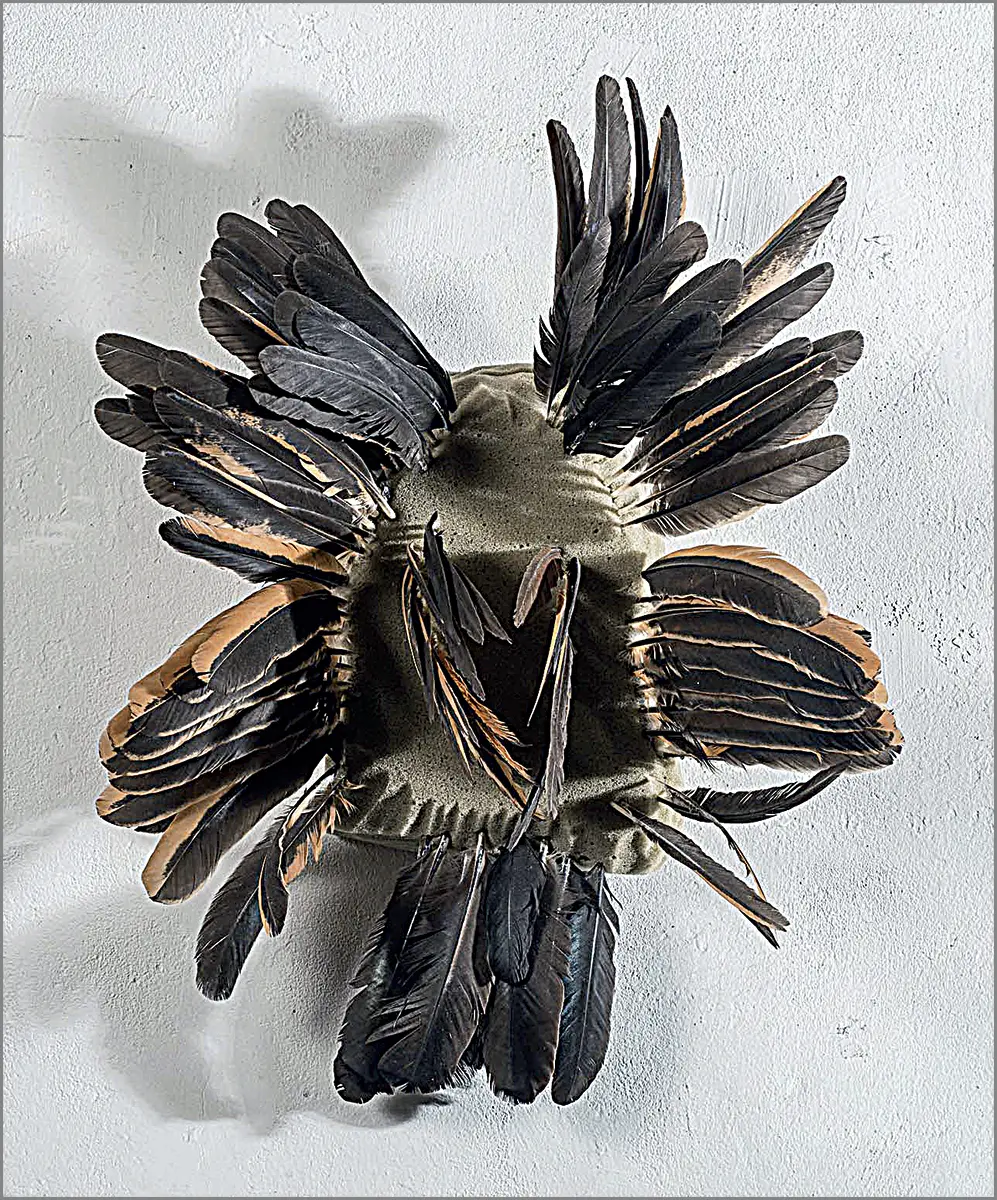
The exhibition is organized in pairs, and each pair presents similarities in format and size. One sculpture is made of feathers and the other one with leather a wooden spear sculpted by the artist. The wood comes from household furniture, which Zé Garcia appropriates, modifying its function and adding an element of hybridity. The dialogue between the materials produces the emotional sensation of the transmutation of a static volume, emphasizing the dynamism, organic nature, and lightness of the feathers.
The sensation this provokes in the viewer brings to mind broad dialogues about multiple cultural encounters that have taken place over several centuries in the territory of Brazil. On the one hand, the traces of pre-Cabral Brazil (nature and indigenous groups); the conflicts imposed by colonization; and the new Christians (persecuted by the Inquisition) that became integrated into the new continent. There are also the Bnei anusim (converted Jews); the many migrations; the relationship with Africa and slave culture; and the new correlations. The works outline the trajectory of uncountable encounters and the resulting plural culture in its emotional, sensible, aesthetic form.
For Paula Borghi, the curator, materials like wood, leather, and feathers, the sculptures’ original materials, create a dialogic discourse with Brazilian culture, its rituals, its myths, and human action upon nature, in a historical chronology of the conflict between conservation and extractivism. On the one hand, one can think of feathers as ornaments, leather as physical attributes, and wood as a representation of the forest. On the other hand, those same elements can be interpreted as icons of the carnival, the festival, rural life, and social stratification. These are natural materials with symbolic representations that weigh heavily on any understanding of Brazilian cultural diversity and its construction, both in a hegemonic and a pluralistic sense.
The sculptures signal a clear variance with regards to the artist’s creative evolution in his earlier investigations of feather art, which Zé Garcia has explored since 2004. The innovation centers on the abstraction of the forms; in previous works, Garcia included the birds’ morphology. The exhibition’s title, Torto, is connected to this. The works are deformed, twisted, which is to say, they are bodies outside their usual pattern, which relates to the artist’s critique of the denial of difference in society and asserts his views about a paradigm shift.
In that sense, Garcia’s work prompts reflection and debate, at a time when the culture forged by social media amplifies prejudices and aesthetic clichés linked to commercial interests. Brazilian culture is a hybrid culture, the result of all those encounters and clashes. It cannot narrow itself to the other, to the difference from a fixed model; the DNA of all Brazilians is the product of many ethnicities and their stories, expressed in their relationships and oral traditions. We are Indian, Jewish, European, African, Asian, all in the same space, where human action transforms nature, and the results come back to haunt humanity. Torto probes and critiques that very issue. What would prompt us to imagine ourselves different, when we are a nation formed by disparities that harmonize?
Zé Carlos’ investigations, as expressed in Torto, reflect his influences, his passions, and his formative experiences: an artist from the Brazilian Northeast relocated to Rio, with a Bnei anusim name (Garcia), a descendant of Jews forcibly converted to Christianity by the Inquisition some 500 years ago. Zé Carlos Garcia does not situate himself outside Brazilian society’s ethnic conflicts as he articulates a discourse about the environment. He was always fascinated by indigenous feather art, from his earliest childhood, and not only for the physical beauty of the material but also for its long endurance. He uses real feathers from various kinds of birds, all sourced from certified farms that raise the animals specifically for that purpose. His works carry, besides that certification, veterinary approval.