It feels like winds of the end of the world are blowing. Cinema, which is a sort of crystal ball that reflects our fears and anguish, never ceases to project devastating scenarios. In many such scenarios, art is presented as hope for a humanity that may yet be resurrected, like the sacred amid the wild. In, for instance, the 2006 film Children of Men directed by Alfonso Cuarón, when the human race is condemned to extinction, only one man is in charge of recovering the works of art from vandalized museums, while the entire world outside self-destructs with hopeless ecstasy. Perhaps the value of an art collection resides in its future permanence and as a result, in the movie, faced with an apocalyptic landscape works of art become things that nobody will ever see again.
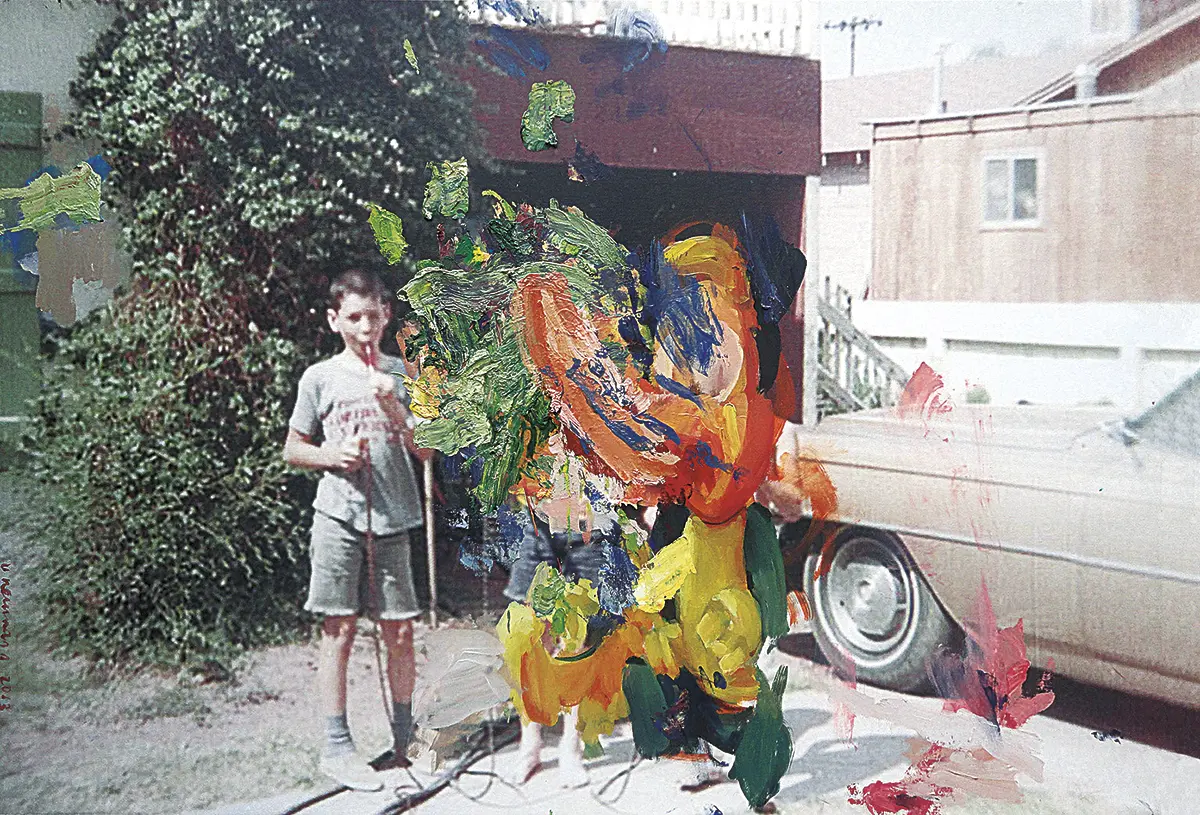
The paintings by Vicky Neumann (Barranquilla, Colombia, 1963) somehow made me reflect on art with an end of the world feel to it. Some pieces contain an inherently violent, repressive, gesture that is also somehow anti-pictorial. In the series titled “Guys Watching TV” (2016), we observe the same scene repeated in several canvases. It is a mundane scene with profound modifications between the various versions. So much so, that, in order to distinguish the different characters, the paintings must be observed as a group. In this manner, while one can differentiate one from the others, the rest appear disfigured by paintbrush strokes and patches or unfinished compositions.
Vicky Neumann works within a tradition that is eager to betray. She crosses out areas using a process that, more than referential seems to negate. A characteristic of our time, violence pours out into peaceful scenes by Goya or Manet to transform images that rest in our memory (collective memory) through paint drips and splashes that, paradoxically, explicitly reveal the medium: we are no longer before recognizable forms (before a mirror), but before material that has been divested of anything arbitrary.
The works by Neumann look like works from important museums that have been damaged, vandalized, as if attacked by a mob no longer looking for the work’s aura but after the power of gestures, of reactions. If we think of a new public, then Neumann could be thought of as an artist that embodies that new despairing public, an artist whose subjectivity is manifested through reaction rather than tradition (but still somehow connected to the latter).
Attacking the mundane—like in “Guys Watching TV,” in the image of some kids posing before the camera in a garden, in En casa solos (Home Alone), in having breakfast on the grass, in a peaceful portrait, or in the portrait of a virgin (bourgeois) carrying a kid in her arms inside her living room—is to devastate the notion of the familiar and to generate a crisis among those intimate environments that make us feel safe (like images we can recognize). These images can lead one to imagine movie scenes of soldiers storming into homes to repress a family, or of a tragedy at night in a bedroom. The paint stains are perhaps (gestures and all) that which unexpectedly assault the peace. Neumann conveys such irruption.
It goes without saying that this reading of Neumann’s work is just one among many possible interpretations. Miguel González, curator of the exhibition at the Museo Rayo, presents an artist that erases, crosses out, underscores, and eclipses driven by an emotional imperative whose prerogatives are not based on representation. Neumann said something quite revealing when she affirmed that her work “[…] seeks to vindicate the discarded, to trash the accepted; to find color, confront fears, take risks, and do whatever I feel like doing…”
In this manner, the exhibition fills two exhibition areas of the Museo Rayo with large works that underscore elements like color and material without hiding them behind iconographies. Among the various paintings shown, there is one piece formed by a collection of several fabric fragments titled On the Road (2015). These remnants seem to be the rags that Neumann uses to clean her brushes. This work clearly expresses an interest in abandoning any image protocols. The spread-out rags are unfolded time, marks of progression.
Chaos, anarchy, and immediacy are arguments given by Miguel González. Impression generated as one move from one painting to another looking to recognize something under the sections crossed out. The irruption of the pictorial overrepresentation could be associated with the irruption of tragedy in everyday life; a rupture in which the comfort of iconography evolves into a state of anguish. The paintings presented at the Museo Rayo pushes visitors against each other, from one to the other, in search of their purpose, their motive, perhaps because we intuitively know that they hide an answer and we want to see “through” something occurring in the foreground: matter and color.
BREYNER HUERTAS