In the exhibition, Tercerunquinto “Obra inconclusa” (Tercerunquinto “Unfinished Work”), curators Cuauhtémoc Medina and Taiyana Pimentel analyze the artistic practices of the titular collective over the last two decades. The collective was formed in the late 1990s in Monterrey, and its members are Gabriel Cázares, Rolando Flores, and, until 2014, Julio Castro.
The key elements that Tercerunquinto deploys in its critical analyses are two: “progress” and “development,” both notions that are foundational social principles of modernity. The exhibition features forty projects created over almost twenty years: installations, sculptures, photographs, videos, drawings, and paintings.
The works on exhibit touch in social and political themes, by following a series of creative models that emerged in Monterrey in the mid-1990s, crucial years for the development not only of group projects but of models of visual production that broke with convention. In the specific case of the Tercerunquinto, one finds that the city was the essential location for the emergence of disruptive actions, interventions, performances, and urban drifts. In this temporal horizon, we see the appearance of groups like Los Lichis, marcelaygina, and ONF Object Not Found, who were able to gain a foothold in the local, national, and Latin American art landscape.
Another critical factor in the evolution of Tercerunquinto was the emergence in Monterrey of independent spaces outside the institutional art-world sphere. The independent gallery BF 15 was vital for these groups of new artists to exhibit their work and position themselves in the national and international scene.
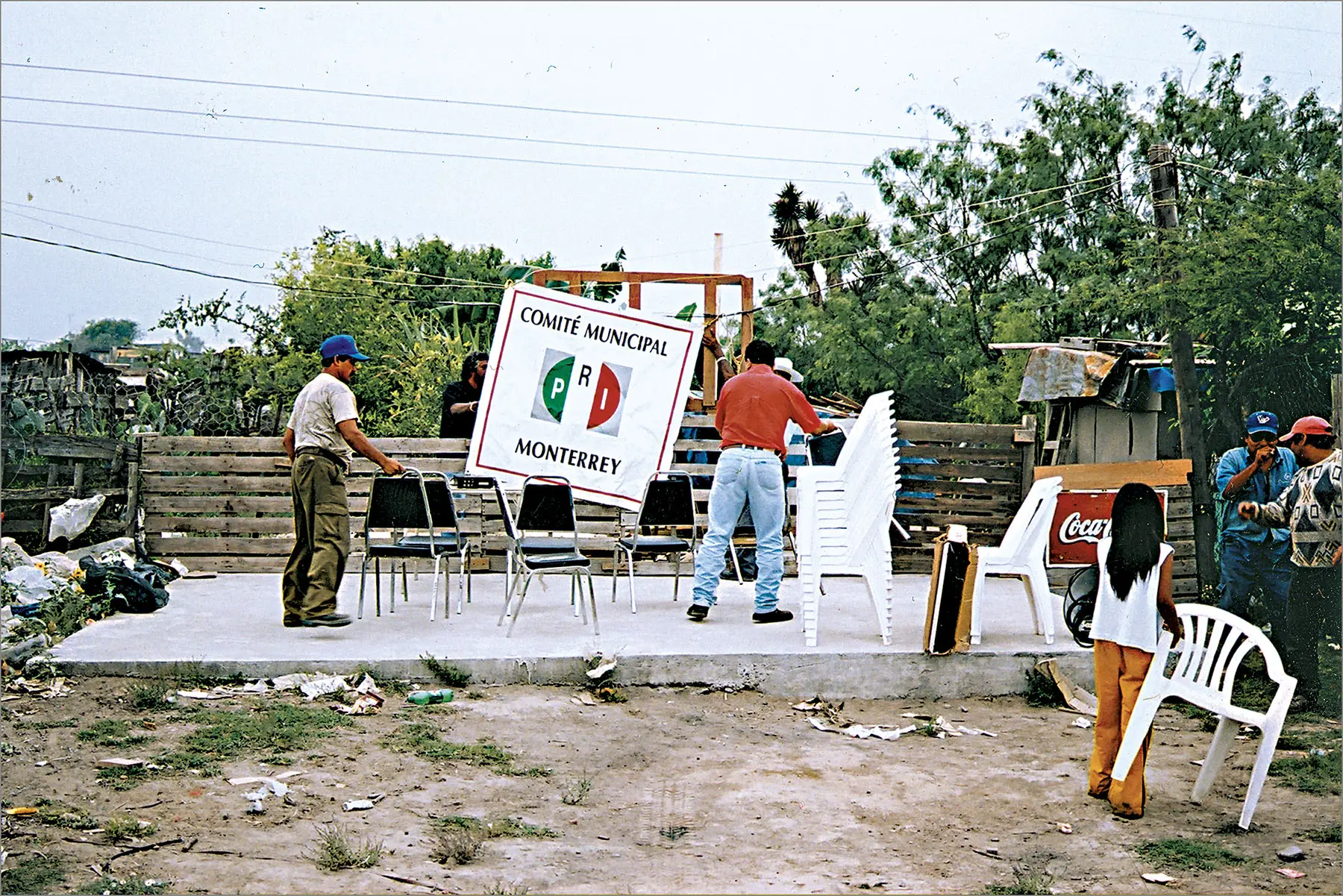
The show starts with Escultura pública en la periferia urbana de Monterrey (Public Sculpture in Monterrey’s Urban Periphery, 2003-2006), one of the group’s most important interventions. It consisted of the construction of a concrete platform, with no prescribed use, in a peripheral sector of the city “Los Naranjos,” an old farmland belt now covered by numerous unregulated dwellings.
Marginality and lawlessness are two of the elements brought together into an integrated whole in this work. Because of their very nature, such urban areas are fragile. They are also notorious for their ephemeral, unstable architecture. Tercerunquinto’s 50 m2 concrete platform generated many legal controversies about the use of the territory and the sense of property. In this work, the architectural insertion of an alien element that declared or revealed a shortcoming of the chosen site generated a sense of invasiveness. The relationship between the city and such improvised or even fragmentary architectures are important frameworks from which the work of Tercerunquinto drive us towards one of the discursive lines proposed in this show: gray artwork.
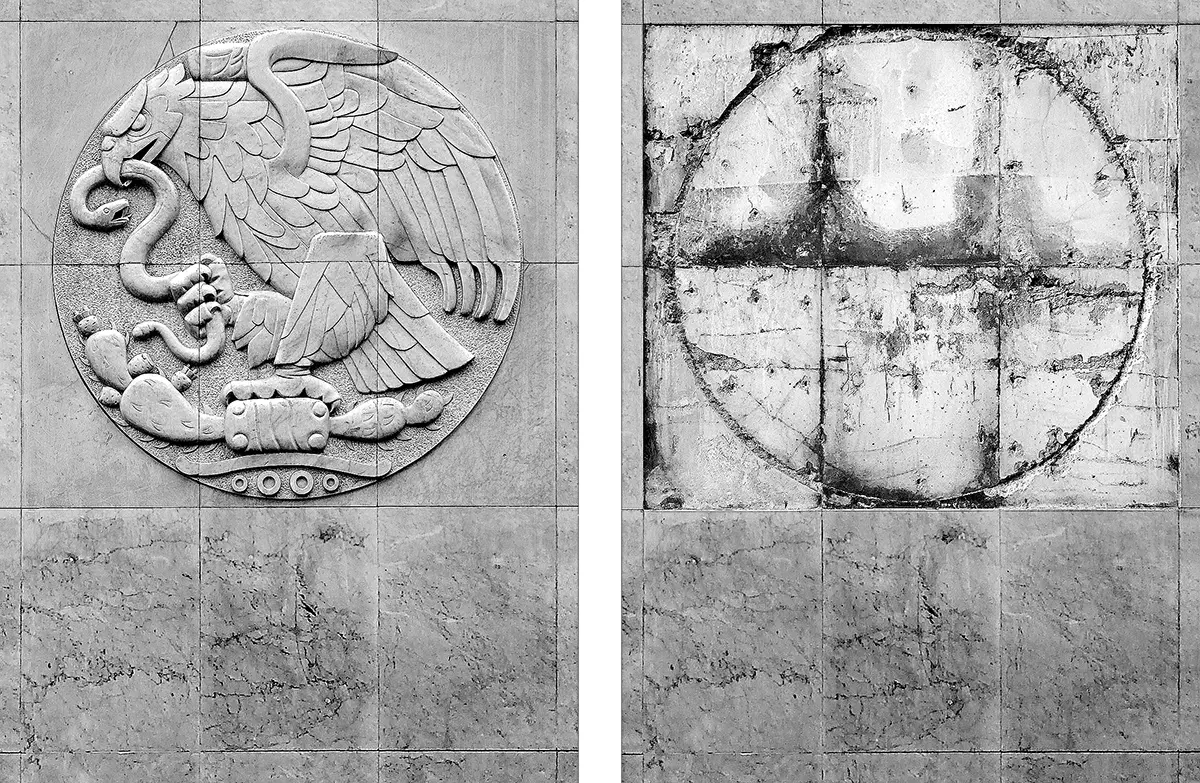
On the other hand, following the discursive line of Protocolos (Protocols)—in the direction of the group’s critical strategies towards the museum as the container of artistic discourses—we find Desmantelamiento y reinstalación del escudo nacional (Dismantling and Reinstallation of the National Emblem), from 2008. A key piece in the ongoing legacy of projects executed by Tercerunquinto, it took place some days before October 2.
The National Emblem is one of Mexico’s three main national symbols. Together with the National Anthem and the National Flag of the United States of Mexico, they represent the symbolic, political, and economic complex often referred to as “fatherland.” The work was built around the fact that it was only to remain active on October 2, and as part of the 40th anniversary of the student massacre of 1968, the carved-marble Seal in Mexico City’s old Foreign Service building was to be removed. Finally, on October 3 the slabs with the emblem were reinstalled. A team of specialists in architectural restoration carried on the task, dismantling and reinstalling the six marble slabs from one of the main façades of the old Ministry of Foreign Relations building, located at the Plaza de Las Tres Culturas.
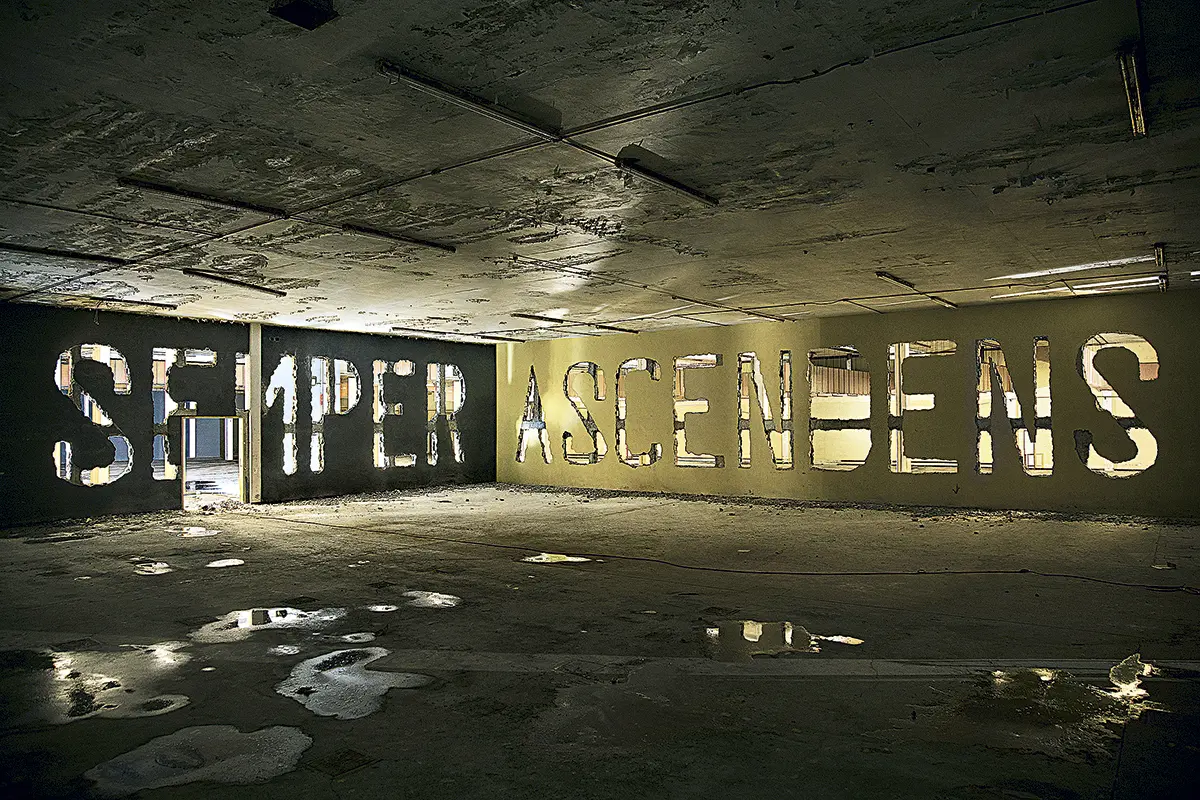
The exhibition’s final discursive line was grouped under the concept of Occupations and featured works in which Tecerunquinto transforms spaces and involves the audience as an active participant in a series of dynamics that interrogate both the primary use of the space and its sensory characteristics. Among the most outstanding works here are Semper Ascendens (2016), which consisted of the inscription of the titular Latin phrase on the walls of an abandoned factory in the city. The inscription was made by carving holes into the walls, in such a way that a relationship between the inside and outside of the building was established, as well as with the landscape. The phrase was recovered from one of the distinctive elements in the official seal of the state of Nuevo León, intended to illustrate the progressive elements that have forged a collective identity in Mexico’s northeastern region. It also functioned as a strategy to interrogate the values imposed on an industrial society like Monterrey’s. Some of the elements and adjectives that are added to this adage are also linked with the working and business memory of the 20th century.
Obra inconclusa is an exhibition populated by open dialogs between visitors and artists. It presents not only the best of Tercerunquinto’s production but a non-linear, non-chronological view of their entire trajectory as one of Mexico’s most potent and critical art groups. The latter required a tremendous effort, given the significant challenges posed for the curators at the material level by the group’s institutional critique, marginal architecture, and interventions. The curators gathered more than forty works that mostly document actions not conceived or intended for an exhibition: photographs, videos, drawings (with great excellence), models, documents, and construction materials converge to build the story of each one of the works.
In their dialog with the museum, space, and architecture, Tercerunquinto sheds light on the possibility of establishing relationships and new agencies, establishing connections with artists and officials in order to question the obsolete concept of “institution.” The way in which the curators present this process is through the formative negotiations, a kind of “ABCs” that forge more complex ideas than those the institution can contain.
*Photo: Roberto Ortíz Giacomán. Courtesy of the artists, Galería Proyectos Monclova, Museo Amparo and Museo MARCO.
ROCÍO CÁRDENAS PACHECO