In addition to being her first solo exhibition in Panama, Guatemalan artist Sandra Monterroso’s show at the NG Art Gallery in November 2018 was the final event in the program of the 21st Paiz Art Biennial, which had taken place a few months earlier in Guatemala. On this occasion, with Gerardo Mosquera as its general curator and under the title of “Más allá” (“Beyond”), the Paiz Biennial had spread out not only beyond Guatemala City into other parts of the country but also beyond its borders, through exhibitions in the capitals of Mexico and Panama.
The Biennial’s curatorial concept as a contextual, inclusive and decentralized event fit well with Sandra Monterroso’s artistic proposition. She is known for her performance works that stem from the Guatemalan context, with connections to its cultural traditions of the past and present. She is acknowledged as one of Guatemala’s postwar artists, who show awareness for their country’s current political situation as well as its tumultuous history: the violence, the power structures handed down from the colonial period, and the oppression in terms of both race and gender. Although Monterroso was born and started her career as an artist in the 1990s in the urban environment of Guatemala City, she has spent many years exploring her heritage as the descendant of the Maya Q’eqchi’ people, on her maternal grandmother’s side. In her creative process, she searches for answers both inside and outside herself and her country. Monterroso has developed meaningful international connections, most recently through her doctoral studies in Austria and an artist’s residency she carried out last year in Sweden. Her work reflects constant research regarding her origin and her sense of identity through what she describes as “recognizing all the other women I carry within myself…I am diverse, that is, I am a descendant of the Maya Q’eqchi’, a Mayan, a woman, migrant, nomad, mother…”1
In Panama, Monterroso showed a series of paintings on cotton paper which successfully combined a geometric, minimalist sense of design with rustic textures, organic materials, and colors that evoke blood and earthiness. She painted them with annatto, a pigment derived from the seeds of the achiote tree, which was used in ancestral times for its healing properties and as body paint for rituals, and which is still currently used in Central American cooking to add color and flavor to food. Monterroso uses the annatto pigment (in combination with watercolors, India inks, and acrylics) to paint lines, circles or blocks of color that represent cracks or fissures, wounds or boundaries. The concept of healing plays an essential role in her art, as she seeks to cure the wounds of colonialism and recuperate the continuity of history from a “decolonial” point of view, to use a term proposed in current critical thought. The curative references are quite evident in paintings with names such as “The Bandage and the Wound” or “The Gauze and the Scar.” Sometimes, her works have titles in Spanish as well as in the Q’eqchi’ language, as in the case of “Extravío/ Ruq’b’e” (“Loss”), an abstract composition in which a dark, transgressive line crosses a field bathed in flowing annatto color.
Several unique pieces in the exhibition contributed to placing the recent paintings on paper in the context of some of Monterroso’s better-known oeuvre, which includes installations, sculptures, performances, and videos which confront the viewer with more dramatic testimonies of her critical and political points of view. She showed “The Restitution of Vucub Caquix’s Feathered Headdress,” a performance documented in video, where she appears standing naked inside a space with transparent acrylic walls. The enclosure is full of black feathers that are being blown around, progressively covering her. It is a ritual in which Monterroso uses her body as the symbol of a place and its inhabitants, to remark on and memorialize the consequences of the Spanish Conquest.
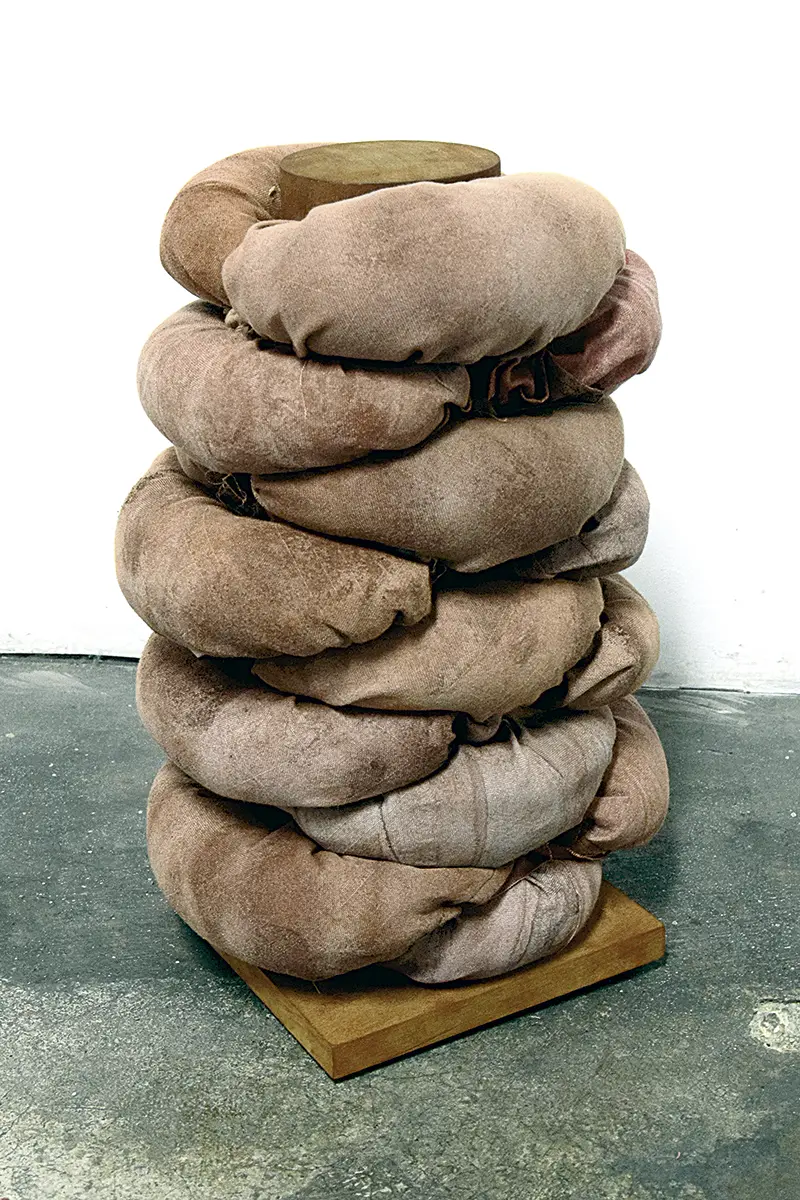
Postcolonial ideas also provide the theoretic basis for the assemblage entitled “The Other Historical Line, Heads or Tails,” composed of dyed cloth, black feathers, and metal coins which show the face of Friar Bartolomé de las Casas on one side and Guatemala’s coat of arms on the other. The piece questions both the circumstances and the dubious nature of the idea of national independence. At the other end of the visual spectrum, we were struck by “Concéntrica,” a vertical sculpture that is abstract and almost silent, and yet loaded with symbolism. Intimately linked to the traditions of the Q’eqchi’ women and their artisanal textiles, it is made out of stuffed and twisted pieces of dyed cloth colored in dark red tones. In Monterroso’s oeuvre, works such as this perpetuate cultural values, trigger the rethinking of historical ‘truths,’ and emphasize the inherent dignity of quotidian activities. In response to a question regarding the meaning of this sculpture, Monterroso declared: “I was thinking about myself and all the other women who feel we are like the goddess Hybris. Concentric, symmetrical, and yet imperfect, with dark skin, unmodern.”2
NOTES
1. S. Monterroso (2015). Del arte político a la opción decolonial en el arte contemporáneo guatemalteco. Iberoamérica Social: Revista de estudios sociales (V), pp. 127-135.
2. S.Monterroso in correspondence with M. Kupfer, January 14, 2019